|
The Near East from 1200 to 538 BC
according to Oded Borowski, Daily Life in Biblical Times, p. 4

First, let's define the terms. The words "Palestine" and "Syria-Palestine" are not to be interpreted in today's political sense. The period covered is approximately 1200-586 BC, known in scientific literature as the Iron Age and the Israelite period. The early Iron Age (c. 1200-1000 BC) is known as Iron Age I and the period of colonization, while the latter part of the period is divided into the United Monarchy (c. 1000-920 BC) and the Divided Monarchy (c. 920-586 BC). The monarchical period is also known as Iron Age II, and some scholars refer to the period between the fall of Samaria (722 BC) and the fall of Jerusalem (586 BC) as Iron Age III.
- The Land
- Geographical location
Amihai Mazar (Archaeology of the Land of the Bible) describes the geography of ancient Israel as follows:
On the one hand, this region formed a bridge between the two ends of the Fertile Crescent, Egypt to the south and Syria and Mesopotamia to the north; on the other, it was compressed between the Mediterranean Sea to the west and the desert to the east. This unique situation was a fundamental factor in the country's history and cultural development. More than any other country in the ancient world, this land has always been directly or indirectly linked to other parts of the Near East and Eastern Mediterranean.
Its location between the two great civilizations of the Nile and Mesopotamian valleys, from which armies and merchants came, contributed to the development of many cultural elements. The region's inhabitants were influenced not only by the Egyptians and Assyrians, but also by the Hittites, Hurrians (in Mittani), Babylonians, Persians and, later, the Greeks and Romans.
The territory stretched from the Mediterranean to the desert region in the east, from Mount Hermon in the north (in present-day Lebanon) to Ezion Gever (modern Eilat) in the south. There are various ecological zones marked by a diversity of climates and topography. (on the topography, see Topography of Palestine). All this had an influence on daily life, the economy, religion, political and social structures.
- Topography
These areas are echoed in the biblical books, particularly the Book of Joshua, which refers to the mountainous territory that stretches centrally from north to south ("Joshua struck the whole land: the hill country, the Negev, the Shephelah, the Slopes, and all their kings", 10:40). To the north, the territory of Galilee can be divided into Upper Galilee, which reaches the shores of Mount Hermon and Mount Lebanon, and Lower Galilee, which borders Lake Galilee. It's a rugged region where it's difficult to settle, with peaks reaching up to 3,962 feet. Further south, in the region known to us as Samaria, we find another mountainous block, such as Mount Ephraim or "the mountain of Israel" (Jos 11:16), with peaks that can reach between 3,083 and 3,332 feet, interspersed with valleys suitable for farming. Further south, we come to the mountainous region of Judea ("the mountain of Judah", Jos 11:21), with peaks between 1,948 and 3,310 (Jerusalem is 2,474 feet), a region not very suitable for agriculture.
Between the mountainous block of Galilee in the north and Mount Ephraim in the center, in an east-west orientation (from the Jordan near Scythopolis to the foot of Mount Carmel), lies a strip of land called the "plain of Izreel" (Jos 17:16), the granary of Palestine, followed by the plain of Beth-Shean.
To the west, bordering the Mediterranean, is the coastal plain. Its central part is called the "plain of Sharon" ("Sharon becomes [barren] like the Arabah", Isa 33:9). This plain is interrupted to the north by Mount Carmel. As for the southern part of this plain, it was occupied during the Iron Age (1200 to 1000 BC) by the "Sea Peoples", known in the Bible as the Philistines. The coastal area stretching from Mount Carmel to present-day Lebanon was inhabited by the Phoenicians, Canaanites of the coastal region. Finally, the region from the coastal plain in the south to the beginning of the Judean mountains in the west was called the "low country" (Jos 9:1), and was the cultural and political meeting place between Philistines and Israelites. Further south lies the plain of Beersheba and the Negev desert, which joins the Gulf of Aqaba to the south.
Immediately to the east of the central highlands, a deep valley runs north-south, crossed by the meandering Jordan River from the foot of Mount Hermon to the Salt Sea or Arabian Sea, known today as the Dead Sea, the lowest point on earth (1,285 ft. below sea level). The area between the highlands and the Jordan River, from the Beth-Shean Valley to the Salt Sea, is arid, rugged and desert-like. It has always been a favorite place for runaways and hermits (for example, John the Baptist in the region of Salim and Aenom, or the Qumran community on the shores of the Dead Sea). East of the Jordan River, in Transjordan (present-day Jordan), rises a high plateau (up to 4,090 ft.), the northern part of which is covered with basalt emitted by volcanoes that are now extinct.
- The roads
In both ancient and modern times, main and secondary roads followed the topography. Major arteries generally followed a north-south orientation along the Mediterranean coast in the west, the mountain ranges in the center and the Jordan Valley in the east, linking the main centers of civilization, Egypt and Mesopotamia. Secondary, or local, roads linked the main cities to the small towns, villages and farms that depended on them. They criss-crossed the countryside, also following the relief.
The roads of Palestine in Old Testament times
according to Oded Borowski, Daily Life in Biblical Times, p. 6

- The water
Two bodies of water, in fact small lakes, stretch along the Jordan: one of them (now dry) is known as Lake Houla; to the south of this is the Sea of Kinnereth, or Sea of Galilee. Between the Salt Sea and the Gulf of Eilat lies a wide, flat valley called Arabah. The long valley stretching from Mount Hermon to the Gulf of Eilat is part of a geological phenomenon known as the Syrian-African rift.
Water sources are scarce in this region, and dependence on rain (and dew) is very high. Water availability is limited to several streams flowing west from the highlands to the Mediterranean, or east to the Jordan River or lakes. Other streams flow westwards into the Jordan Valley from the Transjordanian Plateau. Most of the streams in the region between the Judean Mountains and the Syrian-African rift are dry river beds (wadis) that only fill up when it rains on the eastern slopes of this mountain range.
Other natural water sources include a limited number of perennial springs around which settlements have been established and maintained throughout history. Some of these springs contribute to the maintenance of oases, particularly in the Negev and Arabah. In some places in the Jordan Valley, hot springs ooze out of mineral waters; they are relics and indicators of the tectonic activity prevalent in the Near East, where earthquakes have been partly responsible for shaping the landscape and have been known to do so throughout history.
Mankind's response to the scarcity of natural water sources has been varied. It includes digging wells to reach water tables, building cisterns and basins to collect runoff, building canals and diversion dams, digging wells and tunnels to reach and divert water sources, and developing various means of storing, conserving and using water efficiently.
- The soil
Deut 8: 8 ("a land with wheat and barley, vines and fig trees, pomegranates, olive oil and honey") praises the richness of agricultural land. On the other hand, the soil is poor in minerals. This is despite the fact that the Bible describes it as rich in iron and copper (Deut 8:9: "a land whose stones contain iron and whose mountains are mines of copper"). However, the limestone available throughout the country and the basalt stone in the north have been used in the construction of buildings and in the manufacture of certain tools and installations. While large parts of the country were wooded, local timber was used in private construction; cedars were imported from Lebanon for many public buildings (1 Kings 5, 22,24).
- The climate
The climate of this region has two main seasons, winter and summer, and two transitional seasons, autumn and spring. In a normal year, rain begins to fall in October, and most of it falls during the winter, from December to March. Occasionally, conditions are conducive to snow and hail. A few late rains fall in early spring, in April, while summer, from June to August, is almost dry, with dews providing the only moisture. Precipitation is higher in the north (40-60 in.) than in the south (0-10 in.) and in the west than in the east. The lowest rainfall occurs on the eastern slopes of the Ephraim and Judean highlands (10-20 in.) and in the Negev and Arabah (0-10 in.).
Temperatures and humidity vary. The average temperature in Jerusalem in January is around 47°F, but in August it's 75°F. On the coast (in the modern city of Tel Aviv), the average temperature is 55°F in January and 81°F in August. In general, the hottest and driest region is around the Dead Sea and along the Arabah to the Gulf of Eilat. The Beth-Shean Valley is also very hot, but also humid. Summer is also the time when the dry east wind (khamsin) blows in from the desert (Ezek 17:10).
- The People
- Origin
Were they foreigners who came to the land and conquered it, as the Bible describes, or did they arrive in some other way? Were they descendants of the local population, known in the Bible as the Canaanites, who for some reason formed a new entity, which we know as Israel? Were the formation processes simple enough for us to reconstruct from the available information, or were they so complicated that we'll never be able to find the full answer?
The Bible states that when the Israelites appeared, the land was already occupied by certain groups, whose names include not only the Canaanites, but also, according to Jos 11:3: "the Amorites, the Hittites, the Perizzites and the Jebusites in the Mountain, the Hivites below Hermon, in the land of Mizpah". There were others, including the Philistines, in the Gaza region. Let us agree, then, that an Israelite entity, perhaps referred to in the Merenptah stele as Israel, developed in the hill country of Israel and Judah during Iron Age I (12th to 7th centuries BC), and that its origins were varied, as the prophet Ezekiel 16:3 points out: "By your origins and by your birth, you are from the land of Canaan; your father was the Amorite and your mother a Hittite". Let's also accept the idea that certain characteristic aspects of Iron Age I settlements (1200 to 930 BC), such as pottery and architecture, reflect the environmental, social and economic characteristics of the settlers rather than ethnicity. In the period from the beginning to the middle of the Bronze Age (3100 to 1550 BC), a long cyclical process of oscillation between the rise and decline of territorial entities can also be observed throughout the West Bank and Transjordan highlands; the Israelites would be part of this process.
- Physical appearance
It's virtually impossible to know what Iron Age I settlers looked like, due to the paucity of artistic representations depicting their physical attributes and clothing. Some Egyptologists suggest that the reliefs at Karnak in Egypt partly represent the people of Israel referred to in the Merenptah stele. Their physical appearance is then no different from that of the Canaanites depicted in other parts of the reliefs. The physical appearance of the Israelites of Iron Age II (930 - 539 BC) can be deduced mainly from two Assyrian monuments. One is the black obelisk of Salmanazar III (c. 858-824 BC), which shows Jehu, king of Israel, wearing an ankle-length tunic and hat, prostrating himself before the Assyrian king.
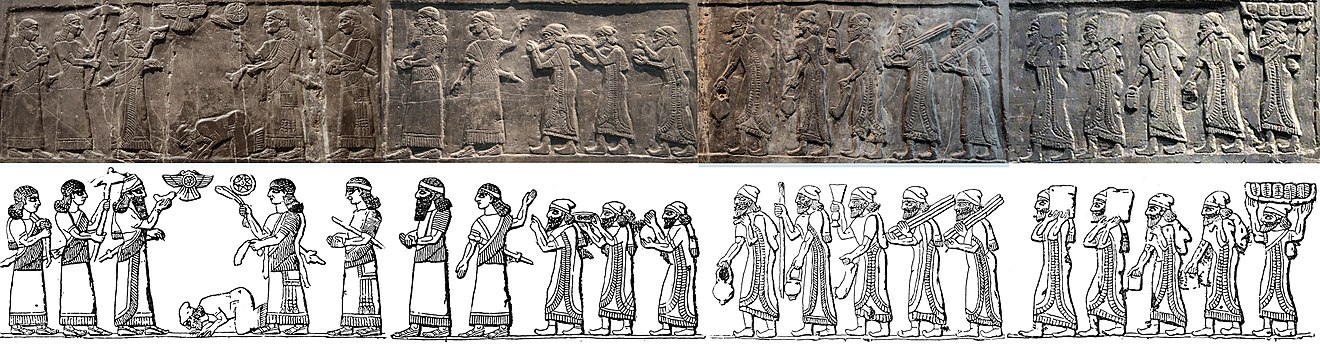
The black obelisk of Salmanazar III (circa 858-824 BC). Courtesy British Museum
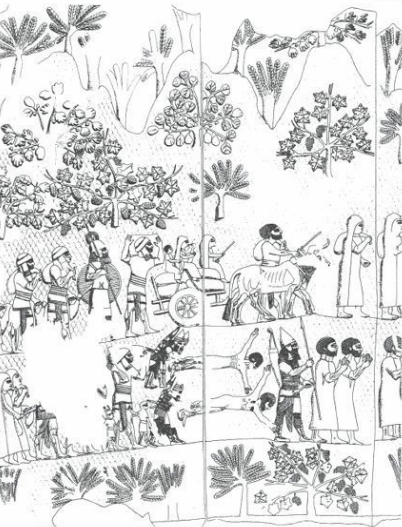
Lachish reliefs. Israelite captives. Courtesy David Usshishkin.
Secondly, the Sennacherib reliefs, celebrating the capture of Lachish (701 BC). These latter reliefs depict Judean defenders fighting the Assyrians from the top of the city walls and towers. Scenes showing entire families leaving the city provide a closer look at the citizens of Lachish. The women wear long dresses and long, ankle-length headdresses. The men wear a tunic just above the knees, held together by a wide belt and a wrap-around headdress. Men who don't wear a headdress sport curly hair and beards. Both men and women are barefoot, but biblical references indicate that people wore sandals.
- The language
What language did the Israelites speak? The written sources left by the Israelites indicate that their language belonged to the West-Semitic family, related to the Canaanite, Moabite, Ammonite and other languages spoken by the various inhabitants of the region. Written sources such as the OT and the Gezer calendar show that the Israelites of the north spoke a dialect different from that of Jerusalem, which is called "Judean". In 2 Kings 18:26 we read: "Then Eliakim son of Hilkiah, Shebnah, and Joah said to the Rabshakeh, 'Please speak to your servants in the Aramaic language, for we understand it; do not speak to us in the language of Judah within the hearing of the people who are on the wall.'" (this verse is also found in Isa 36:11). So, members of the upper class knew Aramaic.
- Demography
Estimates of the Iron Age I population of the highlands put it at around 20,000 in 1200 BC and around 55,000 in 1000 BC; the estimated population of the united kingdom of the West Bank and Transjordan is 350,000. The population of the West Bank at the height of Iron Age II (8th century BC) has recently been estimated at 400,000, while in Transjordan, the Israelite population is estimated at 60,000 and the non-Israelite population at 43,500. For the same period, the population of Philistia (the coastal region around Gaza) was estimated at 50,000. However, the Assyrian campaigns, and in particular that of Sennacherib in 701 BC, caused a sharp decline, and Judah's population for this period is estimated at around 100,000, with a much higher density. Most of the population (66%) of Iron Age II (930 - 539 BC) lived in small villages and the rest in agglomerations (towns) of more than twelve acres. The increase in the number of small villages during Iron Age II is attributed to the relative stability and tranquility offered by monarchies.
Demographic studies show that during the Iron Age, once the population was established in the highlands, changes in political conditions helped to improve socio-economic conditions, leading to an increase in population that manifested itself in the founding of new settlements, and the expansion and strengthening of old ones throughout the country.
- The Sources
- The Hebrew Bible is a first-rate source of information
- Extra-biblical written documents from Palestine and surrounding cultures, including Canaanites, Egyptians and Mesopotamians
- Artistic representations of the various cultures of the Ancient Near East, as well as other archaeological evidence, such as tools and installations.
- Bibliography
- Aharoni, Yohanan, and Michael Avi-Yonah. The Macmillan Bible Atlas. New York: Macmillan, 1968.
- Dever, William G. What Did the Biblical Writers Know and When Did They Know It? Grand Rapids: Eerdmans, 2001.
- Finkelstein, Israel. The Archaeology of the Israelite Settlement. Translated by D. Saltz. Jerusalem: Israel Exploration Society, 1988.
- Hallo, William W., and K. Lawson Younger Jr., eds. The Context of Scripture. 3 vols. Leiden: Brill, 1997.
- Mazar, Amihai. Archaeology of the Land of the Bible: 10,000-586 BCE. New York: Doubleday, 1990.
- Pritchard, James B., ed. Ancient Near Eastern Texts Relating to the Old Testament. 3d ed. Princeton, N.J.: Princeton University Press, 1969.
|
Next chapter: Rural life
List of all chapters
 Topography of Palestine
(click on map to enlarge) |