Oded Borowski, Daily Life in Biblical Times,
|
||
|
It's the time of King Ezekiah (716-687 BC). It's summer, the barley harvest is almost over and the wheat harvest is about to begin (end of April). Two years earlier (701 BC), the great revolt against Assyria took place and King Sennacherib, in his fury, devastated most of the country. Most of Judah lay in ruins and, with the exception of the countryside, life in the few remaining towns was very hard. Shmaryahu, son of Jotham, son of Aminadab, son of Ahiel, son of Nur, who belongs to the Ahuzam family of the tribe of Judah, lives in the small hamlet of Ether, in Shephelah (see map in margin), located in the district of Soko, not far from Mareshah. This is where he was born, and when the time comes, he would like to be buried in his family plot. The village of Ether in the Shephelah
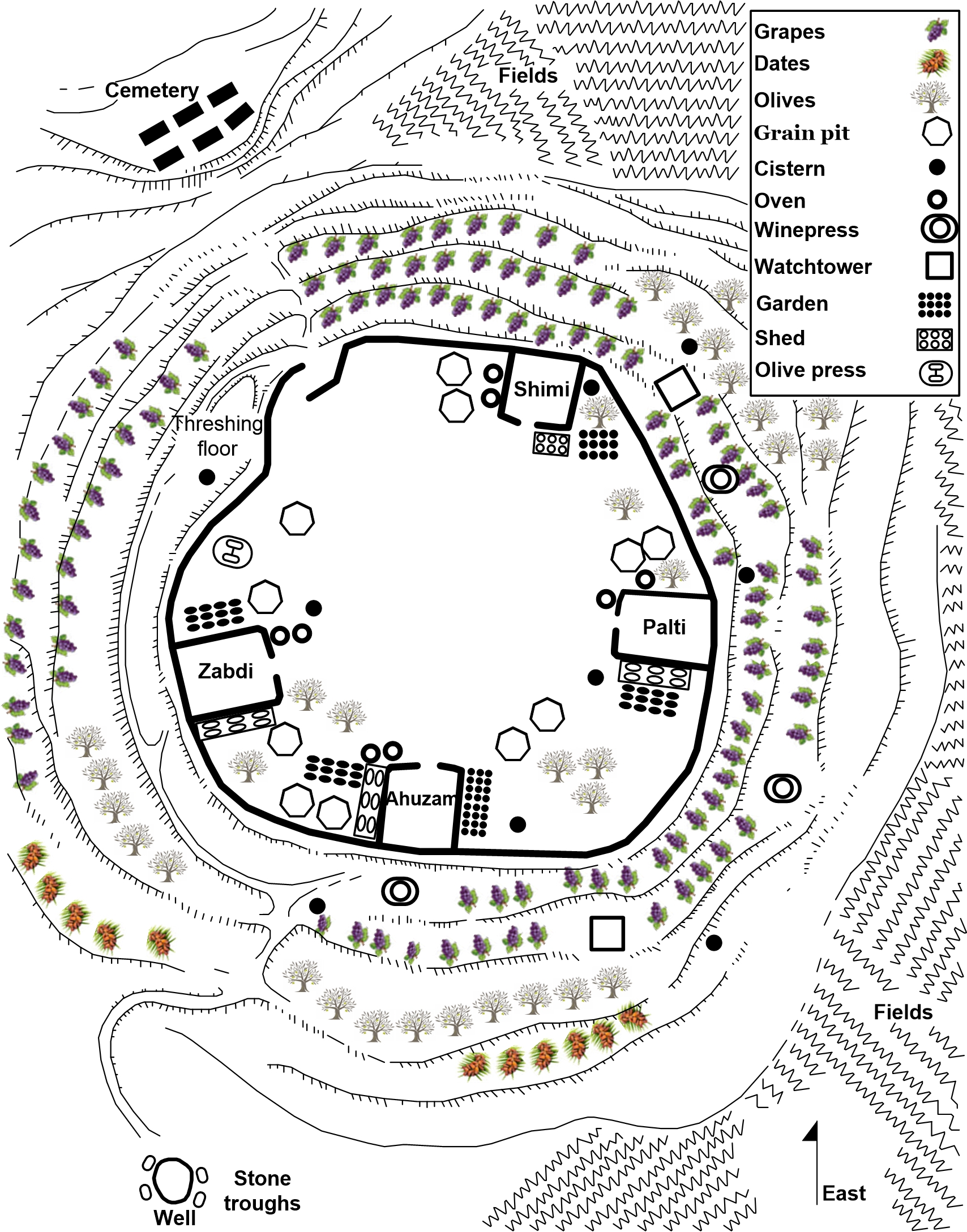
Ether consists of four groups of houses surrounded by a low wall built to contain the cattle, all situated at the top of a rolling limestone hill with rocky, stepped slopes (see fig. 7.1). Terraces planted with vines and olive trees encircle the slopes. They are the fruit of hard cooperative work, which took generations to accomplish and has been passed down from one generation to the next, in accordance with custom and law. Other fruit trees, such as fig and pomegranate, grow closer to the houses, interspersed with vegetable beds. Cereal fields stretch all around at the foot of the hill and can be seen from the hamlet. The people of Ether are fortunate in that their land is very close to home, and there's not much time to waste travelling. At the foot of the hill, in the middle of the dry wadi bed, a stone well surrounded by stone-cut troughs serves as the main water source. The rocky slopes are marked by rock-cut cisterns, and a small cemetery containing seven or eight family caves occupies the northeast slope just outside the hamlet. Near terraced vineyards and groves, the rocky slopes are home to various installations such as watchtowers and wine and olive presses. Closer to the hamlet, on a level area open to the westerly breeze, the threshing floor is the most impressive feature. At the time of the revolt, Ether was under the protection and jurisdiction of the great city of Lachish. But Lachish was conquered and destroyed by Sennacherib, and only recently has it come to light that King Ezekiah is planning to rebuild it. Today, most of Judea's population lives undisturbed in villages, as the Assyrians appreciate the fact that the inhabitants can produce agricultural by-products, which are brought to Assyria each year as tribute.
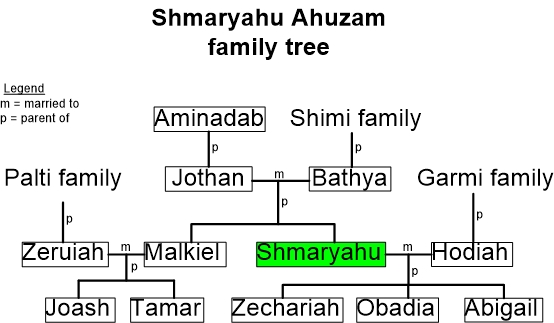
Shmaryahu, married to Hodiah of the Garmi family of the tribe of Judah and originally from the nearby town of Keilah, is a prosperous farmer. His family has been settled here for many generations. Tradition has it that they received the land as an allotment just after the conquest of Canaan led by the legendary Joshua, son of Nun. The real story is more complicated, but the tradition is still maintained by the family. Shmaryahu, the eldest son of his parents Jotham and Bathya, inherited the land and agricultural know-how and was ready to defend it against all enemies and preserve it for his eldest son, who would inherit it in due course. Shmaryahu lives with his wife, two sons (Zechariah, 13; Obadia, 15) and daughter (Abigail, 16) in a two-storey pillared house. Another son and daughter died when they were still babies. With them also live his elderly parents, who can no longer work in the fields, and his younger brother Malkiel, married to Zeruiah and father of two children, a son (Joash, 10) and a daughter (Tamar, 12). Two of Ether's other sets of buildings belong to the Judean Shimi and Palti families, close relatives of the Ahuzam and Garmi families. The Shimites and Paltites have been settled in Ether as long as the Ahuzamites, and they often intermarried. In fact, Zeruiah was from the Palti family and Bathya from the Shimi family. These close relationships allowed for close cooperation between the people of Ether when they needed help in certain situations, such as building and maintaining terraces, building additions to houses, cleaning cisterns before the winter rains, and seasonal tasks like harvesting and processing fruit and vegetables. The Ahuzam family home is a typical pillared house not unlike any other in Ether or neighboring villages. Jotham and his father Aminadab were successful in all their ventures and managed to accumulate property and livestock, which is reflected in the Ahuzam compound, now controlled and managed by Shmaryahu. The two-storey house has several annexes where some of the livestock are kept, in particular two oxen, a large ram and fat calves, as well as some of the farming equipment. The house has a solid stone foundation, an earthen brick superstructure and beamed ceilings, covered with branches, reeds and earthen plaster. The house is entered through a large double wooden door that can be locked from the inside. It opens onto the vast space at the center of the hamlet. Inside, two rows of stone pillars (monoliths) divide the first floor into three long rooms, with a large hall at the rear. The central room is mostly unoccupied, while the two side rooms and the great hall have low, narrow walls that divide them into several activity zones. In some of the smaller rooms, jars are stacked side by side or on top of each other. Most contain wine and oil. A few are full of grain, although the family prefers to keep most of the bulk grain in their stone and plaster-lined storage pits, just outside the house. The products stored in the jars are intended for the preparation of daily meals. In winter, one corner of the room is used to keep the family's two donkeys, while the other corner is used to keep the small flock of sheep and goats. Both rooms are paved and feature wooden and stone troughs. When animals are kept in these rooms, the floor is usually covered with straw. One of the small rooms is filled with fodder, while another is occupied by a vertical loom. A domed bread oven occupies one corner of the central room, while the other corner features an open hearth. A large grinder is located next to the bread oven. For summer cooking, similar facilities are located just outside the house. Access to the second floor is via a ladder supported on one side of a large opening in the ceiling that covers the first floor. The roof is considered the third floor, as it is used as living space and can be reached in the same way. The room layout on the second floor mirrors that of the first floor, but without the small dividing walls. An adult couple and their children occupy each of the side rooms, and the grandparents live in the back room. The central space in the middle of the floor is used for communication between rooms and as a gathering place where the family gathers for communal meals and other social activities. The flat roof is considered a living space and is used as such in summer. Cool breezes make this space a favorite place where family members can sleep away the heat of the rooms below. Temporary cabins with blankets made from branches and reeds provide shelter from the heat of the day and the dew of the night. Parts of the roof are used seasonally to dry fruits such as grapes and figs. The edge of the roof is equipped with a parapet to protect people from falling. In winter, rainwater is collected on the flat roof and channeled via a drain to a cistern below. It's summer, and the days are long and hot. It's important to start the day early, even before sunrise. If the workers set out at dawn, they can be in the fields by first light. Hodiah and Zeruiah get up first. Their biological clocks wake them before dawn, even though it's still dark. Hodiah gets up and lights two oil lamps, one for herself and one for Zeruiah, and Zeruiah goes downstairs to light the fuel in the bread oven. Hodiah follows Zeruiah quietly and enters the storeroom, where she takes a measure of flour, a small amount of oil and some water from the large jar by the door. The flour was milled in the afternoon of the previous day, and the water was also drawn during the day. She puts everything in a large bowl, mixes well and kneads the dough. As the dough doesn't have time to rise, Hodiah and Zeruiah make small flat cakes and place them on round, rough clay trays, which they bake in the oven. As soon as the oven is hot, they place the trays in it one by one. While Zeruiah bakes, Hodiah collects the vegetables she harvested from the garden the day before. These include cucumbers and onions. She also breaks off a few pieces of the large piece of dried cheese. To make sure the day is a success, Hodiah goes to the house shrine, located in a corner of one of the small side rooms, and makes a small offering on a limestone block placed in front of the clay figurine of the goddess Astarte. Shmaryahu doesn't approve of this custom, but it's been practiced in her family for generations and she sees no reason to stop now. Just then, noises are heard from the roof, where the rest of the family is waking up and preparing to face the day after consuming the morning meal. One by one, they climb down the ladder to the first floor to wash their faces and hands. They do this over a basin to conserve water for the garden and the animals. Then they go back up to the second floor and sit in a circle in the middle of the floor, open to the sky. Hodiah and Zeruiah hurry up the ladder from the first floor, bringing with them freshly baked bread and vegetables. Hodiah climbs down once more and brings up a skinful of yoghurt, which she pours into several small bowls that serve as drinking vessels. The meal is eaten in a hurry, as no one wants to waste time in idle chatter. They'd rather be out in the fields in the cool of the day than wasting time. Roles are well rehearsed and known, and there's no need for special instructions or reminders. While the field workers eat their lunch, Hodiah and Zeruiah prepare the midday meals for them to take away. By this time, Jotham and Bathya, Shmaryahu's parents, have joined the family. They eat the morning meal with the rest of the family, and also prepare to do their chores. The family can't afford to have idle hands. The meal is over. Shmaryahu, Malkiel, Zechariah and Obadiah take their goatskin bags containing lunch and another large skin of water and head downstairs to prepare the donkeys for the day. They harness the animals and put a blanket on their backs to protect them from scratches caused by the heavy loads of stalks. They put water in the stone troughs and fodder in the wooden troughs for the animals, while Abigail and Tamar join them on the first floor to milk the sheep and goats before going out to pasture. Jotham arrives from the second floor to help Abigail and Tamar milk the ewes, grabbing them by the head and holding them in place as they are milked into a large open bowl. Once milking is complete, the young lambs and kids are allowed to join their mothers for a short suckling session. Bathya brings two bags of packed lunches for the girls to take on their trek with the flock. They unhook a goatskin container and fill it with water. Each also takes a pouch containing personal items. After separating the mothers from their babies, they are ready to leave just as the four males are ready to head for the field. Their sheepdog yelps with excitement, knowing he'll soon be leaving the house. Hodiah and Zeruiah each take a medium-sized water jar with a narrow neck and go out with the others. They will accompany the girls to the well and, before drawing water to take home, help them water the sheep and goats. Bathya returns to the roof to tidy up the bedding, while Jotham tidies up the first floor. Joash joins his grandfather to clean the first floor; his main task is to collect the manure, which can be used as fuel and for other purposes, such as fertilizing the garden. When Bathya has finished tidying up the roof, she goes to the second floor to sweep it and collect the used bowls for washing on the first floor. When Jotham and Joash have finished cleaning the first floor, they bring in mashed grain mixed with a little milk to feed the lambs and kids. They try to wean them slowly, slowly, so that the ewes have more milk to process. At this point, the two women and two girls reach the well. The descent is easy for everyone. The shepherds from the Palti and Shimi families have started to gather at the well. Water is drawn for the animals on a first-come, first-served basis, which is a good reason to start early. The Ahuzamites are lucky today; they came second and will soon be able to give their animals something to drink, then draw water to take home to fill the large jars by the gate that serve as water containers for daily use. It will take more than one trip to fill them. This is another good reason to get to the well early, as walking up the slope on a hot day is not a pleasant chore. The shepherds near the well are mainly women, as during the grain harvest season most of the men are busy in the fields. The meeting by the well is always a social occasion to exchange gossip and news. When young men are present, they usually look at the girls, while the latter cautiously turn their faces away, but not before catching a glimpse of the young men. It's an opportunity for the bachelors to get to know each other, and perhaps feel a certain attraction that can later be communicated by their fathers, who will meet to discuss an arranged marriage. When Abigail and Tamar have finished watering their little flock, they resume their daily circuit, while Hodiah and Zeruiah fill their jars and start back towards the hamlet. It will be four or five journeys before the big jars are full. * * * The four men of Ahuzam's family have arrived at their destination, where they are joined by a few itinerant workers who will help them with the harvest. Most of these people are refugees from the war against the Assyrians. Their homes in the villages have been ransacked, and they and their families are living in natural caves for shelter. Although they are mainly concerned with their immediate survival, they hope one day to return to their villages and rebuild them. Each of the adults owns a sickle: Shmaryahu and Malkiel each have an iron sickle, while the hired laborers, who are poor, have sickles made from flint blades placed in a wooden holder and held together with bitumen. All are well trained and capable of performing the various tasks involved in harvesting. This means they can change from one task to another before they get tired. The order of tasks cannot be changed. The harvesters go first and, after grabbing a handful of stalks, cut them with a sickle as close to the ground as possible. Even so, there's always something left for the herd to eat. The sheaf collectors then come and gather the small piles left by the harvesters into large sheaves, which they tie together with one or two stalks. The sheaves are taken to the edge of the field, where they are grouped together and tied onto the backs of donkeys, which are driven to the threshing floor. Each Ether family has a designated area on the threshing floor to store the sheaves before they are threshed. Shmaryahu and Malkiel supervise the work. They set the rhythm of the harvest, making sure that the sheaves are well tied and that the load is well balanced on the donkeys, and does not tip over when the donkeys climb a hill. They tie the load to the donkeys' backs with goat-hair ropes. Obadia and Zechariah are the donkey drivers. Once the animals are loaded, they lead them along the beaten path to the threshing floor. This is no easy task, as they have to make sure that the donkeys don't stray from the path and that the load doesn't escape them. What's more, when they arrive at the threshing floor, they have to unload the sheaves in the right place. Going up the hill several times a day is quite tiring. Fortunately, on the way back, they can ride the donkeys down to the fields, and take advantage of the opportunity to have some donkey races. The heat of the day and the cutting of the ears bring out swarms of small gnats that continue to pester the harvesters, despite their attempts to chase them away with their hands. The temperature continues to rise, and the workers wipe the sweat from their foreheads with the brim of their headgear. Workers wear knee-length tunics held together by goat-hair belts; a rolled-up piece of cloth covers each worker's head. It's important to establish a rhythm and maintain it for as long as possible. In general, the workers manage to do this until they take a break for lunch. At that point, they all gather under a large, shady tree. Today, it's a solitary terebinth on a small hill. The tree's surroundings and lower branches have been cleared by sheep and goats. They wait for the boys to return from their trip to the threshing floor before stopping for lunch. They'll have plenty of time under the tree, not only to eat, but also to cool off. An "unofficial" group of workers present in the fields during the harvest are the gleaners. They always pass behind the harvesters and sheaf collectors, picking up individual ears of corn that somehow get left behind and don't make it into the sheaf. Not being part of the family, they are not invited to join the harvesters for their midday meal, so they find a secluded spot where they can have their meal. The gleaners will stay in the field late after the reapers have left in the hope that a sheaf will be left behind, thus becoming their property under the law of gleaning. Obadiah and Zechariah are back from their second trip of the day to the threshing floor. Although they returned by donkey, they are tired, hungry and thirsty. When they return and sit down under the tree, the food is unpacked. Today's menu is similar to yesterday's, and no different from tomorrow's: flat bread, onion, cucumber, greens and herbs. They also have two small jugs, one filled with olive oil and the other with vinegar, for soaking the bread. Water from the wineskin is their thirst-quenching drink. Malkiel strikes a flint against his sickle, producing a spark that catches on a small pile of straw lying in the middle of a small stone circle, and a fire full of smoke emerges. He keeps the fire going by adding more straw and small branches. He takes a few heads of barley he has brought in from the field and rubs them one by one between his hands. The dry grain falls onto a concave piece of broken pottery, which he in turn places in the fire, making dried grain. When the grain is ready, Malkiel gently removes it from the fire and passes it around for everyone to take and nibble. He repeats this operation several times until everyone is full and ready for a nap. * * * After leaving the well, Abigail and Tamar lead the flock and encourage the animals to follow them with gentle calls and whistles. They encourage the leading ewe to follow them by offering her pieces of dry bread. The other sheep and goats, driven by the herd instinct, follow the leader. Their black-and-white spotted dog continually circles the flock to keep it together. As they climb a hill following their daily itinerary, the girls discuss all sorts of things. As Abigail is of marriageable age, part of the conversation concerns her attraction to one of the young Shimi. He wasn't at the well today, but she sees him from time to time when he comes to the well to help his sister. However, the girls can't afford to continue this conversation without doing something productive. Abigail pulls a piece of wool from the last harvest from her pocket. The sheep have recently been shorn in anticipation of the summer heat and have produced a large quantity of wool that needs to be spun, then woven. From the bottom of her saddlebag, she takes out a spindle with a pottery spiral attached, attaches a few strands of wool to its elongated end and begins to spin. She holds the mass of wool under her armpit and, using her fingers, pulls and twists the strands as she turns the spindle to produce a long thread which she winds around the spindle handle. Tamar follows in her footsteps. She's not as accomplished a spinner as Abigail, but she's "in training" and anything she can produce is welcome in the house. The girls reach their destination, a hill covered with dry grass and wilted flowers, topped by an oak tree, under which they take shelter from the scorching sun. The sheep and goats keep moving as they graze, and the dog keeps them close and prevents them from wandering off. Whenever an animal tries to move away from the herd, one of the girls throws a stone that lands a little further away than the animal and encourages it to return to the group. The dog is well aware of these attempts, and when the stone lands and frightens the animal, he's there to bite its ankle and convince it to point its nose in the right direction. The girls have been talking a lot and Abigail feels the need to take a break. She takes a reed flute from her pocket and prepares to play. A few days ago, while sitting with the family after the evening meal, her grandfather Jotham taught her a catchy melody that she repeats whenever she gets the chance. It's a familiar song, and both she and Tamar know the words, so Tamar joins in and sings along. They repeat the exercise three times, then Abigail starts playing another song. The girls have a little fun, but the herd needs their attention. The herd has moved away from the shepherdesses. It's time to get them back. What's more, lunchtime is approaching. With the help of the dog, the shepherds gather the flock and lead them to the shady area under the oak tree. The sheep and goats lie down and ruminate while Abigail and Tamar take the food out of their sacks and set a table. Their meal is similar to that of the men, but somewhat different. Because they're on the move, their meal doesn't include oil and vinegar, and they can't enjoy freshly parched grain. However, their mothers have prepared handfuls of raisins and a piece of dried fig cake for them. Like the men, they drink water from the skin wineskin. With nowhere to go in a hurry, they eat slowly, savoring every mouthful. They would like to allow the ewes to ruminate, knowing that this promotes milk production, and that's the whole point of breeding. Almost. The animals will have another chance to graze on the way home. When they've finished their meal, Tamar pours some water into Abigail's hands for the dog to drink. He drinks quickly, and they repeat the operation three times. They pick up a few scraps of food and feed the dog, then get out the spinning equipment again and continue working until it's time to get the herd up and head home. * * * After the men and two girls have left for their respective destinations, Hodiah and Zeruiah begin their ascent with heavy water-filled jars on their heads. Each has a ring made of a soft material placed on her head under the jar. This helps them balance the jar while walking upright. It takes years of training to be able to do this without having to stabilize the jar with their hands. They walk along the beaten path from the well to the hamlet. Before they reach the top of the hill, they come to a fork in the road; the one on the right takes them straight to their compound. They cherish this shortcut because every step counts when it comes to carrying water from the well. They repeat the operation four or five times before the large jars by the door are full. This depends, of course, on the amount of water consumed before the first walk to the well. As well as quenching thirst and watering certain animals, they use water for cooking, washing up, watering the vegetable garden and washing their faces and hands. They can't afford to use this water for washing; for that, they'll have to go down to the well. Even then, they will rarely do so, and take great care not to waste water unnecessarily. When the large jars are full, Zeruiah goes back to the well and brings another jar to water the garden. Using a bowl, she measures the amount of water she pours beside each plant. Their garden is no different from that of other Ether families. Between the fig, pomegranate, apricot and carob trees are beds of cucumbers, leeks, garlic and watermelons. These vegetables are a treat for the family, as they are seasonal, ephemeral and cannot be processed for later consumption. Once this chore is done, Zeruiah returns to the house and fetches fodder for the oxen and ram that are kept outside in the shed. She also feeds the calves that the family is trying to fatten up. Finally, she prepares what is needed to grind the grain, a task she will undertake in the afternoon. While the other women are busy getting water from the well into the large jars by the door, Bathya finishes cleaning the house. She takes the kitchen waste and buries it in the garden. It will turn into compost that will enrich the soil. Then, while it's still cool, Bathya heads out into the countryside to gather greens and roots that can be used to supplement the daily diet. She's in no hurry, as there's nothing urgent to do. This activity keeps her busy until midday, when all those who have stayed at home gather for lunch. After pouring the last jars of water from the well, Hodiah goes to the small room on the first floor where the milk from this morning's milking has been stored in a jar with a hole in the mouth. She picks up the jar and takes it to a shady spot outside the house. Here, she has a tripod made of three long sticks tied together at the top, from which hangs a goatskin. The feet are securely fastened and the neck is open for now. She calls Joash to give her a hand. While he holds the skin vertically, stretching the neck opening with his small hands, she pours the milk into the skin and ties the neck opening very tightly. She then lets the skin hang horizontally from the tripod and begins to shake it back and forth like a pendulum. Joash sits next to her, ready to lend a hand when asked. The pendulum-like movement separates the fat from the rest of the milk, which will be used to make butter. Some of the milk will be saved and mixed with the milk from the evening milking to make other products such as yoghurt and cheese. As she swings the skin, Hodiah starts humming a tune that helps her to banish boredom. She then notices that Joash is still sitting next to her, and so starts telling him stories, some of which he's heard before. After a while, Joash gets up and starts wandering around the open space in front of the house, picking up manure, gathering it in the hem of his tunic and bringing it to the pile he maintains inside, near the bread oven. He does this whenever his aunt doesn't ask him to relieve her by swinging the goatskin. Having finished tidying up the first floor, Jotham prepares to repair some of the tools and implements used on the farm. As Malkiel wants to start threshing tomorrow, Jotham first plans to take care of the tools that will be used for this task. He decides to tackle this task in the order in which it will be carried out. The first step is to inspect the threshing sled. There are several ways of threshing crops, but the most efficient is by sled. The Ahuzam family owns a sled that has been handed down from one generation to the next. No one knows for sure who built the sled, but despite its age and thanks to seasonal maintenance, the tool is usable. The sled is made of two thick, wide boards, mortise and tenon jointed together. It contains the parts needed to hitch up two animals to pull it forward. On the underside, the front part is cut at an angle, enabling the sled to slide over the stalks without sinking into the ground. In addition, blades, mainly made of flint and a few of iron, are embedded in the lower part. These blades separate the grain from the stem and cut the glumes into small pieces. Jotham checks that the blades are securely in place. He replaces missing blades with new ones, which he secures with bitumen. He also inspects the ropes with which the draught animals will be hitched to the sled. Once he's finished with the sled, Jotham moves on to inspecting and repairing the other tools, including the winnowing fork and the wooden shovel used to throw the grain into the air to separate it from the chaff. Finally, he inspects the various sieves that will be used for the final cleaning of the grain. The Ahuzam family owns a series of different-sized sieves to help them with this task. By the time Jotham has finished repairing the threshing tools, it's lunchtime. Tomorrow, he'll be busy with the ploughs. It's a little after noon. The sun is at its highest for the day and the shadows are short. It's time for lunch. Hodiah enters the house to prepare the meal, but not before asking Joash to continue balancing and churning the milk. This process is almost complete and must not be interrupted. Zeruiah, who has just finished tending the animals in the outer barn and preparing the grain for milling, comes to her rescue. They take up to the second floor a pile of flat bread baked early this morning, vegetables, jugs of oil and vinegar, small dipping bowls and a goatskin containing the yoghurt made yesterday. Before sitting down, Hodiah takes out a bowl of lentils to soak in water for the evening meal. By this time Bathya has returned from the countryside. As she passes one of their terraced vineyards, she picks two bunches of ripe grapes to share at the end of the meal. Although it's still early in the season, she sometimes finds ripe grapes ready to be eaten, especially on the southern slopes. Jotham, Bathya, Hodiah, Zeruiah and Joash are seated on the floor, in a circle, a little south of the middle of the second floor, where the light enters through the roof opening, but remains in the shade. They're eating and talking about what they've accomplished so far. Hodiah and Zeruiah share the gossip and news they gathered at the well this morning. When they have finished, Bathya gathers the bowls and other containers to wash them on the first floor and prepare them for the evening meal. * * * After a short siesta, as the sun begins to move westward and the air freshens with a breeze from the Great Sea, the men get back to harvesting barley. They will continue this task until sunset. Malkiel joins Obadiah and Zechariah on the first afternoon trip of the loaded donkeys to the threshing floor. Although the donkeys can work without being watered for the rest of the day, he would like to pass by the well and let them drink to reward them for their hard work. When they arrive at the threshing floor, Malkiel helps the boys unload the donkeys and pile the sheaves into a neat heap at the edge of the floor. He makes sure their pile doesn't get mixed up with those of other Ether families. His task for the rest of the day, until sunset, is to clean the threshing floor and prepare it for the start of threshing tomorrow morning. He's done this many times before and knows where to place the heap and where to winnow, so that the straw and chaff fall on the right side and don't fly in his face, while the grain falls in just the right place for sieving. The boys return to the field. They will make one more trip, returning to the threshing floor at the end of the day. On this trip, they'll load the donkeys as much as possible; what the donkeys can't carry, they'll pile up. The harvesters continue their harvesting task. They change roles from time to time to keep up the pace until the end of the day. They've almost finished this plot, and by the end of the day it will be finished. They're looking forward to it, because they'd like to start harvesting wheat the next day. The weather cools as the sun migrates west, and the field darkens with the long shadows of the hills on its western side. The reapers finish harvesting the whole field except for one corner, which they leave behind for the gleaners and other needy poor. As the sun quickly sets, they gather all the sheaves into a neat pile, from which they load the donkeys for the final journey to the threshing floor and home. They want to finish this task before nightfall, as they don't want to leave any sheaves behind. In this case, the sheaf cannot be collected the next day and becomes the property of the needy. They also want to get home while they can still see the path. They know the path well, which has been cleared of stones by them and others. The path reflects the moonlight and is clearly visible, but they prefer not to linger too long in the field. As the girls sit under the oak tree, the sun shifts and the sheep and goats change position to avoid the sunlight. The animals lie on the ground with their eyes closed, as if in a deep sleep. The only telltale sign that they are not asleep is the continuous rumination which, along with their split hooves, indicates that these animals can be eaten as food and offered as sacrifices. The animals lie down in a circle, and when an animal is exposed to the sun, it gets up and moves to the shade on the other side of the circle. This continuous movement keeps the herd awake and chewing. The sun continues to move and the animals eventually lose their shadows completely. It's time to get up and get ready to go home. The journey home takes time, as the animals continue to graze as they walk. Their noses are held so close to the ground that they seem to be licking the earth. Indeed, in some places, there's hardly any pasture left, but the animals still find something to eat. Abigail, walking at the head of the herd, takes out her flute again and plays a tune, while Tamar stays behind the herd and, with the help of the dog, puts some pressure on the stragglers to keep up with the rest. She whistles at them, throws pebbles and shouts to keep them together. The girls would like to get to the well before the other shepherds arrive. This time, they won't have their mother's help to water the herd. The animals also know that they're going to be watered, which encourages them to head in the right direction. They arrive at the well when two other herds are already there. Fortunately, as they belong to village families, all the herds are relatively small. Their turn will come soon enough. In the meantime, the shepherds are still exchanging the same gossip and news. As nothing special has happened that day, there's no new information to exchange. Occasionally, a shepherd encounters a carnivorous animal, such as a wolf or bear, and has to protect the animals. This makes for an interesting and exciting story that is repeated and embellished over time. But today was just a typical hot summer's day. When it's their turn, Abigail and Tamar draw water from the deep well with a long goat-hair rope attached to a wide-mouthed jar. They pour the water into the stone troughs and let the animals drink at will. Now it's time to take the path up to the hamlet. The animals don't hesitate, as they know they'll get plenty of fodder when they return. It's a good way to encourage the sheep and goats to return home. After lunch, Jotham joins two other men his age from the Palti and Shimi families, and they head down the slope to one of the cisterns, where they intend to continue the task they started a few days earlier, namely cleaning the cistern in preparation for the rainy season. It's a cooperative effort, as it takes several people to get the job done. In fact, the cisterns are shared by all Ether's inhabitants. Two of them climb down the wooden ladder and one of them, using a metal hoe, fills a straw basket with the silt that has accumulated at the bottom of the cistern over the past winter. The other carries it to the top of the ladder and hands it to the third man, who has remained outside. He takes the silt and dumps it down the hill. The silt can be used in the future to fertilize the gardens and trees near the house. As with other projects, the men change roles from time to time so as not to wear themselves out. They work in this way for a few hours until nightfall. They stop in time to go to a nearby cistern, where they catch a few pigeons returning for their night's sleep. Bathya, who has spent the morning outside, prefers to spend the afternoon in or near the house. Every afternoon, she devotes herself to weaving. Her loom is set up on the first floor, in a small room near where the fodder is stored. It's a good place for her, as she can join in the conversation of all the women who are busy with different tasks. She's been working on this piece of fabric for two days and is almost finished. She'll probably have it finished by the time everyone has returned from their outdoor chores. The loom consists of two vertical wooden beams leaning against the wall, the bottom of which is sunk into a round stone hollowed out in the middle. This prevents them from slipping. At the top, the uprights are connected by a horizontal wooden beam. The vertical ropes, the chain, are attached to this horizontal beam, and their lower ends are each attached to a circular clay weight with a hole in the middle. Bathya has a large collection of different-sized weights, which she keeps in a circular bin. The different weights enable her to weave different types of fabric. For the weft, as for the warp, she uses wool yarn that she and the other women in the family used to spin when they had the time. She weaves patterns with yarn that she has dyed with pigments from different sources, plants and minerals. She uses bone spatulas to weave the patterns. The various balls of thread are kept within her reach in open bowls with pierced bottoms. Bathya passes the thread through the hole, while the ball remains inside the bowl. This prevents the balls from rolling around on the floor and helps keep them clean. Zeruiah, who prepared her flour milling station before lunch, is busy with the task she has been given. Earlier, she brought in a large bowl of wheat from the storeroom, enough for two days. She wants to grind enough flour for two days, because tomorrow afternoon she intends to get busy making cheese, some of which she wants to turn into dry cheese. Grinding is done by placing a small amount of grain on a large concave stone. Zeruiah uses a large piece of smooth flint. She kneels down and rubs the grain with a smaller piece of elongated flint, which she holds with her hands at both ends. She rubs the stones back and forth against each other, with the grain in between, until it turns to flour. When she's satisfied with the result, she scoops up the flour with her bare hands and places it in a jar with a hole in the mouth. The flour keeps for about three days. She repeats the activity by putting grain on the lower stone and rubbing it with the upper stone. This task is monotonous and time-consuming, especially as Zeruiah would like to have enough flour for two days. The monotony leads her to hum a tune that the other women recognize and join in with. Hodiah's responsibility is to prepare the evening meal. She has plenty of time to cook something delicious. Tonight it's a vegetarian stew. She asks Joash to bring dung for fuel and broken olive pits from last year's pressing for kindling. She lights the fire in the hearth with a piece of coal burning in the bread oven. While Joash keeps an eye on the fire, she goes to the vegetable garden, digs up some carrots and picks a medium-sized squash and a large cucumber. Hodiah washes them in one of the large bowls she has stacked on the first floor near the water jars. Later, she sends Joash to pour the water in the garden. She fills a wide-mouthed pot halfway with water and places it in the middle of the fire. Joash remains in charge of stoking the fire. Meanwhile, Hodiah sets aside the cucumber and cuts the other cleaned vegetables into small pieces to cook faster. When the water boils, she puts the chopped carrots and squash into the pot and adds the lentils she has started to soak before sitting down to lunch. She goes to the storeroom and takes from the shelf a block of salt that Shmaryahu bought at the market the last time he was there. She takes the rock to her worktable and, using a rounded hammer, breaks off a piece which she throws into the pot. She then takes some ground cumin in a small bowl and about the same amount of dill in another, and pours the herbs into the pot. By this time, the entire mixture in the pot is boiling. She mixes it all together with a smooth stick and tastes it with her tongue. She has to adjust the taste until she's satisfied. Now that the stew is cooking, she hands the stick to Joash and asks him to stir it every few minutes. Throughout this process, Hodiah can hear the other women humming and singing in low voices, and whenever she doesn't need to concentrate, she joins in. Zeruiah continues to grind enough flour for two days, as tomorrow she wants to use the afternoon to make cheese. She's almost finished, but is interrupted by Hodiah, who asks her to take some of the wheat and crush it for the stew. Zeruiah takes two handfuls of wheat, puts them in a stone mortar that rests near the milling station, and crushes the grain with a stone pestle. She picks up the mortar and brings it near the hearth, where Hodiah scoops up the crushed grain and throws it into the pot, while Zeruiah resumes her grinding work. Hodiah mixes everything well in the pot and covers it with a limestone slab, then returns to her work table, where she has left the cucumber. She takes another medium-sized bowl and fills it halfway with curds from the morning's churning. Tomorrow, Zeruiah will use the rest to make her cheese. She takes the cucumber and cuts it into small pieces in the bowl. The pieces are so small that they appear to be grated. She takes two dry garlic cloves hanging from the rafters, peels them, crushes them finely and puts them in the bowl. She picks up some of the salt left on the table and puts it in the bowl with a pinch of cumin. Once the mixture is well blended, it's ready to be used for dipping the bread. The stew is now ready. Hodiah moves it to the edge of the hearth and fetches another pot filled with water. She tells Joash to keep the fire burning because, having placed the pot in the middle of the hearth, she wants to boil some water in anticipation of Jotham bringing pigeons for the evening meal. * * * Indeed, Jotham is the first to arrive. He and his acolytes have managed to catch a few pigeons. Each of them caught two. After plucking the feathers, he cleans the pigeons with a sharp knife he usually wears on his leather belt. When he returns home, the water in the second pot is boiling. Hodiah cuts the pigeons into several pieces that will fit in the pot and puts them to boil. A familiar bark is heard from outside. Abigail and Tamar are back. They herd the sheep and goats into the stalls next to the fodder room, then bring in feed made from barley mixed with chopped straw and place it in the wooden troughs. The animals expect it and start jostling for a place in the trough, into which they immediately plunge their heads. While munching on the fodder, they are milked for the second time that day. Abigail takes charge, while Jotham and Tamar prevent the animals from moving or kicking in frustration. Once milking is complete, the ewes are brought together with the lambs and kids for a short suckling session, after which they are separated again and the youngsters are led to their side of the stalls, where a new portion of cereal mashed potato mixed with a little milk awaits them. Meanwhile, Shmaryahu, Malkiel, Obadiah and Zechariah return. Malkiel meets them at the threshing floor when they arrive with the last load of the day, and tells them where to unload. Together, they head for the house. They enter the house accompanied by the two donkeys, who are led into their side room, tied with a rope that is passed through a hole in the stone trough, and given fodder and water. * * * Everyone is back in the house. It's time for the evening meal. Hands and faces are washed, and a little water is saved for watering the garden and animals the next day. The meal will take place in the center of the second floor, under the opening that allows them to watch the stars. The moon is waning, but the sky is clear and the light sufficient. Nevertheless, Jotham brings along a few oil lamps, which he lights with a branch he has plucked from the fire on the floor below. He then places the lamps in chosen spots to ensure that the room is as brightly lit as possible. Bathya brings a stack of individual bowls and the washed greens she picked up earlier. The Ahuzam family is well-to-do and can afford to have an individual bowl for each member of the family. Tamar carries a pile of flat bread to the second floor and Abigail brings some of the fresh milk she has just obtained. It's a nice change from the water they've been drinking all day. After placing the boiled pigeons in the stew, Hodiah proudly and carefully passes it on to Jotham. Zeruiah nimbly climbs the ladder, yogurt dip in one hand. The others join the family circle, each taking the place they regularly occupy whenever they gather for a communal meal. Using a ladle made from a broken lamp, Hodiah pours a measure of stew into each bowl, and the bowls are distributed. The pile of bread is also distributed, and everyone helps themselves. They dip the bread into the bowl of yoghurt and swallow the stew directly into the bowl. Using the bread, they push the cooked morsels into their mouths. The bowl of milk is passed around for everyone to take a mouthful or two. The same goes for the pouch of water. When they've finished, each person wipes the inside of the bowl with a piece of bread and turns the bowl upside down to indicate that they've finished their meal. We don't say much during the meal, other than to ask for passing this or that. Once the meal is over, it's time to talk about the day's events. They go over what they've done and start coordinating tomorrow's activities. Abigail can't wait to show her grandfather how well she can play the song he taught her two days earlier. Tomorrow is another big day, and they have to get started early. There's no time to sit down and chat. Bathya still has to wash the bowls, which she does with the help of Zeruiah, who also helps her take down two of the lamps. Tamar and Abigail take a final look at the animals in the herd to make sure all is well. They also look after the dog who will be with them again tomorrow, giving him pigeon bones, table scraps and water. Hodiah makes sure the hearth fire is out and places an oil lamp to light the ladder. Before retiring to the roof, each individual leaves the enclosure in a given direction to attend to personal needs. As there are no facilities available, they do this in the open air, in the dark. The same problem arises during the day, and they have to deal with it individually. At this point, they're all ready for bed. They'll be sleeping on the roof again, where it's nice and cool. And it was an evening and it was a morning, a day in the life of the Ahuzam family. |
 (click on map to enlarge) |