|
- The City
Urban planning in Israel first appeared with the advent of the monarchy. What differentiates the Israelite city from other types of settlement is the concentration of a large population and the absence of dependence on agriculture for subsistence. In fact, the rise of the urban world in Israel was facilitated by the creation of a mechanism for collecting agricultural surpluses in the form of taxes, which were consumed by non-productive segments of society such as the administration, the priests and the army. Without the ability to collect and distribute surpluses, ancient Israel would have remained a tribal society and probably would not have lasted very long.
Several other characteristic features distinguished the town. These included public buildings, a fortification system and a water supply system. Until Iron Age II (930 to 539 BC), the towns of Palestine were mostly independent entities functioning as city-states. During Iron Age II, the territorial state system was introduced to the region, and the city functioned not as an independent unit, but as part of a larger, more complex system. From then on, the older order of the royal palace and court on the acropolis, surrounded by large residential quarters, was replaced by a hierarchy of administrative centers serving the needs of the government, and therefore non-residential structures, and so the towns were emptied of their non-administrative population, which settled in the villages and farms.
- City Planning
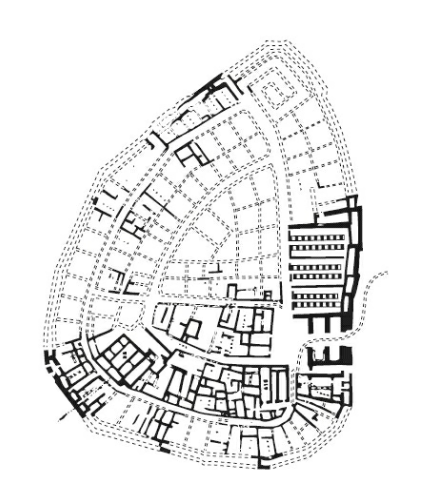 Fig. 3.1: Plan of Beer-sheba. After Ze'ev Herzog, Tel Aviv University
Many Israelite towns were the continuation or reconstruction of late Bronze Age cities previously occupied by Canaanites, Philistines and others. Other Israelite cities evolved from earlier Israelite villages, while Samaria was a newly established site. The remains of earlier occupations influenced to some extent the direction a city's development could take. Sometimes, earlier remains hindered and limited the development of the site, or they could be constructively reused in the development of the new site. As part of a larger whole, Israelite towns had different functions, and their size and layout illustrate their position in the administrative hierarchy. The status of each city was not fixed, but evolved over time in line with political and economic changes. The relationship between a town and its subordinate settlements was defined as "mother and daughter".
A preliminary study of Israelite town plans illustrates that the Israelite town shows a certain degree of pre-planning. These include the type of fortification and gate built on the site, the integration of domestic structures with the casemate wall to form an outer ring, the perimeter road found in many towns, the location of public structures such as palaces and warehouses, and much more (see fig. 3.1).
Towns served as administrative centers for the collection of taxes, which required warehouses, and for the defense of their citizens and the inhabitants of the surrounding villages, called "daughters". As an economic center, the town contained a marketplace and industrial zones. It was inhabited by many members of the bureaucracy and therefore contained housing for the administration, the military and other citizens. However, some inhabitants, particularly in the lower-ranking towns, also practiced agriculture and livestock farming.
- City Types
Geography and topography have influenced the location of towns. Most of them were built at crossroads, in a defensible position, close to a perennial water source. Location must also have determined the hierarchical status of each city, and this in turn dictated the efforts and resources invested in building the various elements of the city.
At the top of the hierarchy were the capital (royal) cities, with Jerusalem as capital of the unified monarchy and later as capital of the kingdom of Judah (to the south) and Samaria as capital of the kingdom of Israel (to the north). Both cities occupied a central position at the time of their creation or when they became capitals, and were close to a major road. The capitals were protected by an elaborate defense system and contained palaces and other public structures. Jerusalem was also home to an important religious sanctuary, which became central after Hezekiah's reforms.
Then came the regional centers such as Lachish in the south, Megiddo, Hazor, Dan and others in the north. Since the north had always been richer and more powerful than the south, it had many more regional centers to meet its economic needs and large population. These well-defended cities included public structures and large warehouses, a limited number of domestic structures and sometimes centers of worship. Regional centers served as military headquarters and economic centers.
From the unified monarchy onwards and throughout the life of both kingdoms, second-tier regional centers such as Beer-sheba, Taanach and Beth-Shemesh played a very important role in extending monarchical control over the local population. This control was exerted even further down, through provincial centers such as Gibeon, Tell Beit Mirsim, Tell en-Nasbeh (Mizpah), Halif and others. It was through these lower-level control centers, which could be described as towns rather than cities, that the central government could exert its influence and maintain "law and order". All these towns were fortified within the means of the central government, and played an important role in the collection of taxes and the distribution of goods. Cities of the lower two tiers (regional and provincial centers) also featured public buildings and, where applicable, a water supply system. Some also housed sanctuaries.
- Fortifications
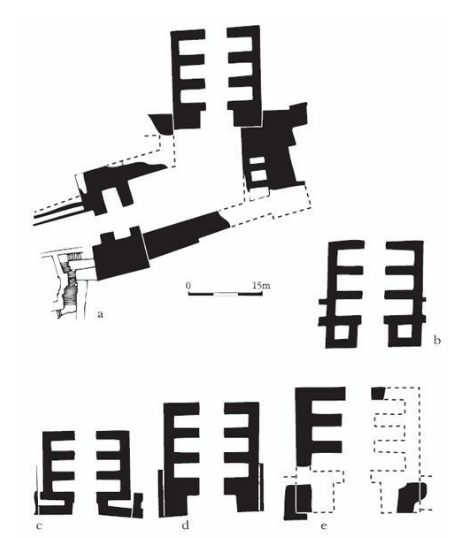 Fig. 3.2: Plans of city gates. Courtesy Ze'ev Herzog, Tel Aviv University. a. Megiddo b. Hazor c. Gezer d. Ashdod e. Lachish
One of the most important features of these cities was their fortification system, composed of several elements: city walls, ramparts, gates, towers, etc. The most important defensive element was the city wall, which encircled the city and constituted a major obstacle to anyone trying to take over the site. The most important defensive element was the city wall, which encircled the town and constituted a major obstacle to anyone wishing to seize the site. The wall had to withstand both direct and indirect assaults, which could be achieved thanks to the type of wall and other support structures used. Over time, several types of wall were developed, and their construction depended primarily on the importance of the site to be defended and the willingness of the central government to invest in its defense.
There are two basic types of defensive wall: solid walls and the casemate walls. The solid wall was the dominant defensive element until the Iron Age, when the casemate wall was developed. Nevertheless, the solid wall continued to be used on many sites throughout the Iron Age. However, to protect the solid wall from the enemy, a series of offsets and insets were built to enable defenders to protect the wall by offering them projections from the straight line of the wall. In some places, the offset and inset effect was achieved by so-called sawtooth projections. The same effect was achieved by placing towers and bastions at critical points.
A less costly system was the casemate wall, consisting of two walls running parallel to each other, with the outer wall usually thicker than the inner wall. Dividing walls perpendicular to the parallel walls created rectangular spaces that could be used for various activities, such as storage. In many places, such as Beer-sheba, casemates were in fact the back room of four-room houses adjacent to the wall, creating an outer ring of domestic structures. Assyrian reliefs show that the walls were high and crenellated.
To increase the height of the wall, a dry ditch was dug in certain places. This prevented attackers from rushing onto the wall and scaling it using ladders. It also prevented the battering ram from approaching the wall. As digging under the foundations was another way of toppling the wall, it was necessary to protect its foundations. To achieve this, a glacis - a sloping rampart - was built in front of the wall. The glacis consisted of beaten layers of different materials (earth, ashes, stones) covered by a layer of well-fitted stones, sometimes even plastered. The glacis made a direct attack on the wall and its foundations extremely difficult.
The weakest point of the defense system was the gate, which was a necessary element for daily traffic in and out of the city in times of peace. To allow access to the city without having to cross obstacles, the gate was generally placed at a low point along the wall. Although an integral part of the wall, the gate was built as an independent defensive unit capable of withstanding continuous assaults. It was at the gate that fighting was at its fiercest, as illustrated by the story of Uriah's death (1 Sam 11:15-18.23-24). However, in times of peace, the gate was a center of civic activity, and its structure had to adapt to these activities.
When we talk about the gate, we need to understand that it's not just a gate, but a system of gates. Many cities, such as Hazor, Megiddo, Gezer, Lachish and Dan, had a series of gates, both outer and inner, through which traffic entered and left the city. Clearly, the main concern was with incoming traffic and the need to control who entered and when. The road led first to the outer gate, which was located at some distance from the main gate. In most cases, the outer gate building had two rooms, one on each side of the road, for the guards. From there, the road led to the main gate, but before reaching the gate, it turned, usually to the left. At this point, a tower or bastion protected the area. It has been suggested that the turning of the road was intended to expose the attackers, who carried their shields in their left hands, to the arrows and sling stones hurled at them by the defenders from the tower.
The main gate was a formidable structure of two or more storeys, designed to accommodate the activities of civil and military administrations and citizens. It could be closed at night or in times of war by a heavy double-leaf wooden door, covered with sheet metal to protect it from fire. Remains of sheet metal covers from Syria and Mesopotamia are highly decorated with mythological scenes using the repoussé technique. The door was locked from the inside by a heavy beam. The street-level floor had one to three chambers on each side (see fig. 3.2). The gate area, including the chambers and surrounding open space, was used in peacetime for judicial, commercial and social activities. The city's elders, as well as the king or regional governor, would gather in the gate to hold court. At Tel Dan, the remains of a low podium for an elaborate seat and canopy were found near the gate adjacent to the open space. Gezer's gate chambers contained low benches along the walls for elders or merchants to sit on. The gate was also a place where certain cultic activities took place (2 Kings 23:8), as illustrated by the standing stones found at Dan and other sites.
Some large cities had an acropolis or citadel, where the king's or governor's palace was located and where a last stand could be organized in case the city walls were breached and the city invaded. Examples of this type of feature can be found in Hazor, Samaria and Megiddo to the north, and in Jerusalem and Lachish to the south.
To protect the well-being of the state, a series of forts and fortresses were built along the borders and main trade routes, such as at Arad. These outposts were well-built and commanded by the regional governor.
- Water Systems
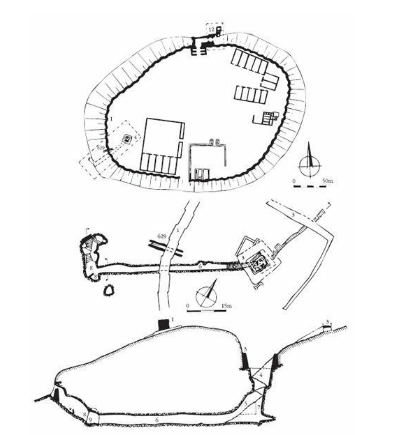 Fig. 3.3: Plan of system water at Megiddo. Courtesy Israel Exploration Society.
Each city's water supply system was an integral part of the defense system, as its most important function was to ensure the water supply of the city's population when an external source could not be reached, as in wartime, particularly during a siege. Due to topographical and geological differences, each city was obliged to develop a system adapted to local conditions. However, there were several ways of managing existing conditions, as we have already observed in a study of water supply systems, which, due to new discoveries, needs to be updated.
According to this study, the water supply systems of ancient Israel can be divided into five groups:
- Shaft and tunnel leading to a perennial spring outside the town, as in the third and fifth phases at Megiddo.
- Shafts and tunnels leading to the water table within the boundaries of the mound, as at Hazor and Gezer.
- Tunnel leading from an external perennial source to the base of a vertical shaft, as in the fourth phase of Megiddo (see fig. 3.3).
- Tunnels and feeder canals diverting water (not necessarily from a perennial source) to reservoirs, as in Jerusalem (Siloam canal, Siloam tunnel), Beer-sheba, Beth-Shemesh and Halif.
- External approach to a perennial spring at the base of the mound, as at Megiddo, and Tell es-Sa'idiyeh (Zarethan).
To these groups should be added another in which water was transported manually from an external source to an internal reservoir, as at the fortress of Arad, where water was brought to the fort from a well in the valley.
- Palaces and Other Accomodations
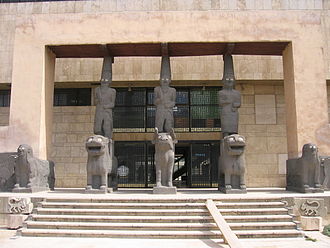 Fig. 3.4: The entrance to the Aleppo National Museum, based on the Kapara Palace at Tell Halaf. An example of the architecture bit hilani.
While domestic structures in the cities largely continued to follow the model of the four-room house, the new socio-political structure of the monarchy imposed the need to develop new types of housing for the upper classes and structures meeting other public needs. Right from the start of the monarchical period, the central authority launched and undertook a vast construction program including palaces, a central sanctuary, warehouses and military installations. This program continued after the separation of the North.
Buildings are considered palaces on the basis of their size, construction materials and techniques, and the small objects found inside. The palaces were home to royalty, bureaucratic nobility and their entourages. On the basis of archaeological remains and biblical references, researchers suggest that Israelite architecture was strongly influenced by Syro-Hittite culture, with execution carried out mainly by Phoenician craftsmen. This includes the floor plan (mainly bit hilani), the use of ashlar masonry and the integration of wood and metalwork. The term bit hilani refers to structures composed of two elongated, parallel rooms. Access to the outer room is via a staircase leading to a door between one to three columns. The inner room served as a throne room. It has been suggested that Solomon's palace was a structure of this type. Many Israelite palaces, such as those at Megiddo, included a series of rooms at the sides and rear of the building. Other palaces, such as those excavated at Hazor, Ramat Rahel and Lachish, do not follow the bit hilani plan but feature other architectural elements mentioned above, such as the use of ashlar in the header and splayed method. Official residences in provincial towns, such as the governor's residence in Beer-sheba, are distinguished by their size and location within the city.
In addition to ashlar masonry, another architectural element associated with royal construction are the proto-aeolic capitals of columns found at sites such as Hazor, Dan, Megiddo, Ramat Rahel and Jerusalem in the West Bank and Medeibiyeh in Trans-Jordan. These capitals have been identified as the "Timora (palm) capitals" mentioned, for example, in 1 Kings 6:29, 32, 35; 7:36; 2 Chr 3:5.
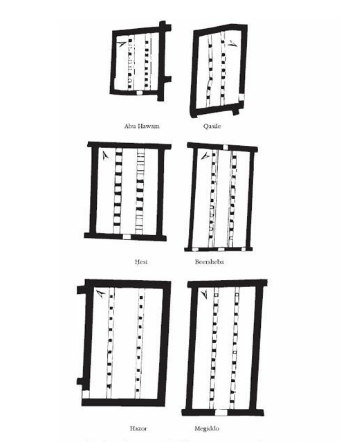 Fig. 3.5: Plan of tripartite buildings. Courtesy Biblical Archeologist.
As taxes were paid in kind (i.e. in grain, oil and wine), their collection required the construction of warehouses. Several Israelite kings are credited with building such facilities, but biblical references do not describe them. In this case, archaeology is very useful. Many sites have yielded a particular type of structure known as a pillared or tripartite building. Both names reflect particular aspects of this type of structure. These rectangular buildings were divided into three elongated rooms with paved exteriors. Like the four-room house, this structure featured two rows of columns, in most cases made of a single stone. Most specialists agree that the superstructure of this building had a higher roof over the central nave than the side rooms, and that clerestory windows allowed light to enter. The paved side rooms were probably used to store goods in jars and other containers. On many sites, tripartite buildings have been uncovered in groups.
Buildings of this type have been uncovered at Tell Abu Hawam, near present-day Haifa, at Hazor, Megiddo, Tell el-Hesi in the Shephelah and at several other sites. These are probably the miskenôt (warehouses) mentioned in the Bible (1 Kings 9:19 = 2 Chr 8:6; see fig. 3.5).
Other storage facilities included stone-lined and sometimes plastered silos, which were large pits for storing bulk grain.
- Population
Urbanization in Israel has changed the composition of the population in many large cities. Political and commercial relations brought international elements. Matrimonial ties with foreign royalty and nobility brought foreign women into the upper classes of the big cities. Political relations brought ambassadors from foreign powers to capitals, either temporarily or for extended periods. Foreign relations evolved to include international trade, which introduced a number of foreign merchants. The great wave of construction brought in craftsmen from abroad, and the accumulated wealth created a need for luxury goods, which was met in part by importing foreign artists. To protect the monarchical order and its assets, mercenaries were recruited from outside Israelite society. Thus, the population of cities like Jerusalem included ethnic elements such as Hittites, Amorites, Arameans, Phoenicians, Egyptians and Transjordanians (Ammonites, Moabites, Edomites, Arabs). This process, and the fact that it made cities densely populated and expensive to live in, drove many Israelites out of the cities and into smaller towns, villages and farms. Naturally, this changed the nature of life in the big cities, sometimes causing resentment and opposition.
To keep control of the situation, the monarchy put in place various means. Firstly, a central government, headquartered in the capital. The Bible lists the ministers under David and Solomon (David: 2 Sam 8:15-18; 20:23-26; 1 Ch 18:15-17; 27:32-34; Solomon: 1 Kings 4). We know from inscriptions that after the division of the kingdom, some of these functions were maintained in the south. Unfortunately, no such list exists for the northern kingdom of Israel. Serving the government was an administration comprising scribes, commanders of the various armed forces, priests, advisors and a tax commissioner in charge of corvée. David was the first Israelite monarch to accumulate so much wealth that he needed overseers to manage and control it (1 Ch 27:25-31), while Solomon was only able to provide for his family by dividing his kingdom into twelve provinces, each under the authority of an official in charge of monthly palace supplies. Other officials and courtiers were stationed in the capital and the palace. Biblical references, inscriptions, seals and seal impressions tell us who these people were: "servant", "over the house", "mayor", and so on. High public office was not reserved for men. Women also held important public positions, as we learn from the mention of the prophetess Huldah (2 Kings 22:14) and the seal of Maadana, daughter of the king.
Indeed, each town or village had its own governing body made up of elders. The town council of elders was formed in the same way as the village council. Towns and villages had links with the central government. These officials were responsible for collecting taxes and enlisting citizens in the militia or in drudgery. They were also responsible for evacuating goods to certain officials who were paid for their services. Military units stationed in the various communities were placed under the authority of a local commander who was responsible to the central government, either directly or through an officer.
The new socio-economic and political conditions gave rise to a new upper class made up of royalty, nobility and priests. Members of this class developed a way of life markedly different from that to which the lower classes were accustomed. For those interested in social justice, this lifestyle became extremely irritating and found expression in certain prophetic speeches. These speeches tell us about this lifestyle of personal gratification and greed, which included excessive consumption of food and alcohol at banquets (Isa 11-12; 21; Am 4:1; 6:1-7) and the perpetration of numerous injustices against the poor, such as cheating and stealing their property (Isa 5:8; Jer 5:27-28; 22:3,13-17; Am 2:6-8; 5:7-12; 8:5-6).
- Religion
Life in the city included participation in the cult practices that took place in the local sanctuary. From biblical references and archaeological discoveries, we can assume that every town and village had a worship center or sanctuary. Some sanctuaries were more important than others, and these are the ones mentioned in the Bible, although not all have been found in excavations. On the other hand, some of the sanctuaries discovered are not mentioned in written sources.
The discovery of domestic sanctuaries such as Tell Halif and other sites suggests that family worship continued even in urban settings. Jeremiah describes it well: "Don't you see what they do in the cities of Judah and in the streets of Jerusalem? Children gather wood, fathers light fires, women knead dough to make cakes for the queen of heaven, and they offer libations to other gods to provoke me to anger" (Jer 7:17-18).
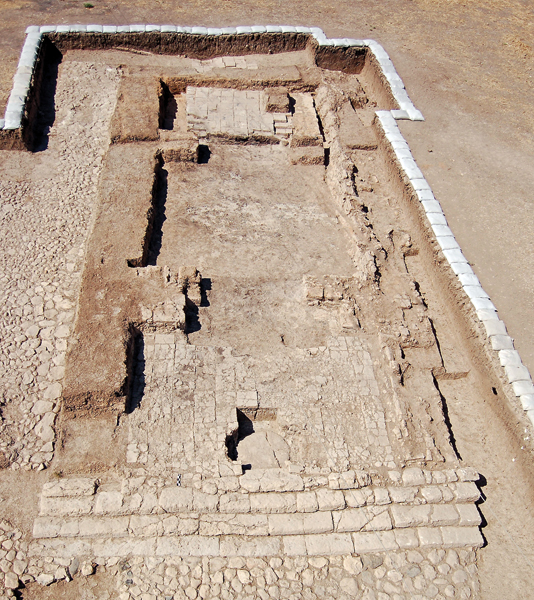 Fig. 3.6: Tayinet's Iron Age temple. The structure of the temple must have been similar to that of Solomon's.
The composition of the population in large cities suggests that much of the worship became public. The Temple of Jerusalem, which began as a royal sanctuary and only later became a national shrine, is described in detail in the Bible, but no remains have yet been found. Based on biblical descriptions, researchers suggest that Solomon's temple must have been similar to the one excavated at Tell Tayinat in Syria and to other similar temples that follow the general plan of tripartite Syrian temples. It has been suggested that a carved ivory scepter head inscribed "holy for priests / (belonging to) the house of [YHWH]" came from the Jerusalem temple. If so, it is the only known vestige of the Jerusalem temple.
The nature of worship in the Jerusalem temple and other sanctuaries can be reconstructed from biblical references and archaeological discoveries. Biblical reports suggest that YHWH was not the only one worshipped in the temple. Under political pressure and the influence of foreign ethnic elements, several kings introduced modes of worship foreign to the Israelites. In fact, the monotheistic viewpoint expressed in the prophetic books was followed by only a small number of Israelites.
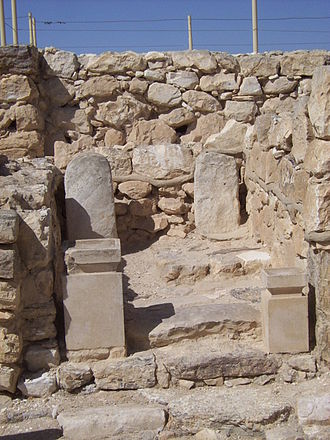 Fig. 3.8: Arad temple in the Iron Age. In the foreground, the two incense pillars. In the background, two stelae, one to YHWH, the other probably to Ashera.
The Bible mentions several temples, but only Dan's elaborate sanctuary has been discovered. At this site, excavators uncovered an open cult center consisting of ashlars and other religious fixtures and fittings. Other urban sites mentioned in the Bible as having cult centers have yielded only religious objects, but no trace of the center itself. The most famous of these is Beer-sheba, where an ashlar sacrificial altar was found in secondary use in the wall of a warehouse. However, the site of Beer-sheba's cult center has not been discovered. It has been proposed that the cult center of Beer-sheba was destroyed during Hezekiah's reforms. The reforms did not eliminate cult practices in all urban centers, as several urban sites produced domestic sanctuaries.
Not all regional temples are mentioned in the Bible. One of them was discovered in Arad. This temple had a long history, beginning in the tenth century BC and ending around 700 BC. In general, it follows the plan of a tripartite temple comprising an open courtyard with a large sacrificial altar, an enclosed wide hall and an inner sanctuary, which featured two standing stones with two incense altars in front of them. The temple appears to have been decommissioned during Hezekiah's reforms.
In short, Israelite worship in urban areas continues to be family-based, but in many cases people take advantage of existing public facilities, either by choice or as a result of reforms instituted by the central government.
- The Economy
Most city dwellers didn't make their living from farming or herding, but were linked to the bureaucracy or engaged in activities that enabled the bureaucrats to function. Many city dwellers carried out manufacturing activities similar to those in the villages, such as pottery-making, stone-cutting and masonry, brick-making, metallurgy, weaving and the production of foodstuffs in large quantities for sale. Among the latter were bakers (Jer 37:21; Neh 3:13; 12:38); other services for sale probably included laundry (Isa 7:3; 36:2). Commerce was an important component of the urban economy.
- Trade and Commerce
During the pre-monarchic period, the economy was based on self-sufficiency, with small-scale barter using limited quantities of surplus produced by small landowners in villages and upland farms. With the advent of the monarchy, the nature of the economy changed when trade and commerce were introduced and became a major feature of the economy.
When discussing trade in ancient Israel, we need to consider the following: (1) overland trade, which includes both short-distance and long-distance trade, including desert trade; and (2) maritime trade.
Most long-distance trade was subject to a royal monopoly, or special permits with taxes and royalties levied by the government. This helped to maintain the trade infrastructure and meet part of the monarchy's financial needs. These taxes were added to the price of imported goods, which thus became luxury and prestige items. The involvement of the Israelite royal family in trade is echoed in biblical traditions, which associate Solomon with the horse and chariot trade, his relationship with the Queen of Sheba and his maritime expeditions (1 Kings 10:11-12, 28-29; 2 Ch 1:16-17; 8:17-18; 9:1-13).
- Overland Trade
Most trade took place overland over short distances, particularly between villages and between villages and towns. Small markets, such as those still held today by Bedouins on the outskirts of towns and those held weekly in European towns and villages, existed in ancient Israel. Most of the goods and merchandise available at these markets were surpluses and other products produced by rural dwellers. Agricultural surpluses mainly included cereals, oil and wine, as well as livestock such as lambs and kids. They could also include fresh seasonal fruit and vegetables, or by-products such as dried fruit and cheese.
Most of the roads between villages were simply paths that followed the terrain. Goods were transported mainly by donkey, which can be considered the jeep of the ancient Near East. When the monarchy became involved in trade and some roads were improved and maintained, carts were also used for transport, with oxen serving as the main beasts of burden. It is possible that mules were also used for this purpose, but it seems that horses were not used for the daily transport of goods.
City dwellers could buy from middlemen, while villagers probably traded among themselves. As coins had not yet been invented, exchange took place either for metals and precious stones, or in the form of barter for other goods or services. Dry and liquid goods were measured by units of volume, many of which are mentioned in the Bible and in extra-biblical inscriptions such as the ostraca of Samaria and Arad. The value of goods and the unit of exchange were determined by weight; the unit was the silver shekel. Weighing was done with a balance that held the goods at one end and the weights at the other. In addition to the shekel and its multiples, there were also fractions of the shekel, such as gera, beqa', pym and nesep. While some names are known from biblical references, many details of the weight system are known from archaeological finds. Numerous weight stones, particularly from 8th-century Judea, have been found in archaeological excavations; they are dome-shaped, made of limestone and, in most cases, bear an inscribed denomination on the top of the dome. Multiples of the shekel bear a sign similar to the Greek letter gamma and a denomination numeral, some of which are in Egyptian. It has been suggested that in the late eighth century BC, the Judean weight system was changed from the Egyptian deben/qedet to one closer to the Assyrian system. Moreover, this change was the result of increasing trade with the Assyrian Empire, while contacts with Egypt were diminishing. It is possible that such changes took place under King Hezekiah as part of his reforms, both religious and economic.
Haggling over the price of goods is not an experience that only the modern Middle Eastern tourist knows when visiting the oriental bazaar. The story of Abraham's purchase of the cave of Makpelah (Gen 23) and Abraham's haggling over the price of saving the city of Sodom (Gen 18:17-33) are good examples of typical market behavior in biblical times.
Long-distance trade in the ancient Near East was not an Israelite invention. International trade was practiced from the earliest stages of Near Eastern history, as evidenced by artefacts uncovered in archaeological excavations and written records of commercial activities found in ancient archives at Ebla, Mari, Ugarit and others. In addition, trade needs and responsibilities were included in international treaties. The Bible attributes participation in trade to the Canaanites, and sometimes uses the term Canaanite as equivalent to merchant (Isa 23:8; Ezek 17:4; Hos 12:8; Zeph 1:11; Zech 14:21; Prov 31:24). Indeed, the attitude of conservative biblical circles towards trade was very negative (Ezek 28: 4-5). Traders followed established land routes. The most important of these was the Via Maris (the way of the sea), which ran from Egypt along the eastern shore of the Mediterranean (hence its name), through Syria-Palestine and into Mesopotamia. This main road had several branches to the hills and other regions. Another important route, known as the "King's Road", crossed Transjordan from north to south.
Along the main road linking major cities such as Ashkelon, Gezer, Megiddo, Hazor, Dan and others, conditions permitted the use of carts and wagons, in addition to donkeys and camels. The major cities had accommodation for commercial caravans, as well as large open markets and closed stores, as shown by archaeological finds at Dan and Ashkelon respectively. With the domestication of the camel and its introduction to the region around 1200 BC, desert caravans linked the eastern Mediterranean to remote regions beyond the deserts of Arabia and Syria. The use of camels to transport goods, particularly frankincense, is illustrated in the story of Joseph, where a caravan of Ishmaelite camels is described as carrying "gum, balsam and myrrh" (Gen 37:25). The final resting place of many of these camels is attested by the discovery of numerous carved camel bones at Ashkelon. Goods imported from other parts of the ancient world reached local markets via intermediaries who distributed goods purchased in long-distance trading terminals along local roads to towns and villages. Among the exotic products brought to Israel by long-distance merchants were foodstuffs that were not available locally and were processed and purchased in distant places such as Egypt (e.g. fish). Other items brought by long-distance merchants included jewelry, pottery vessels and the products they contained.
- Maritime Commerce
Maritime trade around the Mediterranean dates back at least to the end of the Bronze Age, as indicated by shipwrecks on the southern coast of Turkey and other sites in the eastern Mediterranean. Objects imported from Cyprus and other parts of the Mediterranean basin also bear witness to this. Maritime activity continued throughout the Iron Age under the continued domination of the Phoenicians (Ez 27-28) who, as early as 900 BC, established colonies on Mediterranean shores and on defensible promontories as far south as Spain, and were the seafarers of the ancient world. Their continued involvement throughout the Iron Age II has recently been documented by the discovery of two of their ships off the Ashkelon coast. From these wrecks and other written and archaeological evidence, it seems that the main items of Phoenician trade were grain, oil, wine, wood and purple dye.
Maritime trade took place mainly along the coasts; however, navigation on the high seas was seasonal, depending on the winds and currents that prevailed at certain times of the year. The Israelites' maritime activity was closely linked to that of the Phoenicians. Biblical references to Israelites associated with navigation are limited to groups located close to the Phoenicians, such as Zebulun (Gen 49:13), Dan and Asher (Jdg 5:17). Solomon also took part in joint maritime expeditions with the Phoenicians (1 Kings 9:26-28; 10:11-12; 2 Chr 1:16-17; 8:17-18). These expeditions brought back gold and silver, precious stones, exotic trees and animals. King Jehoshaphat of Judah (c. 874-850 BC) tried to emulate Solomon's maritime success by acquiring gold (1 Kings 22:49), but his ships were wrecked. King Ahasiah of Israel (c. 850-849 BC), who wanted to make it a joint venture, was rebuffed by Jehoshaphat (1 Kings 22:50).
No other maritime activity related to Israel is reported in the Bible or can be deduced from other sources.
- When the Kings Went to War
The advent of the monarchy in Israel encouraged the growth of urbanism. This brought about a radical change in the socio-political structure, creating a new way of life that encouraged the accumulation of wealth. The new economic conditions in Israel, on the one hand, attracted outside forces and, on the other, encouraged offensive action, resulting in countless wars. In terms of warfare, the period of Saul and David was one of transition. During this period, particularly in the middle and end of David's time, we can observe a slow change in army composition, weaponry and strategy. Saul continued to wage essentially defensive wars, for this was the mandate he had given himself (1 Sam 8:20). David was the first Israelite king to launch offensive wars to expand the territory under his control. As king, David was the first to employ mercenaries; the Cherethites and Pelethites, originally members of the coalition of the Sea Peoples, were placed under the command of Benaiah, son of Jehoiada (2 Sam 8:18; 20:23). David also employed Uriah the Hittite (2 Sam 11), who must have been a mercenary. David had a special forces unit, some of which were not of Israelite origin, which took part in daring operations (2 Sam 23:8-39; 1 Chr 11:10-47; 12:1-22). David also employed Israelite units in his army (1 Chr 12, 23-38).
David continues to rely on foot soldiers, while his enemies use chariots (2 Sam 10:18). When he had captured his enemies' horses, "David took from him one thousand seven hundred horsemen and twenty thousand foot soldiers. David hamstrung all the chariot horses but left enough for a hundred chariots." (2 Sam 8:4; see also 1 Chr 18:4). It has been suggested that he did this because he did not aspire to build up a chariot force. Espionage continues to be used. Hanun, king of Ammon, suspected David's emissaries, who had come to console him after the death of his father Nahash, of being spies (2 Sam 10:3; see also 2 Chr 19:3). Duels continue to be used as a means of deciding the outcome of the conflict (1 Chr 20: 4-8). When the armies of Joab and Abner met at the pond near Gibeon, Abner proposed and Joab agreed that the outcome of a series of duels would decide the outcome of the conflict. Only when the result was a draw did the armies face each other in battle on the field (2 Sam 2: 1 - 3).
However, efforts were made to avoid war, and David used treaties to establish relations with his adversaries, starting with the house of Saul (2 Sam 3:12-21) and continuing with Israel's neighbors. To this end, David married the daughters of neighboring kings. This provided support and, at times, shelter and refuge for him and his offspring (2 Sam 13:37-38).
Fortification systems continued to include walls and gates, as some war stories show. The most striking accounts from the early monarchical period are those of David's conquest of a heavily fortified Jerusalem (2 Sam 5:6-9; 1 Chr 1:4-8) and the war against Rabbah of the Ammonites. The latter is linked to the David and Bathsheba incident, since her husband, Uriah, took part in the assault on the city after a long siege (2 Sam 1:1-12). The conquest of Jerusalem was made possible when David's forces, under the leadership of Joab, managed to enter the city through an element supposedly part of the water supply system. According to biblical accounts, when David's forces attacked Avel-Beth-Maaka, where the rebel Sheba ben Bikri had taken refuge, they laid siege to the city, built a siege ramp and attempted to destroy the city wall (2 Sam 20:14-15) by ramming or undermining it. Punishment of the vanquished was part of the consequences of war, and in some cases the punishment was quite severe (2 Sam 12:31 "As for the population, he sent them away to wield the saw, iron picks and iron axes. He assigned them to the molding of bricks. So he did for all the cities of the sons of Ammon"; see also 1 Chr 20: 3).
The time of Solomon is considered by the Bible to be a time of peace: "He [Solomon] made peace on all sides. Judah and Israel lived in security, each under his own vine and fig tree, from Dan to Beer-sheba, throughout Solomon's life" (1 Kings 5:4-5). But despite these declarations of peace, it was Solomon who introduced large-scale horse-drawn carriage and cavalry to Israel (1 Kings 5:6; 9:19; see also 2 Chr 8:6, 9; 9:25, 28) and, as the biblical text reports, it was Solomon who built large-scale fortified cities (1 Kings 9:15). It is possible that, as a result of these efforts, Solomon succeeded in establishing peace for his fellow citizens during his lifetime. In addition, the pax Salomonica could be the result of Solomon's insistence on concluding treaties sealed by marriage, the most famous being his marriage to Pharaoh's daughter (1 Kings 3:1).
After the division of the monarchy (circa 920 BC), the kings continued to employ a standing army (2 Chr 17: 12-19; 25: 5-10; 26: 11-15), fortified and refortified cities when conditions required (2 Chr 17: 2; 26: 9-10; 27: 3-4; 33: 14), used chariots (1 R 22: 4: 34-35 = 2 Chr 18: 33-34; 2 R 8: 20-21) and sometimes conducted night raids (2 R 8: 21). Armament included swords, bows and personal armor (1 R 22: 34 = 2 Chr 18: 33). Treaties were made and broken, and alliances continually changed. They fight Egypt (2 Chr 12: 9; 14: 7-14; 35: 20-24), clash with the Edomites (2 Chr 25: 11-14a), continue the conflict with the Philistines and other groups (2 Chr 26: 6-8; 27: 5 ; 28: 17-19), fight with and against the Arameans with or without treaties with Israel (2 Chr 16: 1-6; 24: 23; 2 Kgs 15: 16-22; 2 Chr 28: 5-6), and wage wars between the two kingdoms, Israel and Judah (2 Chr 25: 17-24; 28: 7-15). Ancient Israel's involvement in the wars is also evident in extra-biblical sources. The Moabite stone erected by King Mesha of Moab bears witness to the territorial expansion of the northern kingdom under the Omrides, as far south as Transjordan. The Assyrian annals are a good source of information for certain military encounters in which Israel participated. Shalmaneser III (c. 858-824 BC) reports that Ahab of Israel supplied two thousand chariots and ten thousand infantrymen to the Aramean coalition he faced. This last reference, compared with the forces supplied by the other members of the coalition, shows that Israel was a great military power.
The worst wars were those that led to the extinction of both kingdoms. The first outside power to confront the Israelites was Assyria, which devastated Judah and annihilated Israel (2 Kings 15:29; 17:1-20; 18:9-17; 2 Chr 28:16-21; 32; 33:10-13). The final blow to the Israelite entity is dealt by the Babylonians (2 Kings 24: 1-2, 10-17; 25: 1-21; 2 Chr 36: 6-7,10,17-20). Both Assyrians and Babylonians used siege techniques to seize Samaria (2 Kings 17:5) and Jerusalem (2 Kings 25:1-4). Assyrian bas-reliefs depict the impalement of rebellious leaders as punishment, and written documents such as biblical and extra-biblical records tell of the exile of the upper classes (2 Kings 24:14-16; 25:19-21; 2 Chr 36:20). The exile, or exchange of populations, brought new ethnic elements and new ways of thinking to the region. The economy became rural again, and remained so for a long time.
- Bibliography
- Biran, Avraham. Biblical Dan. Jerusalem: Israel Exploration Society and Hebrew Union College-Jewish Institute of Religion, 1994.
- Herzog, Zeev. Archaeology of the City: Urban Planning in Ancient Israel and Its Social Implications. Tel Aviv: Institute of Archaeology, Tel Aviv University, 1997.
- Reich, Ronny. "Palaces and Residences in the Iron Age." Pages 202-22 in The Architecture of Ancient Israel from the Prehistoric to the Persian Periods. Aharon Kempinski and Ronny Reich, ed. Jerusalem: Israel Exploration Society, 1992.
- Shiloh, Yigal. "Elements in the Development of Town Planning in the Israelite City." Israel Exploration Journal 28 (1978): 36-51.
- Ussishkin, David. The Conquest of Lachish by Sennacherib. Tel Aviv: Institute of Archaeology, Tel Aviv University, 1982.
- Wright, George R. H. Ancient Building in South Syria and Palestine. Vols. 1-2. Leiden: Brill, 1985.
|
Next chapter: The Household and Life Cycles
List of all chapters

(click on map to enlarge)
|