Jerome Murphy-O'Connor, Paul. A Critical Life.
Chapter 7: The Years in Ephesus, p. 158-184
(Detailed summary)
Paul does not tell us who prevailed in his dispute with Peter in Antioch. But his silence reveals that it was not him. For if he had won, he would certainly have mentioned it to the Galatians, and the fact that Peter would then have sided with him would have been a powerful argument against the Judaizing tendencies in the Galatian church. But, conversely, the very fact that Barnabas sided with the delegation from Jerusalem left him completely isolated. He no longer felt at home in Antioch, for he could not identify with this church that was creating a division between Jewish and non-Jewish Christians—a church that no longer centered on Christ but on Jewish nationalism. Drawing on his experience as a Pharisee, he could clearly foresee that community life would henceforth be marked by a certain legalism. Therefore, in good conscience, he could no longer be its representative, as he had been in his previous mission. At the same time, he could not deny the call to mission he had received at his conversion: he was an “apostle—not from men nor through any man, but through Jesus Christ and God the Father” (Gal 1:1). So, sometime in the spring of the year 52, when the passes of the Taurus Mountains, known as the Gates of Cilicia, were passable and most of the snow had melted on the plateau, Paul left Antioch, never to return.
- Two Journeys through Asia Minor to the West
Paul had already crossed Asia Minor at least once, during the journey from Antioch, in AD 46, that had taken him to the Aegean coast, which he crossed to land at Neapolis, the port of Philippi. At that time, there was no need to calculate the time and route, since the distances were similar. But that is not the case here, since we need to determine where Paul might have stopped.
- Galatia and Galatians
Fig.: Map of Asia Minor in the time of Saint Paul
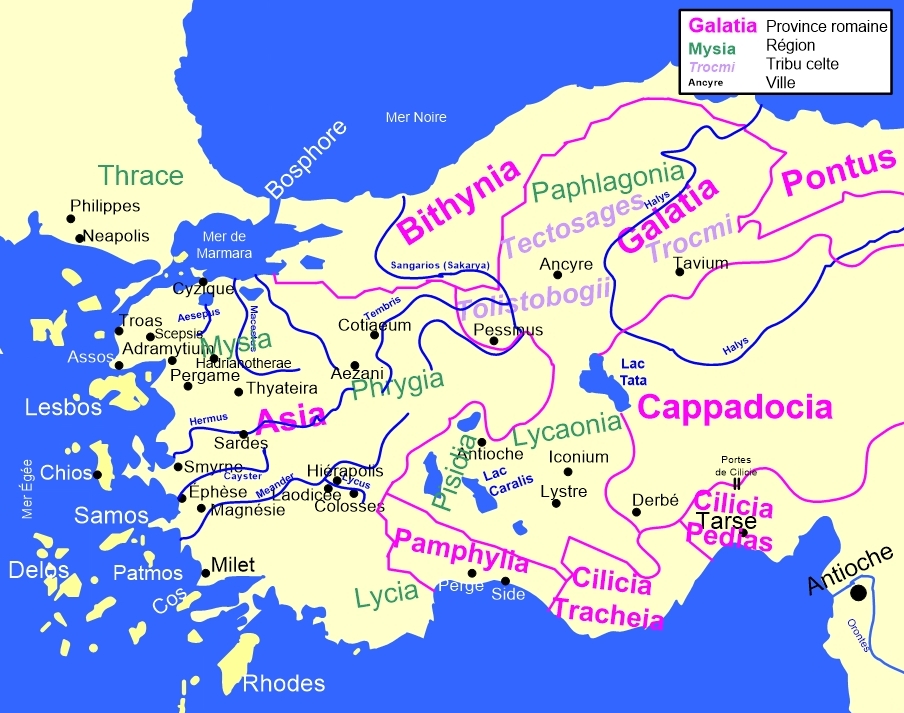
Where do the Galatians live? Paul gives us only the following information:
and all the members of God’s family who are with me, to the churches of Galatia (Gal 1:2)
Now concerning the collection for the saints: you should follow the directions I gave to the churches of Galatia (1 Cor 16:1)
You foolish Galatians! Who has bewitched you? It was before your eyes that Jesus Christ was publicly exhibited as crucified! (Gal 3:1)
You know that it was because of a physical infirmity that I first announced the gospel to you (Gal 4:13)
In the 3rd century BCE, Celtic tribes from the Pyrenees settled in Anatolia. In 25 BCE, upon the death of the last Celtic chieftain, Amyntas of Galatia, Emperor Augustus merged Galatia with Lycaonia and part of Pamphylia to form a province under a Roman governor. This means that the four cities evangelized by Paul on his first missionary journey according to Luke (Acts 13:13–14:28)—Antioch in Pisidia, Iconium, Lystra, and Derbe—belonged to the province of Galatia. But they were located in the southern part of Galatia. Does the Letter to the Galatians refer to the southern part of the Roman province of Galatia or to the tribal territory north of Galatia? In principle, the term “Galatians” can refer to a group of communities anywhere within the Roman province. But it is unlikely that the Galatians Paul speaks of are those in the southern part of the Roman province. On the one hand, the four cities he had already visited are scattered and represent different worlds, and it would make little sense for him to address a joint letter to them. On the other hand, in Galatians 4:13, Paul reveals that it was an illness that brought him to the Galatians, but in 2 Timothy 3:11, when he speaks of the trials he endured in the cities of southern Galatia, he never mentions this illness.
We must therefore rule out southern Galatia. In Acts 18:23, Luke tells us that Paul, after leaving Antioch, “traveled through the region of Galatia and Phrygia,” which resembles his previous journey when Luke wrote: “Paul and Silas traveled through Phrygia and the region of Galatia” (Acts 16:6). The very fact that Luke can reverse the order of the two regions implies that they refer to roughly the same area, which corresponds perfectly to the territory where Pisidian Antioch and Iconium were located, but it is unlikely that this is what Luke had in mind. Paul must have reached Pisidian Antioch, the last major city in Galatia, when he realized he could not cross into Asia. He then chose to travel through the Phrygian-Galatian territory, that is, the border zone between Asia and Galatia north of Pisidian Antioch, which would bring them to a point east of Mysia and south of Bithynia (Acts 16:7: “When they reached the border of Mysia, they tried to go into Bithynia, but the Spirit of Jesus did not allow them to do so”). But why did Paul find himself east of Mysia and close to south of Bithynia, when the normal route to Troas in the west would have been through Phrygia? Why such a detour so far east? Moreover, it was only southeast of Pessinus (modern-day Balahisar) that it would have been easy to make a detour eastward, which would have taken him into Galatian territory. Some event must have forced Paul to temporarily abandon his plan to bypass Asia. The illness he mentions (Gal 4:13) could explain this change. It therefore seems highly likely that the Galatians to whom Paul was writing lived in the northeastern corner of Galatia, that nearly square territory bordered on three sides by the immense meander of the Sangarios River (modern-day Sakarya).
- From Galatia to Troas
After Galatia, Paul set out to preach the Gospel in Macedonia. But how did he get there? He gives us no clues. Luke simply writes: “They then passed through Mysia and went down to Troas.” Three routes are possible. Starting from Cotiaeum (see map), there is first the northern route that reaches the Sea of Marmara east of the city of Cyzicus, then one can travel westward via various ports; but Paul may have avoided this route due to a shortage of ships or because of headwinds. The other route, one that Paul likely did not take, runs through the interior from Cotiaeum, passing through Hadrianutherae and Scepsis before reaching the coast: it is difficult terrain and known for its bandits. Finally, there is the southern route, which seems the best, passing through the city of Aezani and the upper reaches of the Macestus River to reach the city of Adramytium, or even Assos, and from there one can take the sea to Troas in the north. The city of Troas was the usual transit point for those wishing to travel to Europe and reach the city of Neapolis, where the Via Egnatia began, or conversely, for those wishing to reach Asia from Europe.
Since Paul left us no letters addressed to the people of Mysia, we can hypothesize that Paul passed through the region without stopping to preach. This means that upon leaving Galatia, he had decided to go to Troas to cross over to Europe.
- Maintenance not Mission
The churches in Pisidian Antioch, Iconium, Lystra, and Derbe were well established. Paul had high hopes for his new churches around Pessinus. In his view, the faith was firmly rooted in Galatia, the central province of Asia, from where it could spread in all directions. The best course of action for him, therefore, was to head west, beyond the missionary reach of the Galatian churches. Let us recall his strategy in Greece: he founded the churches in Philippi and Thessalonica to the north, and Corinth to the south, but he made no attempt to evangelize Thessaly; in his view, central Greece fell under the missionary responsibility of the churches flanking it to the north and south.
Furthermore, Paul’s experience with the challenges of the Thessalonica church’s growth had made him realize that simply founding churches was not enough. They needed to be nurtured to grow. New converts needed time to mature, and in this process, proclamation had to be complemented by teaching. What had happened in Antioch on the Orontes had made it even clearer to him that the development of a church could not be taken for granted. Thus, when he traveled through Asia Minor for the second time, strengthening the faith had become more important than evangelism, at least initially.
From the letters, we know that Paul traveled through Galatia at least twice (Gal 4:13) before writing the Epistle to the Galatians. He founded churches there before the Council of Jerusalem (Gal 2:5) and subsequently organized the collection for the poor in Jerusalem, as decided at that council (1 Cor 16:1). And it is highly likely that he personally invited the Galatians to participate in the collection. Then, according to 1 Cor 16:1, 8, upon leaving Galatia, Paul planned to go to Ephesus. He most likely reached this city by taking the mountainous route around the Cayster River. And to take this route, he had to depart from the vicinity of Pessinus.
- Galatia and Galatians
- Ephesus
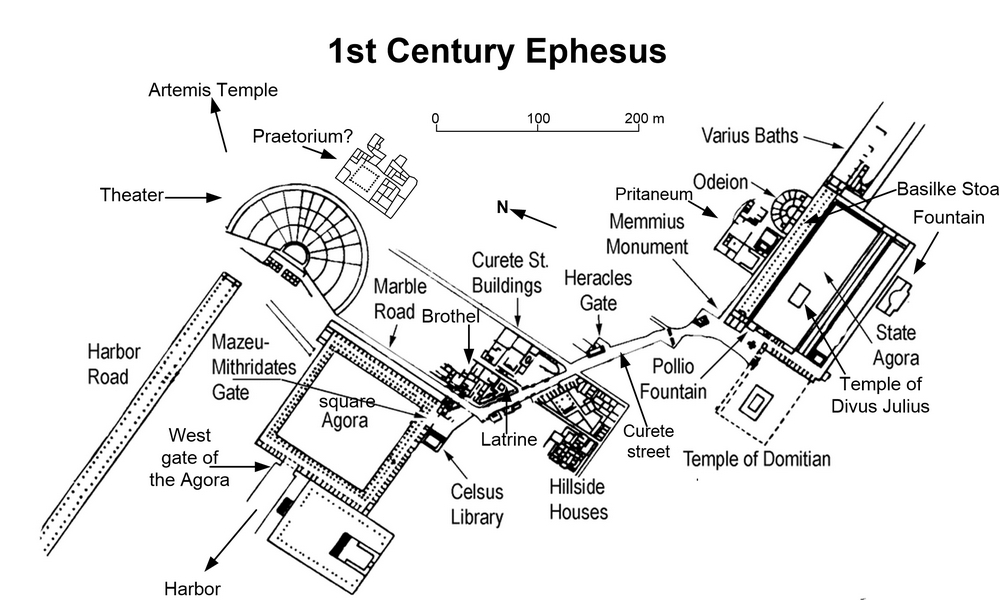
Fig.: Map based on the book by Jerome Murphy-O’Connor, Paul. A Critical Life.
Paul’s choice of Ephesus was a wise one, as the city lies equidistant as the crow flies from Thessalonica and Galatia (about 480 km), as well as from Corinth (400 km), Philippi (445 km), and Antioch in Pisidia (330 km). According to Luke, Paul stayed there for two years and three months (Acts 19:8–10).
The oldest remains date back to the middle of the 2nd millennium BC. According to Pausanias, the city was named after Ephesos, who was considered the son of the river Cayster. Around 286 BC, it was relocated to its current site by Lysimachus (360–281 BC), a companion and successor of Alexander the Great. The move further west was intended to counteract the silting up of the Cayster’s mouth, which necessitated periodic dredging of the harbor. In 133 BC, Rome acquired the kingdom of Pergamon, which then became the province of Asia. Although Pergamon remained the capital, Ephesus became the most important city. Emperor Augustus made it the seat of the proconsul and ensured the city’s prosperity by commissioning magnificent buildings that marked the era of Paul. Thus, in the southern part stood the city hall (Prytaneum), the Temple of Julius Caesar, and the 200-meter-long open-air basilica, which adjoined the north side of the State Agora. Three new aqueducts were added to the Sextilius Pollio Aqueduct to improve the quality of life and accommodate population growth, along with the presence of baths and gymnasiums. The theater seated 25,000 people. It was rivaled only by the Temple of Artemis, built just outside the city to the east and considered at the time one of the Seven Wonders of the World. Erected in the 7th century BC, it was rebuilt several times. It measured 115 × 55 m, and the 98 columns of the double row surrounding it reached a height of 17.65 m. The pilgrims it attracted to Ephesus were an important factor in the local economy. It stood until the 3rd century CE.
Excavations carried out in the neighborhood of terraced houses on the rocky slope, south of the street connecting the Square Agora to the State Agora, revealed a residential complex dating from the 1st century BCE. The quality of construction was such that it was still in use 600 years later, even though the house had undergone several renovations. The ground floor of the eastern part of the complex covered 3,000 m² and housed a single very wealthy family. In contrast, the more modest houses in the western complex likely better represent those who could host Christian assemblies, such as one of the seven two-story dwellings.
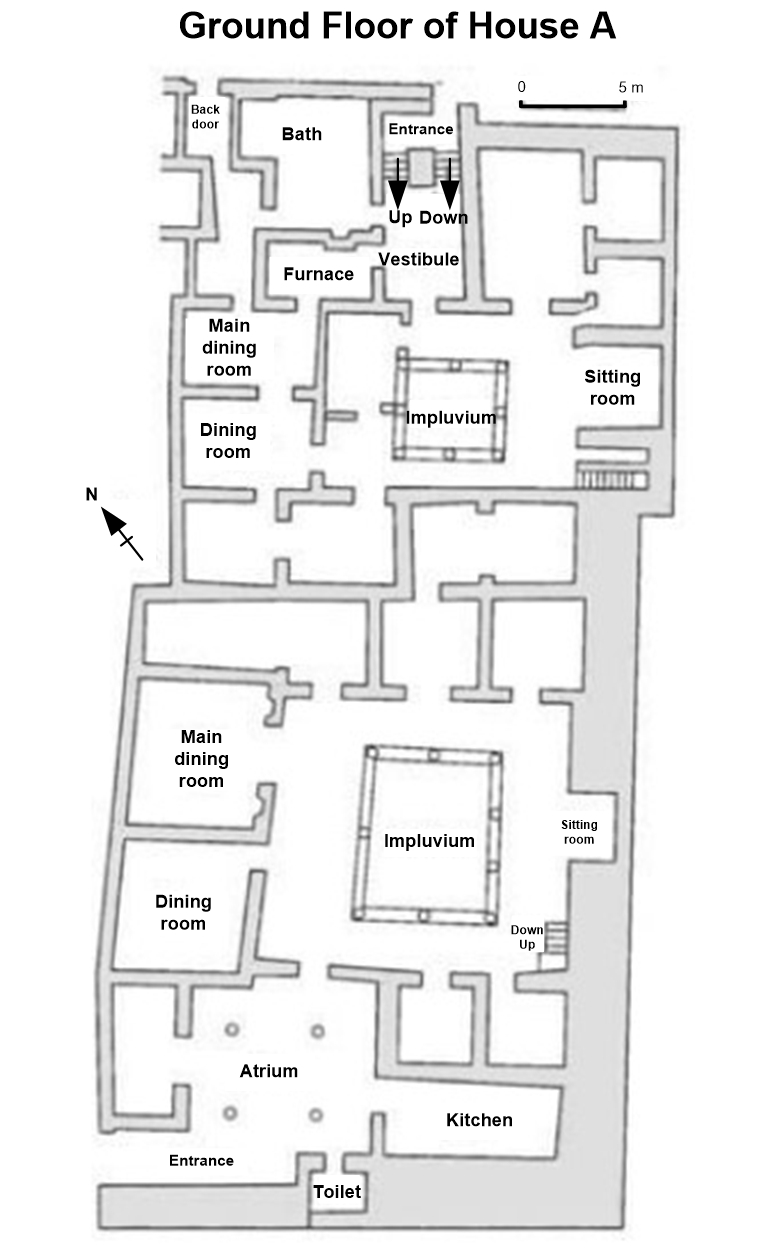
Fig.: Plan copied from Jerome Murphy-O’Connor’s book, Paul: A Critical Life.
The ground floor of House A covers an area of 380 m². To the right of the vestibule, a door leads to the Roman baths, which also served to heat the house. Opposite is the atrium (7.5 × 5 m) with its impluvium (3 × 3.75 m). A small side room provides access to the dining room (3 × 5.5 m); the kitchen is nearby. A much larger room (6.5 × 4.25 m) is accessible directly from the other side of the atrium through a large arched doorway. These were the public rooms; the rest of the house was off-limits to casual visitors. The size of the rooms meant that, as soon as the Christian community reached a certain size, complications were inevitable. When it became impossible to gather everyone in a single room, the risk of creating first- and second-class members arose, which indeed occurred in Corinth (1 Cor 11:17–34). Inevitably, there was a tendency to gather in small groups, such as the house church that met at Prisca and Aquila’s home (1 Cor 16:19). The diversity of Ephesus’s population is undeniable. As the gateway to the West for the Anatolian hinterland, it was also the opening to Asia for Greece and Rome. Ephesus was a true melting pot of cultures, much like Rome itself. Its population is estimated at a quarter of a million. Citizens in the strict sense (that is, those with the right to vote) may have accounted for a quarter of that number.
- The Founding of the Church
- Prisca and Aquila
Paul went to Ephesus during the summer of AD 52. It was not his first visit. Recall that, according to Luke, Paul made a brief stop there on his way from Corinth to Palestine (Acts 18:19). Furthermore, he left Prisca and Aquila there to prepare for his return (Acts 18:24–28), just as they had provided him with a foothold in Corinth (Acts 18:2–3). This means that by the time Paul returned, after the Jerusalem conference, they had been in Ephesus for a year. It is highly unlikely that during this time they limited their activities to their tent-making business. Just as they were Paul’s partners in evangelizing Corinth, we can assume they did the same in Ephesus; they are, in a sense, the true founders of the church in Ephesus. The information provided by Luke is all the more reliable because it is somewhat embarrassing for him that Paul, his hero, was not the one who laid the foundations of this church. We sense this embarrassment when he is keen to add in Acts 18:19 that, during his brief stop, Paul went to the synagogue to preach to the Jews: it was absolutely essential for him that Paul be the first to speak in Ephesus. Paul’s letters confirm our hypothesis. The greetings in 1 Cor 16:19 reveal that Prisca and Aquila are with Paul: “The churches of Asia send you greetings. Aquila and Prisca send you many greetings in the Lord, as does the church that meets in their home”; for him, the role of this couple is so important that he names them personally and mentions the church that meets in their home.
- Those who had received the Baptism of John
When the mission began in Ephesus, an unusual phenomenon was encountered, as mentioned by Luke in Acts 18:24–19:7: people who knew Jesus but had received only the baptism of John the Baptist, of whom Apollos was an example. How can this phenomenon be explained? It is the evangelist John who provides the answer by stating that Jesus was first a disciple of John the Baptist, whom he baptized (John 3:22), and that he enjoyed great success, so much so that many people went to him to be baptized (John 3:26). These were therefore people who became disciples of Jesus of Nazareth, the associate of John the Baptist, and accepted his baptism of conversion, but without knowing anything about his passion and resurrection. We can assume that Prisca and Aquila invited them to become full believers and to receive Christian baptism. Luke presents this scene as a new Pentecost (Acts 19:5–7). One of them was Apollos, a highly educated Jew from Alexandria.
Aside from this particular group, we know nothing specific about this church. Given that the city resembled Corinth in many respects, we can assume with some certainty that the two communities were comparable in size and composition (1 Cor 1:26–29). Each was a city in miniature: a few relatively wealthy members, a majority of merchants and slaves, and perhaps more women than men.
- Prisca and Aquila
- Missionary Expansion
In 1 Corinthians 16:19, Paul mentions “the churches of Asia” in his greetings to Corinth. We must therefore assume that there were other Christian communities established around Ephesus in this Roman province. The only ones known to us, because they are mentioned by Paul, are Colossae, Laodicea, and Hierapolis (Col 4:13). But it is highly likely that this list is not exhaustive. However, Paul did not found these churches in the Lycus Valley. In fact, in Col 1:7, Paul refers to the teaching the community received from Epaphras, a native of that community, whom he presents as his companion and minister of Christ, and in Col 4:13 as the one who also works hard for the Christians in Laodicea and Hierapolis. We can infer from all this that he is the founder of the three churches.
Did Epaphras act on his own or as Paul’s delegate? The fact that in Col 1:7 Paul presents him as a faithful minister of Christ suggests that he acted as an authorized missionary, sent by Paul (see the expression “minister of Christ” in 2 Cor 11:23). This is confirmed by the use of the expression “beloved fellow-servant” to refer to Epaphras (Col 1:7), an expression he also uses for Tychicus (Col 4:7). And the very fact that he was imprisoned with Paul (Philemon 1:23) means that the authorities clearly understood that he was Paul’s agent. Thus, he represents the typical missionary sent to the province of Asia.
The fact that Paul did not go to the Lycus Valley himself confirms his commitment to strengthening the existing communities. However, if the demands of his stay in Ephesus and the restrictions on his freedom of movement prevented him from traveling to continue his mission, he could entrust others with preaching in his name. Paul had finally realized that he could not do everything. It is unlikely that Epaphras was the only missionary sent from Ephesus, and it is highly probable that most, if not all, of the churches in Western Asia were established as part of the evangelization plan of the Ephesian community, guided by Paul. If Ephesus and Laodicea, two of the seven churches of Revelation (Rev 2:1–3:22), were Pauline foundations (the latter at least indirectly through Epaphras), then there is no reason not to attribute the establishment of the communities of Smyrna, Pergamum, Thyatira, Sardis, and Philadelphia to the missionary initiative of Ephesus. We could also add Magnesia and Tralles, to whom Ignatius of Antioch addresses his letters. All these cities lie within a 192-kilometer radius of Ephesus and are connected by major roads. Colossae is the farthest city, but can be reached easily within a week.
But apart from Colossae, why do we have no letter from Paul addressed to these communities, since they are considered the result of Paul’s mission? The simplest answer is that Paul adopted a policy of delegation. He therefore trusted the missionary in charge of a church to resolve any problems that might arise. The exception of Colossae can be explained by the fact that when Epaphras went to Ephesus to inform Paul of the problem of false teaching being spread by some and to discuss a strategy to address it, he found Paul in prison and was himself imprisoned (Col 4:10, 18). The defection of a member of the local leadership team made it imperative to resolve the situation quickly. And none of Paul’s associates possessed the necessary authority. A letter was therefore the only solution, and Paul wrote it to give it as much weight as possible.
- Imprisonment
The scenario just outlined assumes that Paul was imprisoned in Ephesus. However, according to Luke, Paul’s stay in Ephesus was peaceful, with the exception of the silversmiths’ riot (Acts 19:23–40); the only imprisonments he mentions are those in Philippi (Acts 16:23), Caesarea (Acts 23:23–26:32), and Rome (Acts 28:16). But according to Paul himself, he had to “fight against wild beasts” in Ephesus (1 Cor 15:32). We must therefore choose between Ephesus and Rome as the place where Paul wrote his prison letters.
The letters to the Colossians and to Philemon seem to have been written under similar circumstances to overlapping groups of people.
- Paul is a prisoner (Col 4:10–18; Phil 1:1, 9, 23)
- Timothy is with him (Col 1:1; Philem 1:1)
- Epaphras is also with him (Col 4:12; Philem 1:23)
- Aristarchus is also with him (Col 4:10; Philem 1:24)
- Mark is also with him (Col 4:10; Philem 1:24)
- Luke is also with him (Col 4:14; Philem 1:24)
- Demas is also with him (Col 4:14; Philem 1:24)
- Onesimus also accompanies him (Col 4:9; Philem 1:10–12)
- Archippus appears to be the recipient (Col 4:17; Philem 1:2)
Three facts indicate that Philemon’s house church was in Colossae.
- Epaphras, a native of Colossae, knows the recipients well enough to send his greetings (Philemon 1:23)
- Onesimus was from Colossae (Philemon 1:23)
- Archippus is one of the recipients of both letters
According to the prevailing interpretation of the letter to Philemon, Onesimus, one of the bearers of the Epistle to the Colossians, was a runaway slave who, after meeting Paul in the city where the latter was imprisoned, was sent back to Colossae. But where had he taken refuge during his escape? Some biblical scholars have hypothesized Rome. But this is unlikely, given the distance—which would have required two boat trips—making it a very costly escape. It wasn’t necessary to go that far to remain unnoticed: unless the master was a man of influence and had distributed a wanted notice everywhere, the slave could have gone to the large city of Ephesus and gone unnoticed. But what brought him to Paul? A provision of Roman law allowed a slave facing punishment to seek the help of a friend of his master in order to restore good relations. In this case, the slave was not considered a fugitive in the legal sense of the term. If he went to a friend of his master, one could not presume that his intention was to run away. In a letter to Sabinianus, Pliny the Younger recounts a similar situation:
The freedman whom you met and with whom you said you were angry came to see me, threw himself at my feet, and clung to me as if I were you. He begged for my help, weeping bitterly, while leaving out many details; in short, he convinced me of his sincere repentance. I believe he has reformed, for he has understood his mistake. I know you are angry, and I also know that your anger was justified, but mercy is most praiseworthy when there has been just cause for anger. (Letters 9:21)
According to Philemon 1:18, Onesimus caused Philemon some serious harm. He therefore needs someone who would have great influence over his master. Even though he is a Gentile, he seems aware that Paul is this person of great influence. This would explain why he went to Ephesus rather than seeking out a friend of Philemon’s in Colossae. This scenario presupposes that the people of Colossae knew that Paul was not very far away, in Ephesus, and not a prisoner in Rome. And Onesimus’s situation needed to be resolved quickly.
It is therefore only under the assumption of imprisonment in Ephesus that Paul’s plan to go to Colossae—made concrete by a request for lodging (Philemon 1:22)—makes full sense. Nothing is more natural than his desire to see for himself the impact of his letter on the communities, which were being disrupted by false teachings of Jewish origin. The churches in the Lycus Valley were not quite halfway between Ephesus and Galatia. If they had shown a preference for Jewish-inspired doctrine, might they not have fallen under the influence of the Judaizers, whom he had had to combat in Galatia? Similarly, the letter to the Colossians was written in the same prison as the letter to Philemon. Furthermore, at least two of the three letters that were combined to create what is known as the Letter to the Philippians—namely, Letter A (Phil 4:10–20) and Letter B (Phil 1:1–3:1; 4:2–9)—are believed to have been written in Ephesus. The reference to the praetorium in Phil 1:13 corresponds to Ephesus, which, as a proconsular city, had a praetorium. The same applies to the reference to the house of Caesar (Phil 4:22), since the large imperial estates in Asia required the presence of members of the house of Caesar, a fact confirmed in Ephesus by inscriptions. Finally, the frequent contacts between Paul and Philippi suggest a place of imprisonment closer than Rome. And as soon as he regained his freedom, Paul planned to go to Philippi (Phil 1:26; 2:24). This can only refer to the visit mentioned in 1 Cor 16:5–9, written in Ephesus.
Phil 1:26, 30 give the impression that this visit would be the first since the founding of the church in Philippi. Roman law at that time did not provide for imprisonment; detention was not used as a punishment. Individuals were removed from society for varying lengths of time through exile. They were placed in detention in two situations: either during the investigation, or after the death sentence was pronounced and while awaiting its execution. Other penalties (for example, flogging, fines) were carried out immediately. In practice, of course, detention could be prolonged indefinitely. The Acts of the Apostles illustrates this practice. Thus, in Acts 16:19–35, after the magistrates had accepted the charges against Paul and Silas, they were punished immediately by being beaten with rods, then thrown into prison to be expelled the next day. Similarly, in Acts 21:33–23:22, Paul remains in prison awaiting his trial. In none of his letters is there any indication that Paul was awaiting execution. On the contrary, he hopes to be released soon (Phil 2:24; Philem 1:22). We must assume that imprisonment lasted only for the duration of the investigation.
- The Date of Galatians
To establish this date, we have some reference points: the letter was written after the Jerusalem Council in the fall of AD 51, and before the Letter to the Romans, written during the winter of AD 55–56, for which it served as a first draft containing somewhat fragmented and personal arguments, before arriving at a systematic treatment and a general approach in the latter. In Galatians 1:6, Paul writes: “I am astonished that you are so quickly deserting the one who called you by the grace of Christ.” He is stunned by the fact that resistance to the Judaizers was so short-lived. In Galatians 5:7 he writes: “You were running well.” So little time elapsed between the “you were running well” and the “turning away.” But when did Paul observe that the Galatians were “running well”? The only plausible answer is that Paul learned of the situation of the churches in Galatia during his visit to that region, where he preached the collection for the poor in Jerusalem, en route to Ephesus—a journey we have dated to the spring and summer of the year 52. It is not impossible that the Judaizers followed Paul closely when he left Antioch, and thus arrived in Galatia shortly after his departure. We can assume that the Judaizers spent the winter in Galatia and that news of their misdeeds reached Paul in Ephesus only after the snow had melted and the roads had reopened to traffic. We can be certain that Paul reacted immediately; the use of the present participle “who are troubling you and who want to pervert the gospel of Christ” (Gal 1:7) indicates that the troublemakers were still at work at the time he was writing and that they had not yet fully succeeded (cf. Gal 5:10). Consequently, the Epistle to the Galatians should be dated to the spring of the year 53.
- An Ephesian Chronology
We have already established that Paul arrived in Ephesus in August 52 and left in October 54, making for a stay of 27 months. His first year seems to have passed without any specific problems. After informing the churches in Macedonia and Achaia of where they could find him, he was able to devote his energy to the growth of the local church. Paul’s period of imprisonment must have occurred between the writing of the Letter to the Galatians in the spring of 53—in which there is no indication of imprisonment—and the First Letter to the Corinthians, written in May 54, where he is free to plan his journey to Corinth via Macedonia.
The sending of two sections of what constitutes the Letter to the Philippians must have taken place between the spring and fall of 53. Let us first consider Paul’s relationship with the Philippians. Since the prevailing winds came from the north, it was easy to travel by boat from Philippi to Ephesus via Troas, which could take about nine days, depending on the weather and the stop in Troas. On the other hand, for the return journey, due to the wind direction, it was better to travel on foot from Ephesus to Troas (about 350 km), a two-week journey. Then, the crossing to Neapolis could take two days, followed by the walk to Philippi (15 km) taking another day. The round trip would therefore take about a month. Thus, if the Letter to the Galatians was written in April or May of the year 53, Epaphroditus arrived in Ephesus in the summer of 53 with gifts for Paul from the church in Philippi (Phil 4:18). But while staying in Ephesus, Epaphroditus fell ill (Phil 2:26). Paul therefore had to find another messenger to express his gratitude to the Philippians (Letter A: Phil 4:10–20). It is not certain that Paul was in prison at this time. His arrest was likely linked to the arrival of the new proconsul on July 1, 53 (Phil 1:13) and to the proconsul’s zeal to assert his authority against subversive groups. Paul was likely released before the end of the summer. Due to travel restrictions in winter, Letter B (1:1–3:1; 4:2–9) to the Philippians, as well as the Letter to the Colossians and the Letter to Philemon, were most likely written before the end of the summer of 53. Once released, did Paul make the promised visit to the Lycus Valley? We do not know.
According to Acts 19:1, Apollos had left Ephesus for Corinth by the time Paul arrived in Ephesus. This seems to be confirmed by Paul in 1 Cor 3:6. But Apollos certainly returned to Ephesus before Paul wrote his first letter to the Corinthians, since he was with him at that time in May of the year 54. However, since the letter from the Corinthians—which is the source of Paul’s response in his first letter to the Corinthians—asks for Apollos’s return (1 Cor 16:12), we must assume that Apollos had been in Ephesus since the summer of 53. He is likely the one who brought the letter that prompted Paul to write this previous lost letter (1 Cor 5:9). The following chronology can be established:
Summer 52 Paul in Galatia Apollos to Corinth. September 52 Paul arrives in Ephesus. Judaizers arrive in Galatia. Winter 52-53 Consolidation of the church Ephesus and beginning of its missionary outreach to Asia Spring 53 Epaphras begins his mission in the Lycus valley Bad news from Galatia. Paul writes Galatians (April – May) Summer 53 Gift from Philippians Paul writes Letter A to the Philippian. Paul and his collaborators arrested Epaphras returns to Ephesus From prison Paul writes Letter B to Philippians, Colossians, and Philemon Apollos returns to Ephesus Paul writes the Previous Letter to Corinth Autumn 53 Paul travels to the Lycus valley? Winter 53-54 Paul winters in Ephesus Spring-Summer 54 Intense contacts with Corinth First Letter to Corinthians (may) October 54 Paul departs from Ephesus