Jerome Murphy-O'Connor, Paul. A Critical Life.
Chapter 11: Confusion at Corinth, p. 252-290
(Detailed summary)
We noted earlier that Paul first arrived in Corinth in the early spring of the year 50, and the community he founded there reflected the best of that bustling, dynamic city. Its members were committed and enthusiastic, but at the same time, they were the ones who exasperated Paul the most: almost everything he taught them took on a somewhat distorted form among them. All of this forced Paul to reflect even more deeply on a number of issues. Moreover, the turbulent nature of this community pushed his relationship with them to its limits, revealing aspects of his personality that had not been seen before. The intense emotions he experienced became like a prism through which the facets of his character refracted into vivid colors. Thus, the letters to the Corinthians reveal Paul’s soul with greater depth than the letter to the Galatians did.
- Letters to Corinth
The depth of Paul’s relationship with the Corinthians is illustrated by the number of letters he wrote to them—more than to any other church: the New Testament canon lists two letters, but these letters refer to two others—first, the Previous Letter (1 Cor 5:9), and second, the Painful Letter (2 Cor 2:4). But since the late 18th century, doubts have been raised about the integrity of the two canonical letters to the Corinthians. Over time, the theories that dissected these two letters have become increasingly complex. We will return to this.
- 1 Corinthians
A distinctive feature of this letter is the lack of logical order in its content, which explains the impression of disorder; for some, this suggests that several letters have been combined. The key to understanding the structure of this letter is to recognize the different sources of information that prompted Paul to respond: first, the people of Chloe (1 Cor 1:11); then, the letter sent by the Corinthians (1 Cor 7:1); and finally, a delegation from the community including Stephanas, Fortunatus, and Achaicus (1 Cor 16:17). Once this is established, everything becomes clear, for Paul responds in turn to the issues raised by these three sources. Consequently, it is not surprising that the majority of biblical scholars uphold the unity of 1 Corinthians.
- 2 Corinthians
When we take a broad look at 2 Corinthians, we notice a sharp divide between chapters 1–9 and chapters 10–13. It is impossible that Paul would have followed his celebration of his reconciliation with the church in Corinth (chapters 1–9) with a torrent of reproaches and sarcastic self-justification (chapters 10–13). Biblical scholars who have tried to demonstrate that these two sections were originally a single letter have failed to provide convincing arguments. Other biblical scholars have used rhetorical arguments to assert that the section comprising chapters 1–7 forms a complete whole, and that chapters 8–9 are superfluous and therefore belong to a separate letter, being too long to be a postscript. This argument is contradicted by Cicero’s letter to Atticus (Atticus 12:28–29), where the postscript is longer than the letter itself. Using similar arguments, biblical scholars have claimed that chapters 8 and 9 present two different rhetorical patterns and therefore constitute two separate letters. Not only is this not the case, but it overlooks the distinctive features of Paul’s style: the shift to the first-person singular at the beginning of chapter 9, combined with the structural similarity to Galatians 6:11–18—where a personal appeal gives way to profound theological argumentation—identifies chapter 9 as a personal postscript that authenticates the letter. This practice was just as common among Paul as it was among his contemporaries.
If, then, 2 Cor 1–9 and 2 Cor 10–13 constitute two letters, which was written first? First, note that some biblical scholars have identified 2 Cor 10–13 with the Painful Letter. But 2 Cor 10–13 follows an attack on Paul’s apostolic authority by Judaizing intruders, a subject never addressed in Paul’s remarks regarding the Painful Letter. Similarly, the reason for the Painful Letter was an insult hurled at Paul by an individual; this is not even mentioned in chapters 10–13. Finally, 2 Cor 10–13 was written in anticipation of an imminent visit to Corinth, Paul’s third (12:14; 13:1–2), whereas the Painful Letter was composed as a substitute for a visit that Paul had promised during his second visit but subsequently declined (2 Cor 2:1–4). To summarize the various elements of this discussion, Paul wrote five letters to the Corinthians:
- the Previous Letter, now lost;
- the First Epistle to the Corinthians;
- the Painful Letter, also lost;
- chapters 1 through 9 of the Second Epistle to the Corinthians;
- chapters 10 through 13 of the Second Epistle to the Corinthians.
The relative order of letters 1 and 2 has been established, as has that of letters 3 through 5. The only remaining question is the relationship between the First Epistle to the Corinthians and letters 3 through 5. There is a consensus among biblical scholars that 1 Cor predates the two parts of 2 Cor. The main argument is the reference to the collection for the poor in Jerusalem: in 1 Cor 16:4, Paul responds to the Corinthians’ initiative by giving practical instructions, but in 2 Cor 8–9, he must rekindle their commitment. Furthermore, 1 Cor gives the impression that this is Paul’s first contact with the community since its founding, and we learn that he sent Timothy to assess the situation, whereas in 1 Cor 8–9 Timothy is with him again, returning from Corinth. Finally, in 1 Cor 16:5, Paul plans to travel to Macedonia from Ephesus, whereas 2 Cor 1:16 presents a different plan in which Paul travels to Macedonia, but from Corinth.
- 1 Corinthians
- The Road from Athens to the Isthmus

We need to examine Paul’s first journey to Corinth in detail.
To travel from Athens to Corinth, Paul and his companions, Timothy and Silas (2 Cor 1:19), had two options: the overland route or the sea route. Ships made regular trips between Piraeus, the port of Athens, and Cenchreae, via the island of Salamis. However, delays were frequent. Bad weather, headwinds, or simply bad omens could prevent departure. The sea route could therefore take as long as the overland route, which took two days via Megara. It is highly likely that the Apostle chose the overland route.
On foot, Athens is 80 km from Corinth. For the first 22 kilometers, his route followed the Sacred Way toward Eleusis, where the great procession in honor of Demeter passed each autumn. Upon reaching the shores of the Gulf of Eleusis, he saw on his right the saltwater ponds, dedicated to the Virgin and Demeter, and the meadow of Rharia, the first place ever sown or cultivated, according to Greek legend. It is doubtful that Paul wasted time admiring the great sanctuary of Eleusis. His concern must have been to reach Megara, 19 kilometers away, before nightfall. It must have been an exceptionally long stage.
Leaving Megara, the 8-kilometer stretch of road known as the Sceironian Rocks is described as follows by Strabo:
They leave no room for a road along the sea, but the road from the Isthmus to Megara and Attica passes above them. However, the road approaches so close to the rocks that it many places it passes along the edge of precipices, because the mountain situated above them is both lofty and impracticable for roads. (Geography 9. 1.4; trans. Jones)
According to Pausanias the track was hewn for active men and was enlarged into a real road only by Hadrian. Its association with bandits did not end when Theseus threw Sceiron into the sea. He had been a robber who forced travellers to wash his feet and, as they finished, kicked them over the cliff. In Paul's day it was a place in which he certainly experienced 'danger from robbers ... dangers in the wilderness'(2 Cor 11: 26). Once Paul reached Crommyon (today Hagios Theodoros) he was in Corinthian territory.

At Schoenus Paul had his first experience of the dynamism of Corinth. If the isthmus was a land-bridge, permitting trade to flow easily between the Peloponnese and the Greek mainland, it was a barrier to east-west shipping, and mariners needed an alternative to the long route around the Peloponnese. As early as the sixth century BC, the Corinthians thought of cutting a canal. Like later plans, this project came to nothing, and an ingenious, provisional solution remained in place for 1,300 years. The Corinthians laid a paved road, the diolkos (figure on the right), to join the Corinthian and Saronic gulfs. About 400 metres of the road have been excavated on the west side of the Isthmus. The width varies from 3.4 to 6 metres. Grooves cut in the paving 1.5 metres apart guided the wheels of the wooden platform (the holkos), on which small boats and goods were hauled across the isthmus. Earthen tracks on either side were used by pack animals.
The noisy, restless crowd of workers thronging the street—through which Paul had to make his way—gave him his first real glimpse of what life in Corinth would be like. The city was bustling with activity. The immense volume of trade was amplified by a considerable number of travelers. Profit was easy for those willing to work hard, and fierce competition ensured the survival of the most determined. Once he had made his way through the crowd, Paul found himself in a completely different world. The road led to the sanctuary of Poseidon at Isthmus, with its temple, theater, and stadium. Paul could not fail to notice that the place was the site of the Isthmian Games, one of the four great Panhellenic festivals, celebrated every two years in late spring. There might still be traces of the games of the year 49, which had taken place about nine months earlier. This meant he would have little trouble finding work in Corinth. During the week of festivities, visitors flocked to the region, and all of Corinthia mobilized to serve them and celebrate with them. The former needed tents for shelter, and the latter brought stalls to display their wares. A skilled tentmaker would have no shortage of work. Repairs were just as necessary as making new tents, and the next Isthmian Games were only fifteen months away. From there, he had just ten kilometers left to the city.
- The Narrative of Acts
Map of Corinth in the year 50
according to David Gilman Romano, The Corinthia in the Roman Period, Journal of Roman Archeology, Sup. 8, ed. T. E. Gregory (Ann Arbor, 1993)
Luke recounts Paul’s stay in Corinth in Acts 18:1–18. But we cannot accept his account as it stands. On the one hand, we are dealing with two different textual traditions, and on the other hand, the text bears the mark of numerous editorial additions. The original account speaks only of Paul’s failed attempt to convert Jews, followed by his vision of Christ who consoles him and whose protective presence is demonstrated by Gallio’s refusal to hear the Jews’ accusations against him. It is clear that such an account cannot reflect a stay that lasted eighteen months and produced several converts (Acts 18:18).
- Working with Prisca and Aquilas
The first editorial addition is the introduction of Prisca and Aquila (18:2–3), which is corroborated by 1 Corinthians 16:19, showing that they were in Corinth and had a close relationship with Paul. Why did Paul go to live with this couple? According to Western tradition, Paul had previously met Aquila because he was from the same tribe, that of Benjamin. According to Alexandrian tradition, Paul joined this couple because they practiced the same trade. The Western tradition is unreliable because, lacking information, it attempts to deduce Paul’s encounter with the couple based on tribal reasons, or perhaps because it was embarrassed by Paul’s manual labor, whereas the Alexandrian tradition is more solid, since the reference to the same trade has no symbolic connotation and can only be explained because this fact was well known.
- Silas and Timothy
The second editorial addition concerns the arrival of Silas and Timothy in Corinth (Acts 18:5). According to this verse, Paul is said to have ministered there for some time before his companions arrived from Macedonia to join him. Historically speaking, it is unlikely that Paul would have left Athens for Corinth before Timothy’s return from Macedonia with the news he was expecting, which would have forced Timothy to search for him in a city he did not know. 2 Cor 1:19 assures us that Silvanus and Timothy were Paul’s companions from the very beginning when he arrived in Corinth. Furthermore, we must question Acts 18:5, 7, which states that Timothy arrived with funds that allowed Paul to devote himself full-time to preaching. Timothy’s role was solely to strengthen the faith of the Thessalonians and to return to Paul as quickly as possible, and this was certainly not the time to go fundraising. Therefore, upon the trio’s arrival in Corinth, they had to quickly find work.
- A Change of Location
In Acts 18:7, the Western text reads: “Leaving Aquila’s house, he went to the house of Justus,” whereas the Alexandrian text reads: “Leaving that place [the synagogue], he went to the house of a certain Titius Justus.” The first reading implies that Paul changes his residence, while the second simply states that Paul changes his place of preaching. The Western version is suspect, as it assumes a change in Paul’s strategy: not only does he no longer preach to the Jews, but he no longer lives among them. In reality, it is implausible that Paul, in a symbolic gesture, would have abandoned Priscilla and Aquila, a couple who were already Christians even before their arrival in Corinth. Thus, historically speaking, it can be said that as Paul’s ministry expanded, particularly among the God-fearing, the hostility of the Jews intensified, and it became increasingly impossible to preach in the synagogue; he need only open his mouth to be met with shouts.
Small shops run by artisans such as Prisca and Aquila were scattered throughout the city. They lined the bustling streets and were grouped in specially designed commercial complexes, opening onto a wide covered gallery that surrounded the square on all four sides. There was no running water or toilets. In a secluded corner, a stone or brick staircase, extended by a wooden ladder, led to a mezzanine lit by a window without glass, centered above the shop’s entrance and closed at night by wooden shutters. Prisca and Aquila lived on the mezzanine, while Paul slept downstairs, amid workbenches strewn with tools and rolls of leather and canvas.
The workshop was ideal for making initial contacts, especially with women. While Paul worked on a cloak, a sandal, or a belt, he had the opportunity to converse, and the conversation quickly turned into instruction (cf. 1 Thess 2:9). Subsequent meetings were easily justified by the need for new garments or other repairs. However, as his ministry grew, a more suitable location became necessary. The workshop space was so cramped that he had to stop working whenever he addressed a group, and the gathering inevitably drew the attention of passersby. The lack of privacy prevented deep discussions. Only the home of a relatively wealthy believer, with its atrium and spacious rooms, could offer him the necessary space and tranquility.
- Many Conversions
The Western text expands on the brief reference to converts in the original text (Acts 18:18: “the brothers”) by mentioning the conversion of a leading figure in the synagogue, Crispus, along with his entire household, and “a large crowd of Corinthians” (Acts 18:8). But the two events—Crispus and the large crowd—are simply juxtaposed, with no cause-and-effect relationship, since the crowd is converted by “the word of the Lord.” In contrast, for the Alexandrian text, the conversion of a prominent Jewish figure enhanced the credibility of Paul’s message.
The original account mentions another figure from the synagogue, Sosthenes (Acts 18:17), whom the Jews attacked after the proconsul Gallio dismissed their charges against Paul. This detail likely implies that Sosthenes subsequently became a Christian. His familiarity with the Corinthian community may explain why he is associated with Paul’s first letter to the Corinthians.
- Working with Prisca and Aquilas
- The Evangelization of Corinth
Fig.: Map of Central Corinth in the year 50
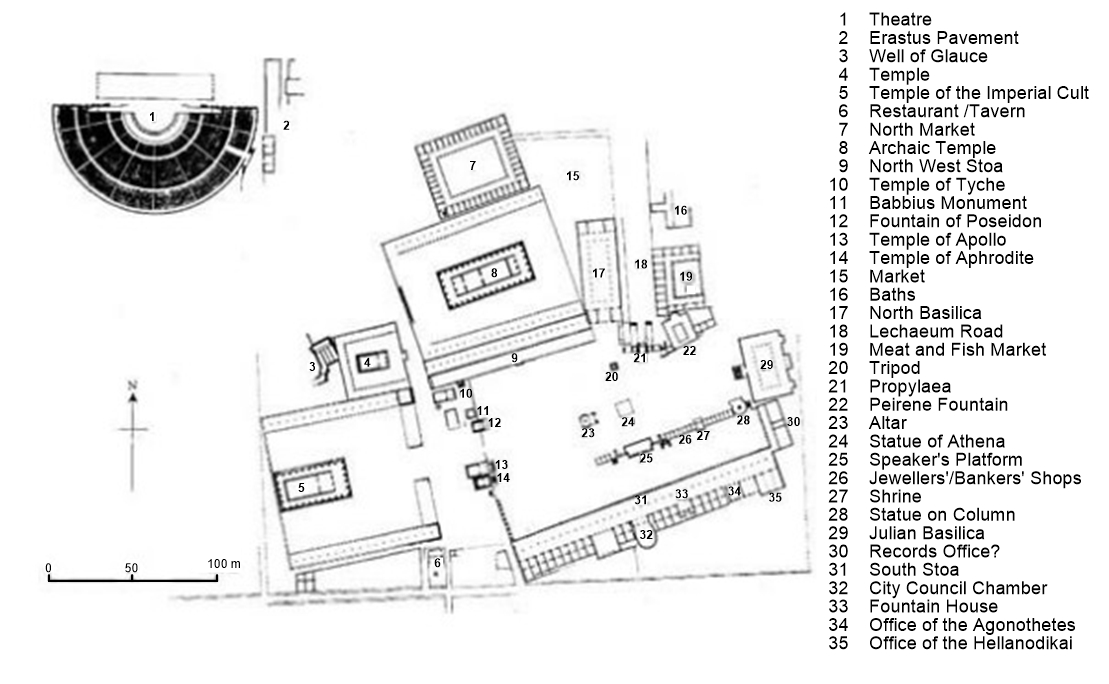
Source: C. K. Williams II, The Corinthia in the Roman Period, Journal of Roman Archeology, Sup. 8, ed. T. E. Gregory (Ann Arbor, 1993) as reproduced in J. Murphy-O'Connor, A Critical Life.
How long did Paul wander the streets of Corinth before meeting Prisca and Aquila? We’ll never know. Perhaps they welcomed him into their workshop, not because they needed help, but because they saw his trade as common ground that would facilitate the conversion of a fellow Jew. One can then imagine their utter surprise upon discovering that they all shared the same faith in Christ.
- The First Converts
Paul writes that “Stephanus and his household are the first fruits of Achaia” (1 Cor 16:15), meaning that he was among his first converts and one of the few whom he baptized (1 Cor 1:15). If it was Paul who made the first converts, this means that Prisca and Aquila were not very successful in their ministry. No doubt they had been traumatized by their experience in Rome and preferred to keep a low profile within the Jewish community in Corinth. Paul’s arrival changed everything and gave them new momentum, so much so that they became the most committed members of the community, even risking their lives (Rom 16:4), preparing for Paul’s arrival in Ephesus (1 Cor 16:19) and in Rome (Rom 16:3).
When we consider that Paul worked out of a small workshop and practiced a trade that the elite despised, it is surprising to note that his first converts were members of high society. The leadership role played by Stephanas and his family implies that he was financially well-off, which enabled him to be part of the delegation sent to Ephesus (1 Cor 16:17). Another of Paul’s converts is Crispus, whom Luke gives the title of archisynagogos, perhaps an honorary title for a benefactor of the community, suggesting that he was wealthy enough to make various donations. Similarly, Gaius (1 Cor 1:14), also mentioned in Rom 16:23 as “my host and that of the whole church,” must have been wealthier than most believers to be able to host all the house-churches of Corinth in a single location.
It is probably no coincidence that Paul’s first converts belonged to the wealthy class, for his practical sense allowed him to grasp that, even though the gospel is offered to all, only people with initiative, financial means, and an education could become effective assistants in its spread. Slaves could be model Christians, but they were not masters of their own time or movement. It is as if Paul had followed Jesus’ method of recruitment, who, in choosing Peter and Andrew, had chosen people with a certain level of education; Andrew, with his Greek name, suggesting a bilingual family. Similarly, these two brothers, working in partnership with James and John, the sons of Zebedee who had employees (Mark 1:20), give us the impression that they were boat owners (Luke 5:1), and had left Bethsaida, their hometown, for Capernaum, the territory of Herod Antipas, to pay less tax on the export of their catch to Magdala. Finally, Peter and Andrew could afford to let their companions fish while they followed John the Baptist without ceasing to financially support their families.
Paul’s attitude toward this core group of wealthy individuals in the Corinthian community was complex. While taking advantage of the benefits they offered him, he refused to become dependent on them. He continued to provide for himself as best he could and supplemented his income with donations from Macedonia, in order to preserve his independence (1 Cor 9:1–18; 2 Cor 11:7–9). This desire to accept only very limited offerings from the believers in Corinth would later become a source of discord.
- Status Inconsistency
Another prominent convert in Corinth was named Erastus (Rom 16:23), whom Paul referred to as the city’s oikonomos. Recall the discovery in Corinth, between the northern market and the theater, of an inscription carved into the pavement and dated between the years 50 and 100, which reads as follows: “Erastus, in exchange for his aedile, paved (this area) at his own expense.” The absence of any mention of a father in the inscription suggests that Erastus was once a slave but is now a freedman. Clearly, Erastus was one of those enterprising freedmen who thrived in the competitive atmosphere of Corinth and who had the necessary funds to hold public office. The standard Greek translation of aedile, however, is agoranomos, not oikonomos, hence the well-founded hypothesis that the latter was the equivalent of the Latin quaestor, a lower-ranking financial position in the municipal hierarchy. Naturally, to attain a higher office, one had to have proven oneself in lower-ranking positions, and the inscriptions reveal that the office of quaestor served as a stepping stone to that of aedile, just as the latter served as a stepping stone to that of duovir.
Erastus was therefore at the beginning of his public career, and clearly, this career was not affected by his Christian faith. We must assume that he found a way to reconcile his monotheistic faith with his duty to participate in the worship of the city’s gods and in city council meetings that involved pagan sacrifice; he was likely among those Paul refers to in 1 Cor 8:4 who had no qualms about eating meat offered to idols, since idols had no real existence.
Despite his success, Erastus likely did not feel entirely at ease among those born free. The prosperous freedman’s sense of insecurity became a favorite theme in literature. The source of this insecurity lay in the bitter awareness of not being recognized for his true worth. There was a sense that contemporaries projected onto reality an unflattering image drawn from other sources. Erastus imagined that those who looked at him saw not the quaestor, but simply a former slave. However, freedmen were not the only ones to feel the unease of an ambiguous status. Phoebe of Cenchreae, although she possessed sufficient wealth to be the patroness of Paul and many others (Rom 16:2), would have been perceived first and foremost as a woman, with the social and political disadvantages that her gender entailed. The Gentile Justus experienced a sense of dissonance within his own society, which led him to attend the synagogue (Acts 18:7). Prisca and Aquila possessed the authority of recognized experts, and Crispus and Sosthenes held important positions, but to their Gentile neighbors, they were first and foremost Jews, living among them by virtue of tolerance.
One of the factors that made the Gospel appealing to these people was that it embodied the paradox they were living. Its central thesis, that the Savior of the world died under torture, echoed the contradictions of their existence. Although considered weak, they knew their own strength and could thus easily grasp the idea, revealed in the life of Christ as well as in that of Paul, that “power is made perfect in weakness” (2 Cor 12:9). Christianity gave meaning to the ambiguity of their lives and, at the same time, integrated them into a society that regarded them first and foremost as human beings, all equal and respected. It offered them a space where they could flourish in complete freedom.
- The Composition of the Community
Paul writes in 1 Corinthians 1:26: “Not many of you were wise by human standards, not many were powerful, not many were of noble birth.” The “wise” refer to educated people who had a reputation for being prudent and moderate and demonstrated sound judgment in politics and business. The “powerful” refer to influential people whose opinions carried weight in civic life. The “noble” refer to those born into the wealth of the aristocracy created by the freedmen sent by Julius Caesar to found Corinth. It goes without saying that these people were a minority both in the city of Corinth and in the Christian community.
The other believers were not so fortunate, but at the same time they were not at the bottom of the social ladder. Among the unidentified members of the household of Stephanas and Crispus, there were most likely slaves (1 Cor 7:21). Despite their legal disadvantages, they enjoyed a standard of living and an education often denied to people born free, and they could exercise their talents once they were freed. Furthermore, slaves were guaranteed room and board.
Tertius’s skills as a secretary (Rom 16:22) placed him on the same level as Tiron, Cicero’s famous secretary. His talent made him a valuable man. If he had not already been freed, he would certainly obtain that status one day. Achaicus (1 Cor 16:17) is a nickname, “the man from Achaia,” and it is therefore more likely that this name belonged to a slave rather than a free man. Clearly, this nickname was acquired outside of Achaia, and its Latin form suggests a rather western origin. In all likelihood, he had been a slave in Italy and had returned to Corinth as a freedman. His participation in the delegation to Ephesus suggests that he was a man of his own time. The same applies to Fortunatus (1 Cor 16:17). Nothing is known about Quartus (Rom 16:23); this name is common among slaves and freedmen.
There is some doubt as to whether Lucius, Jason, and Sosipater (Rom 16:21) belonged to the church in Corinth: were they simply present when the Epistle to the Romans was written? This wording distinguishes them from Timothy, who is presented as Paul’s collaborator. Consequently, they cannot be considered part of Paul’s missionary team. A certain Sopater (perhaps a shortened form of Sosipater) of Berea appears in Acts 20:4 among those accompanying Paul to Jerusalem with the money collected for the city’s poor (cf. 1 Cor 16:1–4). Like Jason, he is explicitly identified as a Jew. The latter may be the one who welcomed Paul in Thessalonica (Acts 17:5–7). The hypothesis that these two men were entrusted with the collection for their respective churches suggests that the same is true of Lucius.
It is unlikely that Chloe’s people (1 Cor 1:11) were from Corinth. The issues they report did not concern matters of concern to the Corinthians themselves, such as divisions within the community. On the contrary, these were deviations from the norm that deeply affected visitors from another church—in this case, Ephesus—and which they would have been eager to discuss upon their return.
Among the members of the Corinthian church, we know the names of 16 people. Two of them (Prisca and Aquila) are married. Two are women (Prisca and Phoebe). Six are explicitly of Jewish origin (Aquila, Crispus, Prisca, Sosthenes, Jason, and Sosipater). Two are certainly Gentiles (Erastus and Justus). From these last two groups of people, one might conclude that Jewish believers were in the majority within the community. However, such an extrapolation is categorically ruled out by the nature of the issues Paul addresses in 1 Corinthians: the use of pagan courts (6:1–11); the frequenting of prostitutes (6:12–20); marriage and sexuality (7); participation in pagan temple meals (8–10); and by his explicit statements that the majority of the community had been idolatrous (6:10–11; 8:7; 12:2). The predominant group within the church in Corinth consisted of people of pagan origin belonging to various middle social classes. Only the highest (the great lords) and the lowest (the field slaves) on this scale were absent. Jews were in the minority, but at least two of them (Crispus and Sosthenes) stood out.
- The First Converts
- A Turbulent Community
The potential for discord within the community was evident. They differed considerably in their level of education, financial resources, religious beliefs, political skills, and, above all, their aspirations. Many of them were drawn to the church because it seemed to offer them a new realm of opportunity, where they could fully utilize the talents that society stifled. They were dynamic and ambitious people, and their motivations, often hidden, differed. A certain spirit of competition was an integral part of the church’s ethos from its very beginnings.
- The Arrival of Apollos
According to Acts 18:24–28, Apollos came to Corinth from Ephesus in the late summer of AD 51. By writing, “I planted, Apollos watered” (1 Cor 3:6), Paul confirms that Apollos carried out a ministry following his own. Paul also tells us that Apollos was with him in Ephesus (1 Cor 16:12). None of this appears in the Acts of the Apostles.
Acts 18:24–28 presents difficulties, for it states that Apollos “taught accurately what concerned Jesus,” but Prisca and Aquila had to explain to him “the Way of God even more accurately” (Acts 18:26). Furthermore, if he knew only John’s baptism, how could he teach accurately? This apparent inconsistency stems from Luke’s theological project regarding the growth of the Church. Moreover, the very fact that Apollos is not rebaptized supports the idea that he was already a fully qualified missionary. Once the editorial additions are removed, the story of Apollos becomes perfectly clear.
Apollos would therefore be from Alexandria. If the Christian faith had reached Antioch to the north and Damascus to the northeast, there is no reason why it could not have also reached Alexandria, Egypt’s great seaport. The ties between Alexandria and Jerusalem have always been very close. We must assume that merchants or pilgrims brought the Gospel to Alexandria. Apollos is described as logos, meaning an eloquent and educated man. Acts 18:24 presents him as an expert in the Scriptures. Now, the Jewish philosopher and theologian Philo lived in Alexandria, who presented the Law from a Hellenistic perspective. There is no doubt that he had a great influence on Apollos. Acts gives us the impression that Apollos arrived in Corinth before Paul returned to Ephesus at the end of August of the year 52, after his departure from Galatia (Acts 19:1).
This scenario easily accommodates the previous letter addressed to the Corinthians (1 Cor 5:9) and written from Ephesus. The occasion was news arriving from Corinth that led Paul to write “not to associate with the sexually immoral.” The simplest hypothesis regarding the bearers of the bad news is that they were Corinthian merchants who had returned to Ephesus at the start of the new trading season, in the spring of AD 53, or Apollos, who could not accept the way he had been opposed by Paul. Clearly, there was no question of divisions within the community, for Paul would certainly have addressed the subject and, in 1 Corinthians, would have reminded the Corinthians that they had disregarded his insistence on the importance of unity for the local church. Divisions must have become a problem in Corinth only after the previous letter was sent. If this is correct, Apollos’s activity in Corinth must have unfolded in two phases. In the first, as reported in Acts 18:28, he was working as a missionary engaged in controversy with the Jews. Faced with the failure of this endeavor, he turned inward and became, in a sense, the theologian of the Christian community.
- Differences within the Community
There was something anti-intellectual about Paul’s preaching, for he emphasized Christ crucified as the model of authentic humanity (1 Cor 2:1–5) and was primarily concerned with the transformative power of grace (2 Cor 3:2). Apollos’s presence introduced a taste for speculation and true theology into the community. By employing Philo of Alexandria’s methods of interpretation and his philosophical framework, Apollos fostered intellectual growth by constructing a rich synthesis of the elements provided by Paul. Being gifted in oratory, he drew certain members of the Christian community to himself, while alienating others who insisted on the bare minimum instilled by the founder, particularly love of neighbor. Thus the group of Apollos’s followers and the group of Paul’s followers were formed. Surprisingly, 1 Cor 1:12 also mentions a third group, the followers of Cephas. This group may have included Jewish converts who found it difficult to integrate into a community made up of people of pagan origin. Even though Cephas probably never set foot in Corinth, his name symbolized a type of Jewish Christian, embodied in Paul’s eyes not by the conservative James, but by Peter, who, under pressure, renounced his freedom. Time had not softened the bitterness of the memory of the incident in Antioch (Gal 2:11–14).
When Paul puts these words into the mouths of the Corinthians: “I belong to Paul. – I to Apollos. – I to Cephas. – I to Christ,” he is not presenting the way people identified themselves, but rather using this as a deliberate critique of their attitude—a rhetorical device of imitation to suggest a strongly condemnatory judgment. Note that the formation of these three groups was facilitated by the fact that the Corinthian church was too large—perhaps forty people—to accommodate everyone in a single house, however large it might be. Instead of lounging comfortably, some were forced to sit under the portico of the atrium. Furthermore, the unequal treatment during the liturgical meal mentioned by Paul in 1 Cor 11:22 highlights another division, already suggested by the allusion to a privileged elite (1 Cor 1:26). Among the believers in Corinth, there were “the wealthy” and “the poor,” and the former showed little or no interest in the latter.
- The Arrival of Apollos
- Contacts with Corinth
At the start of the sailing season in late April 54, Chloe, a wealthy merchant from Ephesus, sent some of her employees to Corinth, where new goods had arrived from the West. It is possible that they took the initiative to contact the city’s Christians, but it is more likely that Paul was the first to seize the opportunity to check in on a church he had not seen in three years. And he had a very clear idea of the problems that could arise when a church was seeking to define itself and reach full maturity. Sexual morality was certainly among the areas they had been asked to evaluate, for Paul must have been concerned about the impact of the Previous letter. The report relayed by Chloe’s relatives stunned Paul. They undoubtedly emphasized the bizarre aspects—an incestuous marriage (1 Cor 5:1–8), male homosexuals presiding over the liturgy (1 Cor 11:2–16), drunkenness during the Eucharist (1 Cor 11:17–34)—but there were other observations, particularly regarding factional divisions, that made Paul realize the situation in Corinth was far more complex than anything he had encountered before.
His first reaction was to send Timothy to investigate, especially since Chloe’s people might have exaggerated the situation. And Timothy had already carried out a similar mission in Thessalonica (1 Thess 3:1–6); he was not only trustworthy but also experienced. Given the urgency of the situation, it is highly likely that Timothy boarded one of the many ships making the journey between Ephesus and Corinth. The duration of the journey is uncertain. It depended on many factors, including fair weather, favorable winds, and auspicious omens. Two weeks for the round trip was likely the minimum for Timothy. He could hardly have spent less than fifteen days in Corinth. We can therefore reasonably assume that he was away from Paul for six weeks, probably from early May to mid-June.
At the beginning of this period, a delegation consisting of Stephanas, Fortunatus, and Achaicus (1 Cor 16:15–17) arrived from Ephesus, bearing a letter in which the church in Corinth sought Paul’s advice on several matters (1 Cor 7:1). The presence of this delegation meant that all the information Paul had hoped to obtain through Timothy was now immediately available, and from a representative source. He had access to people capable of speaking with authority about the state of the community and its problems, and thus of confirming or refuting the rumors circulating among Chloe’s disciples. Paul was therefore able to formulate his response, not only to the questions the Corinthians were asking, but also to the aspects of their lives he deemed problematic. He did so in the letter we know as 1 Corinthians, written before June 2, the date of Pentecost (1 Cor 16:8), in the year 54.
- The Kaleidoscope Letter
In 1 Corinthians, Paul addresses the various problems in Corinth one by one and answers the questions raised. He presents a coherent argument aimed at showing the Corinthians that the factionalism they were engaging in was not beneficial to them; he constantly urges them to live in harmony. Finally, he focuses primarily on the attitude and behavior of a particular group in Corinth—the so-called “spiritual” people—to whom he devotes 13 of the letter’s 16 chapters.
- The Influence of Apollos
1 Corinthians 1–4 introduces us to a group whose members believe themselves to be perfect because of their “wisdom” (2:6). Possessors of “the Spirit who comes from God” (2:12), they consider themselves “spirit-people” (2:15). They see themselves as “filled with divine blessings,” “rich,” “kings” (4:8), “wise,” “strong,” and “honored” (4:10). They despise other members of the community who have not attained their elevated spiritual status, regarding them as “children” incapable of drinking anything but “milk” (3:1), and as “fools,” “weak,” and “dishonored” (4:10). The language used by this group reflects the distinction established by Philo between the heavenly man and the earthly man. All the key elements mentioned appear in two passages from the same work by the Alexandrian philosopher, the De Sobrietate (9–11 and 55–7). We may therefore reasonably assume that other elements essential to Philo’s conception of the heavenly man and the earthly man were also part of the religious vision of the “spirit-people,” and that Paul has them in mind when he refutes such arguments.
The body was a fundamental point of disagreement between the heavenly man and the earthly man. The wisdom of the former revealed to him that “the body is evil by nature and treacherous toward the soul” (Legum Allegoriarum 3.71), whereas the earthly man was “in love with his body” (Legum Allegoriarum 3.74). If the body is “a conspirator against the soul, a corpse and always dead” (Legum Allegoriarum 3.69), it is natural to conclude that the “spirit-people” were those who denied the resurrection (1 Cor 15:12). Death, from their perspective, was a liberation from the burden and defilement of the body (De Somniis 148). Regaining one’s body after death would have made no sense. It is therefore highly unlikely that the “spirit-people” could have accepted Paul’s preaching about the risen Jesus in the sense that he intended it. Perhaps they conceived of him as a purely spiritual “Lord of Glory” (1 Cor 2:8). In accordance with their sapiential conception, they were theists, and whenever Paul addresses them, he must remind them of the importance of Jesus Christ (1 Cor 2:16; 3:23; 8:6; 10:16; 15:3–5). When Philo’s contempt for the body is linked to his adage that “only the wise man is free” (De Posteritate Caini, 138) — meaning that “he has the power to do anything and to live as he pleases ” (Quod omnis probus liber sit, 59), we see in this the foundation of the Corinthian slogans “everything is permissible for me” (1 Cor 6:12; 10:23) and “every sin a man commits is outside the body” (1 Cor 6:18). Their belief in the moral insignificance of the body allowed believers to satisfy their sexual desires (1 Cor 5:1–8; 6:12–20) and to eat whatever they desired (1 Cor 8–10).
The importance that some Corinthians attached to glossolalia (1 Cor 12–14) fits into this context, given that, for Philo, possession of the prophetic spirit was expressed through ecstasy, madness, and inspired frenzy, since “the spirit is driven out upon the arrival of the divine spirit ” (Quis rerum divinarum heres sit, 264–265). Regarding speaking in tongues, Paul specifically mentions “madness” (1 Cor 14:23) and the inactivity of the spirit (1 Cor 14:14). This mysterious and unintelligible speech reinforced the conviction of the “spirit-people” that they were superior.
Who could have spread the Philonic philosophy within the community? The answer is clear: Apollos. What he said, however, and what his disciples understood were not necessarily the same. If they misinterpreted Paul’s words so badly, it is unlikely that they understood Apollos correctly. Certainly, Paul’s dispute concerned the practical implications of their interpretation of Apollos, rather than Apollos’s personality or teaching (1 Cor 16:12). Indeed, it is possible that Apollos left Corinth to go live with Paul in Ephesus, dismayed by the way his teaching was being used.
- An Unfortunate Strategy
Paul’s understanding of the situation in Corinth reinforced his bias against speculative theology. And instead of getting to the root of the problem and trying to understand the legitimate aspirations of the “spirit-people,” Paul chose to ridicule them. Why did he act this way? The most important factor is probably the influence Apollos wielded in Corinth, which cast a shadow over Paul’s leadership. Thus, in writing chapters 1–4 of his letter, his goal is to mystify these “spirit-people” and thereby reduce them to a confused silence, amid the laughter of all who hear the letter read aloud. He achieves this by appropriating some of the most precious terms from the lexicon of the spiritual and assigning them a meaning radically opposed to the one they give them. He concedes that they are “spiritual” and possess “wisdom,” but their spirit is “the spirit of the world” (2:12) and their wisdom “the wisdom of this age ” (2:6). He accepts their self-description as “mature” only to redefine it as childishness (3:1). Those who set themselves up as judges prove themselves incompetent (2:14). The infallible precision with which he probes the heart of their beliefs is inexplicable without the help of Apollos, who was with him at the time of writing (1 Cor 16:12). The piercing tone of mockery bursts the bubble of their self-importance.
The rhetorical questions of biting irony that conclude this first section (3:3–4) reappear in 4:7: “Who distinguishes you from others? What do you have that you did not receive?” These spiritual beings possess no qualities that could make them valuable allies or supporters. They receive, and create nothing. The contemptuous tone intensifies when Paul mocks them by taking their spiritual language literally, thereby transforming their legitimate religious aspirations into absurd social achievements. One can easily imagine the stifled laughter of the assembly and the mischievous glances exchanged as the reader of the letter emphasizes these words: “Without us, you have become kings! And if only you were reigning, so that we might share power with you!” (4:8). It seems quite likely that those claiming to be possessed by spirits came mainly from the wealthiest and most educated circles of the Corinthian church. They were the ones who had the leisure and the capacity to indulge in religious speculation.
The tone of this letter likely offended the sensitive souls who felt Paul had gone too far. And the “spirit-people,” wounded and humiliated, became his implacable enemies. Unable to attack him directly, they channeled their pain and anger by attacking his ambitions for the community. Shortly after receiving the letter in Corinth during the summer of AD 54, they offered hospitality to those whom Paul feared as the greatest threat to his ministry—the Judaizers from Antioch, who had troubled the churches in Galatia.
- A Feast of New Insights
Despite his efforts to disparage the “spirit-people,” Paul could not ignore their views, which forced him to reflect on issues that had not previously caught his attention. The Corinthians had the merit of trying to put into practice in their daily lives the Gospel they had received, even if they made mistakes. Paul therefore engages in a dialogue with them on issues concerning the means of ministry, communal and personal freedom, the very nature of the Christian community, and the role of women in the Church.
- Transformed by Grace
His break with the church in Antioch had forced Paul to reflect on the nature of ministry. But it was the opposition that some Corinthians had drawn between him and Apollos that led him to examine and evaluate the differences between them. Was ministry primarily a matter of style? Why did some choose one, and others the other?
The fundamental insight is expressed with exemplary simplicity: “For the kingdom of God is not a matter of talk but of action” (1 Cor 4:20). The Church is not a collection of ideas that fill the mind, but the divine power that transforms the person. Therefore, ministry does not need to resort to rhetorical devices to develop persuasive arguments, but must rather manifest the presence of the Spirit given by pure grace. Faith is not the conclusion of a logical argument, but arises from the vision of God at work here and now. The minister assumes the responsibility of being where God is at work; his conduct must be such that it reveals the power of grace. He must be able to say, “Follow my example” (1 Cor 4:17; 11:1).
The need to define his relationship with Apollos leads Paul to present the minister as “God’s co-worker”: God has chosen instruments through which he brings about and sustains faith (1 Cor 3:5–9), and it is God who assigns each person their role according to his will. Therefore, it is essential that all ministers cooperate together, and any inappropriate behavior nullifies the cross of Christ (1 Cor 1:17). Likewise, the entire community is called to play the role of witness in the proclamation of the gospel. This is why, after addressing divisions within the community (chapters 1–4), Paul develops a coherent three-part section, whose central theme is the importance of the Church as the place where commitment to Christ takes on its full meaning (chapters 5 and 6). The key section is the one devoted to lawsuits (6:1–11). His point is not that the church should hide its problems from unbelievers, but that it should seize the opportunity to demonstrate the power of grace to unbelievers by resolving these disputes itself. If it is not missionary, the church betrays itself. The world needs to see grace at work.
- Personal and Communal Freedom
A distinctive feature of Paul’s intervention in the case of an incestuous marriage in Corinth is his emphasis on his spiritual presence within the community gathering:
For I, though absent in body, am present in spirit, and as if present I have already pronounced judgment in the name of the Lord Jesus on the man who has done such a thing. When you are assembled and my spirit is present with the power of our Lord Jesus, you are to hand this man over to Satan for the destruction of the flesh, so that the spirit may be saved in the day of the Lord. (1 Cor 5:3-5)
Previously, when dealing with a case of disorder in the community (2 Thessalonians 2:14), Paul asked that contact with that person be avoided. Now, he recommends outright excommunication. Note, however, that for Paul, the community is responsible for its own integrity, and he leaves the final decision to them. All he can do is offer his opinion and vote in a spirit of prayer during the community council.
This is the same attitude he takes in the case of disorder in the Eucharist (1 Cor 11:17–24). Without telling the community how to resolve the problem, he points out to them that, due to a lack of charity, their communal meal cannot be the Lord’s Supper. He invites everyone to examine themselves: “Whoever eats and drinks without discerning the body eats and drinks judgment on themselves” (1 Cor 29). For interpersonal relationships are crucial in this meal.
What applies to the community also applies to individuals, and this is the case for those who eat meat offered to idols (1 Cor 8). Even though he does not agree with their positions, he does not give orders, but merely states what he, Paul, would do: “If food causes my brother to stumble, I will never eat meat again, so that I may not cause my brother to stumble” (1 Cor 8:13).
It is regrettable that Paul did not adopt the same attitude toward the “spirit-people.” Perhaps the situation in Corinth would have been quite different.
- The Body of Christ
In Galatians 3:27 (“For all of you who were baptized into Christ have clothed yourselves with Christ”), Paul has only a vague sense of Christian unity, but it is in confronting the factions in Corinth that his understanding of the Christian community as the “body of Christ” will unfold in all its power. In the first part of his letter, he introduces the name “Christ” four times in contexts where it cannot refer to the individual Christ. But in what sense can a community be called Christ? In fact, believers are the only means through which the risen Lord can act in the world: they are his ears, his eyes, his hands. What Jesus did when he was physically present, believers now do in his name and by his power: they are his agents.
In 1 Cor 12:27 Paul writes: “Now you are the body of Christ, and each of you is a part of it.” We must keep in mind the connotation of physical reality or corporeality in the word “body” to understand Paul’s statement, for he distinguishes between two bodies: the individual body of Christ who lived, died, was raised, and is now in God’s realm, and the ecclesial body composed of believers in whom he dwells on earth through his Spirit. By calling this community the “body of Christ,” Paul identifies it as the physical presence of Christ in the world. The mission of the Church is the extension in time and space of Christ’s ministry by manifesting the power and wisdom of God (1 Cor 1:24).
How the Church exercises this ministry is clarified as follows: “Since there is one bread, we, though many, are one body, for we all partake of the one bread” (1 Cor 10:17). Unlike functional groupings, ecclesial unity is organic, for it not only shares a common purpose but also a common existence. Thus, diversity has meaning only as an expression of fundamental unity, just as a leg can fulfill its role only when connected to the whole body. The believer’s existence consists in the expression of this love that comes from Christ, which implies relationships with one another. This is why Paul can say: “I live, yet it is no longer I who live, but Christ who lives in me” (Gal 2:20).
This understanding of the Church in Paul shapes his view of individuals. Like the arms and legs of the physical body, the members of the Body of Christ are distinguished by their various capacities for service. Each possesses a different spiritual gift, necessary for the common good of the community (1 Cor 12:4–7). The authentically Christian use of the first person singular must always express “I am here to serve you.”
Paul’s vision of the Church as an organic unity has profound implications for his conception of Christian morality. This is why he tells those in conflict: “It is already a defeat for you to have lawsuits among yourselves” (1 Cor 6:7). For a Christian, suing another is equivalent to suing oneself, for they are both members of one body. Would it make sense for the arm to sue the leg? From the same perspective, Paul refuses to consider what is right in itself (for example, eating meat sacrificed to idols) as a sufficient moral rule for believers. The questions a believer must ask are: Will the action in question strengthen or harm others (1 Cor 8:9; 11:29)? Will it contribute to the edification of the community (1 Cor 14:3–5)?
- The Ministry of Women
Paul took it for granted that women served as ministers in the church on an equal footing with men. But given the male-centered context of the time, this attitude met with opposition. Nevertheless, he faced a different situation when Chloe’s people brought him news from Corinth (1 Cor 11:3–10): they were shocked to see the liturgical presiding role taken on by a man—who appeared to be homosexual—and a very strange woman. To understand this situation, we must recall one of the themes of Paul’s preaching: “There is no longer Jew or Greek; there is no longer slave or free; there is no longer male and female; for you are all one in Christ Jesus” (Gal 3:28). In a move typical of an infantile mindset, some Corinthians decided to take such a phrase literally and strove to blur the distinction between the sexes! They reportedly adopted hairstyles considered unmanly and unfeminine for the time, and regarded incest as normal (1 Cor 5:1–2).
Paul’s response to the Corinthians is based on Gen 2:21–22 (the creation of woman from one of man’s ribs). From this passage he deduces that gender difference is part of God’s plan for humanity and must be preserved. Therefore, a man should look like a man, and a woman like a woman. Of course, all this depends on the fashion of each era: in Paul’s time, men had short hair, while women, with long hair, braided it and wound it around the top of their heads to form a small headdress. But immediately, Paul hastens to add that man and woman are inseparable from one another and that “though woman was taken from man, man is born of woman, and everything comes from God” (1 Cor 11:11–12). This passage is the first and only explicit defense of women’s full equality in the New Testament: Paul reverses the chronological priority of man in the creation account by highlighting the priority of woman in the birth of man and considering this fact as part of God’s plan. What is at stake here is not their complementarity, but their equality. All of this provides the central argument to show that 1 Cor 14:34–35, which demands that women remain silent in the assembly, is not Paul’s own writing but stems from a later addition by a scribe who sought to harmonize Paul’s thought with the non-Pauline text of 1 Tim 2:11–14.
- Transformed by Grace
- The Influence of Apollos