Establishing the text: textual criticism
- Manuscripts
- Manuscripts Family
- A methodical approach to textual criticism
- Examples of textual criticism analysis
The aim of this task is to find out what was the original version of the gospel text, i.e. the autograph text, when it left the pen of the final editor to be transmitted. Before the invention of the printing press by Gutenberg in 1454, texts were copied by hand by copyists, and as error is human, these copyists could make careless mistakes, and the boldest would even take the liberty of modifying the text they were copying because they suspected an error or added their own theological touch. Let us take the example of the copy of 1 Clement in the Codex Alexandrinus. The text is full of errors: some words are spelled in four different ways; letters are sometimes omitted and sometimes doubled; there are errors in the endings. It gives the appearance of a text written by a scribe under dictation, without paying much attention to what he was doing.
N.B. Raymond E. Brown's excellent introduction to the subject should be consulted.
- Manuscripts
For the period from the 2nd to the 15th century, 6,014 manuscripts have been found (Tommy Wasserman, Manuscripts and the Making of the New Testament, Cambridge University Press, 2023):
- 141 papyri, identified with the letter P, followed by a number;
- 324 uncials, manuscripts written in capital letters, the most important of which are identified with a letter of our alphabet, or of the Greek or Hebrew alphabets, followed by a numeral;
- 2,538 minuscules, identified by a number only, with the exception of two families of minuscules, f1 and f13, each grouping a certain number of manuscripts;
- And 2,538 lectionaries used for liturgical celebrations.
A non-exhaustive list of these manuscripts can be found in The Greek New Testament published by the American Bible Society.
P52  We have no original manuscripts of either the Gospels or the other New Testament writings. The earliest is P52, dated to around 125 AD, containing seven lines from Jn 18:31-33, barely 25 or 30 years after the gospel was first published. Some other manuscripts are very old, such as P104 (a few lines of Mt 21:34-37) from the middle of the 2nd century, P90 (a few fragments of Jn 18:36 - 19:7) or P98 (fragments of Rv 1:13 - 2:1) from the end of the 2nd century. We have more manuscripts dating from the 3rd century, but it's from the 4th century onwards that we find the largest and most complete uncials on which biblical scholars rely heavily today. Let's mention the five main ones:
Codex Vaticanus  The codex Vaticanus, known by the acronym B or the number 03, housed in the Vatican Library and dating from the period 325-350, contains the Greek translation of the Old Testament, known as the Septuagint (on the Septuagint, see the Glossary), and the Greek text of the New Testament. It consists of 759 leaves, written in three columns, with 42 lines per column, except for the poetic books, which are written in two columns. Unfortunately, the first 20 leaves are missing (Gen 1:1 - 46:28a). It contains all the Septuagint texts except the four books of the Maccabees, and all the New Testament books except 1-2 Timothy, Titus, Philemon and Revelation. It should be noted that the version of the Gospel according to Mark stops at Mk 16:8, and this codex does not contain the sections Mk 16:9-20 (post-resurrection scenes) and Jn 7:53 - 8:11 (account of the adulterous woman).
Below we offer as an example Mt 14:22-24 taken from the Vaticanus manuscript. In the left column, you will find the image of this column in the Vaticanus. In the center column, we present a facsimile of the image, given that the text of the Vaticanus is not always very legible. Note that the Greek text of the manuscript is written entirely in capital letters, with no spaces between words and no punctuation, just as it has no chapter or verse numbers, which appeared much later. Note also that the Greek letter Σ is written as C in the Vaticanus. In the right-hand column, we have included the text from K. Aland's New Greek Testament. There are two differences to note. First, in K. Aland's text, the word (αυτου) is in parentheses because it is a word from the Vaticanus (in red) which, according to Aland, does not reflect the original text and which he did not include in his edition. Second, in K. Aland's text, the word [τὸ] is in square brackets because it does not appear in the Vaticanus, but Aland, based on other manuscripts, believes that the Vaticanus omitted it either through carelessness or because the copy he used as a basis did not contain it.
Image from the Vaticanus of Matthew 14:22-24 Facsimile Text from Greek New Testament of K. Aland, v. 28 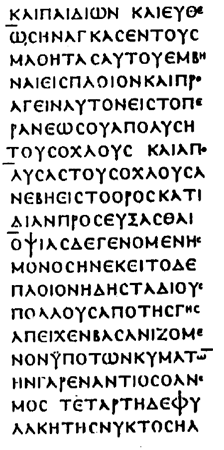
ΚΑΙΠΑΙΔΙΩΝ ΚΑΙΕΥΘ
ΕΩΣΗΩΑΓΚΑΣΕΝΤΟΥΣ
ΜΑΘΗΤΑΣΑΥΤΟΥΕΜΒΗ
ΝΑΙΕΙΣΠΛΟΙΟΝΚΑΙΠΡΟ
ΑΓΕΙΝΑΘΤΟΝΕΙΣΤΟΠΕ
ΡΑΝΕΩΣΟΥΑΠΟΛΥΣΗ
ΤΟΥΣΟΧΛΟΥΣ ΚΑΙΑΠΟ
ΛΥΣΑΣΤΟΥΣΟΧΛΟΥΣΑ
ΝΕΒΗΕΙΣΤΟΟΡΟΣΚΑΤΙ
ΔΙΑΝΠΡΟΣΕΥΞΑΣΘΑΙ
ΟΨΙΑΣΔΕΓΕΝΟΜΕΝΗΕΣ
ΜΟΝΟΣΕΝΕΚΕΙΤΟΔΕ
ΠΛΟΙΟΝΗΔΗΣΤΑΔΙΟΥΣ
ΠΟΛΛΟΥΣΑΠΟΤΗΣΓΗΣ
ΑΠΕΙΧΕΝΒΑΣΑΝΙΖΟΜΕ
ΝΟΝΥΠΟΤΩΝΚΥΜΑΤΩ
ΗΝΓΑΡΕΝΑΝΤΙΟΣΟΑΝΕ
ΜΟΣ ΤΕΤΑΡΤΗΔΕΦΥ
ΛΑΚΗΤΗΣΝΥΚΤΟΣΗΛκαὶ παιδίων. 14, 22 Καὶ εὐθέως
ἠνάγκασεν τοὺς
μαθητὰς (αυτου) ἐμβῆναι
εἰς [τὸ] πλοῖον καὶ προάγειν
αὐτὸν εἰς τὸ πέραν,
ἕως οὗ ἀπολύσῃ
τοὺς ὄχλους. 23 καὶ
ἀπολύσας τοὺς ὄχλους
ἀνέβη εἰς τὸ ὄρος κατʼ
ἰδίαν προσεύξασθαι.
ὀψίας δὲ γενομένης
μόνος ἦν ἐκεῖ. 24 τὸ δὲ
πλοῖον ἤδη σταδίους
πολλοὺς ἀπὸ τῆς γῆς
ἀπεῖχεν βασανιζόμενον
ὑπὸ τῶν κυμάτων,
ἦν γὰρ ἐναντίος ὁ ἄνεμος.
τετάρτῃ δὲ φυλακῇ
τῆς νυκτὸς ἦλθενCodex Sinaticus  The codex Sinaiticus, designated by the first letter of the Hebrew alphabet א or the number 01 and discovered by the biblical scholar Tischendorf in 1844 during a visit to the monastery of St. Catherine in Egypt's Sinai desert, is dated to the period 330-360; 347 leaves of the codex are preserved in the British Library, and 43 leaves in the library of the University of Leipzig. It probably originally contained all the books of the Septuagint, but unfortunately not all have survived the test of time. Thus, the following writings appear in fragmentary form: Genesis, Leviticus, Numbers, Deuteronomy, Joshua, Judges, 1 Chronicles, Ezra, Nehemiah, the Twelve Minor Prophets, Ezekiel, Lamentations, and the following books are missing: Ruth, 1-2 Samuel, 1-2 Kings, 2 Chronicles, 2 and 3 Maccabees. As for the New Testament books, they appear in their entirety, and two more have been added: the Epistle of Barnabas and the Shepherd of Hermas. It should be noted that Mark's version of the Gospel stops at Mk 16:8, and does not include Mk 16:9-20 (post-resurrection scenes) and Jn 7:53 - 8:11 (story of the adulterous woman).
Codex Alexandrinus 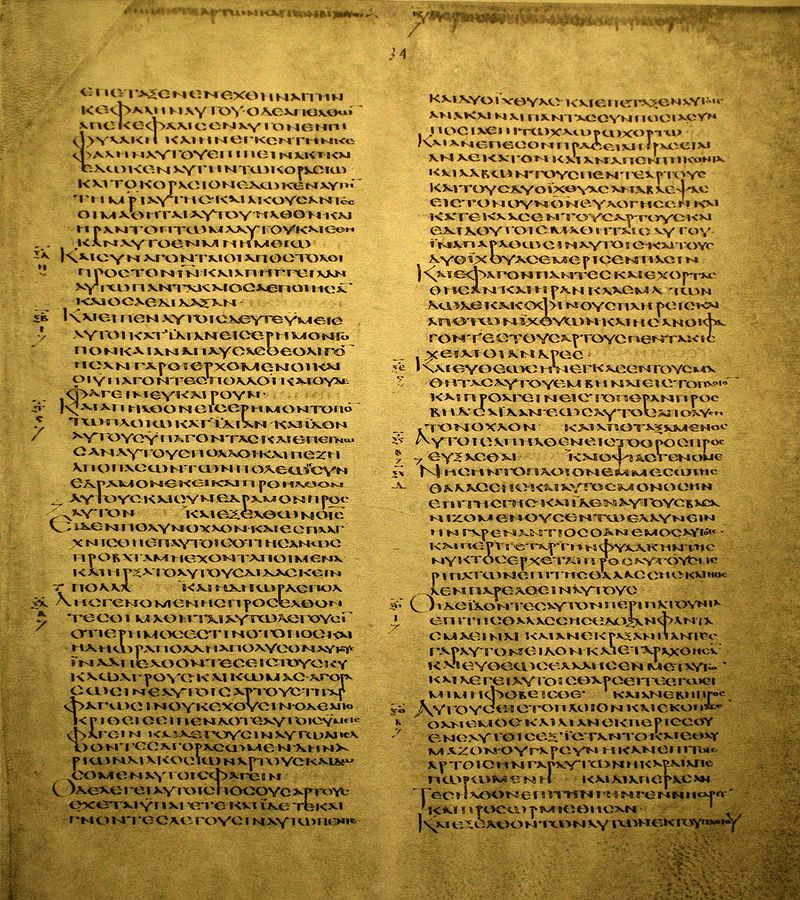 The codex Alexandrinus, designated by the letter A or the number 02, dates from the period 400-440. Its name derives from the fact that it was kept for many years in Alexandria, Egypt, before being transported to Istanbul and then to London at the British Library. It consists of 773 leaves divided into four volumes. Three volumes contain the Septuagint text, with 10 leaves missing. The fourth volume contains the New Testament, with 31 lost leaves concerning 1 and 2 Clement, so that chapters 56, 6 to 58, 4 of 1 Clement and the end of 2 Clement from chapter 12, 5 onwards are missing. But leaves that have survived the test of time are sometimes damaged, and so the texts of Genesis, Leviticus, Sirach, 1 Samuel, Psalm, Matthew, John, 2 Corinthians, 1-2 Clement are sometimes fragmentary; the pages on Revelation are trimmed at the edges. Note that Jn 7:53 - 8:11 (account of the adulterous woman) is absent from this codex, but it does contain the addition Mk 16:9-20 (post-resurrection scenes).
Ephraemi rescriptus 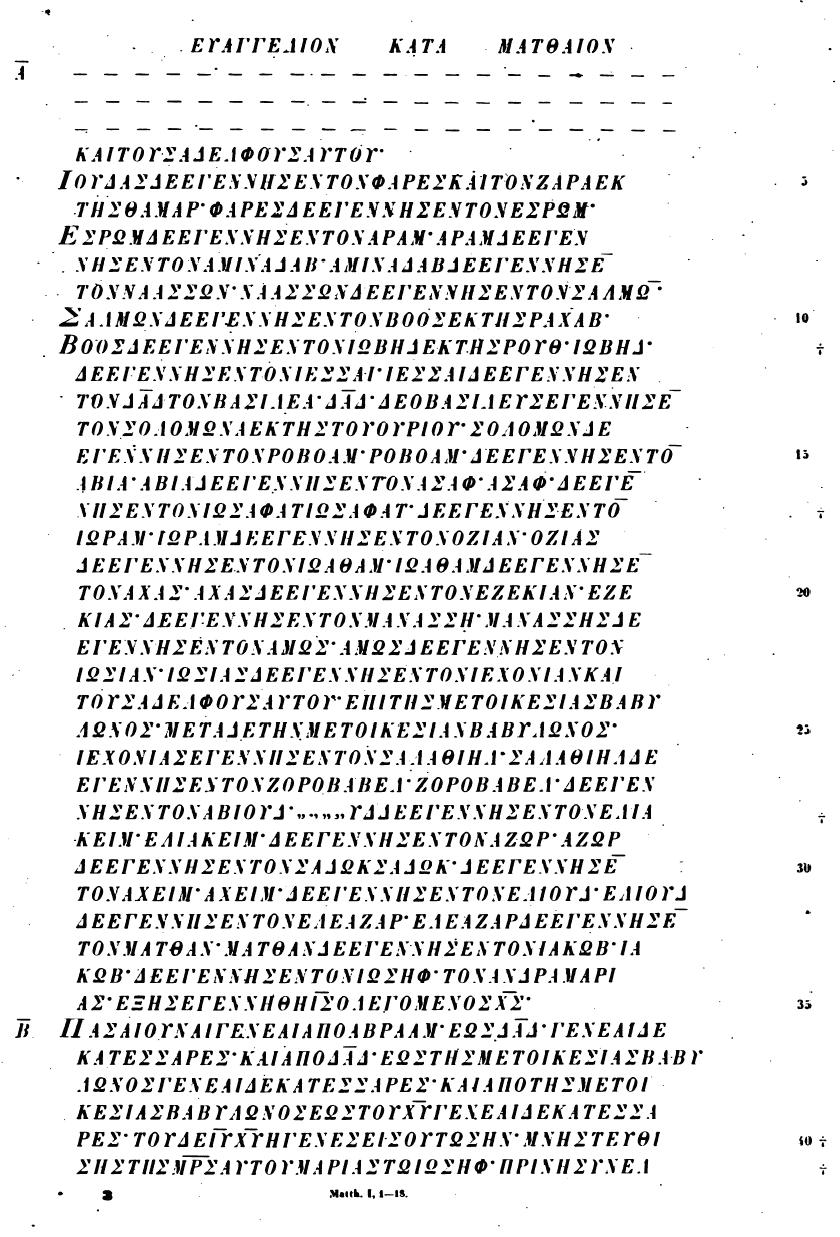 The codex Ephraemi rescriptus, designated by the letter C, or the number 04, is dated circa 450 and housed in the Bibliothèque nationale de France. This codex is a palimpsest, i.e. the original text was scraped out and the Greek translation of the 38 sermons of Ephrem the Syrian was written in its place in the 12th century, hence the name of the codex: rewritten by Ephrem. It was therefore necessary to decode the remnants of the text that had been scratched out. The origin of this codex is unknown (Egypt?), but it is likely that the last corrector worked on the manuscript around 800 AD in Constantinople (Istanbul) and, after it had been reused for Ephrem's treatises in the 12th century, it was found again after the fall of Constantinople in 1453 when a scholar brought it to Florence, and it was Catherine de Medici who offered it as a gift to the King of France, who stored it in the Bibliothèque nationale. It was in the early 18th century that awareness of an ancient text undergoing rewriting began, and the library supervisor began the first readings of what had been scratched out. But it wasn't until the use of potassium ferricyanide to highlight what had been scratched out, and the intervention of Tischendorf, who published a complete version of the codex in 1843, that this was achieved. What about its content? For the Septuagint, only parts of the books of Job, Proverbs, Qohelet, Song of Songs, Wisdom and Sirach have survived. For the New Testament, it contains all the usual books except 2 Thessalonians and 2 John, but some of the books are missing a number of verses. The codex currently comprises 209 leaves (64 for the Septuagint, 145 for the New Testament). Note that Jn 7:53 - 8:11 (story of the adulterous woman) is absent from this codex, but it does contain the addition Mk 16:9-20 (post-resurrection scenes).
Codex Bezae  The Bezae codex, designated by the letter D, or the number 05, dates from the 5th century and is housed in the library of Cambridge University in England. Unlike the previous four, this codex contains only the New Testament, and in a bilingual version: Greek and Latin. It originally comprised 534 leaves, of which 406 have survived. Gaps (absence of a group of verses) are found in Matthew, John and Acts. This codex stands out from the others for its interpolations, remarkable omissions and tendency to paraphrase. The Latin part has retained the form of the old Latin versions that prevailed before 250. Distinctive features of this codex include the long ending of Mark (16:9-20) and an 8% longer version of the Acts of the Apostles. Its origin is disputed. It has been pointed out that it was repaired in the 9th century in Lyon (France) and kept for several centuries in the library of the Saint-Irénée monastery in Lyon. But during the religious wars of the 16th century, the Huguenots ransacked the monastery library in 1563 and entrusted the codex to the Protestant biblical scholar Theodore Beza, who in turn donated it to the Cambridge University Library in 1581.
Despite the great value of these uncials, they are dependent on earlier manuscripts that had been copied, and their value cannot be greater than that of the manuscripts on which they depend. Thus, when we look at the various variants for a particular verse, we cannot simply decide that the reading proposed by one of these five uncials is necessarily the best (i.e. best in reflecting the original text); while we must recognize that they exert a certain weight in the evaluation, other criteria come into play.
- Manuscripts Family
In the early centuries, New Testament manuscripts tended to be copied more and more in the major centers of Christianity: Alexandria, Caesarea, Antioch, Rome, Constantinople (after Constantine's victory). Over time, the variations found in manuscripts were associated with one or other of these centers, giving rise to a classification by family. This resulted in four families: the Alexandrian text, the Western text, the Caesarean text and the Byzantine text.
- Alexandrian text-type
It accounts for a large proportion of ancient manuscripts, and biblical scholars generally prefer this family of texts. Modern translations give it a place of choice. In this family, the text sometimes ends abruptly, like the ending of Mk 16:8, a sign that the copyist did not try to improve this ending. Another feature is its conciseness, a sign that the copyist has not tried to paraphrase the text. Another feature is apparent in the synoptic parallels: the particularities of each evangelist stand out more clearly, a sign that the copyist did not try to harmonize the various versions. Finally, this lack of harmonization or “polishing” of the text means that we are often faced with a reading that is considered difficult to explain.
Which manuscripts belong to this family? You can consult Wikipedia for a suggested list. Of our five uncials, the first four belong to this family (except for the Gospels in the case of the Alexandrinus and Ephraemi rescriptus codices), the exception being the Bezae codex, which belongs to the Western family. Old papyri such as P66 (c. 200, containing much of the Gospel of John) and P75 (c. 200-225, containing parts of Luke and John) also belong to this family. Similarly, the oldest Sahidic Coptic translation belongs to this family. Some early Christian authors reflect this family, such as Origen, Athanasius, Didymus and Cyril of Alexandria.
- Western text-type
The name of this family comes from the fact that the manuscripts were copied in the western part of the Roman Empire (North Africa, Italy, Gaul). But it often serves as a catch-all for several text families. This family is found in the old Latin and Syriac translations of the 2nd and 3rd centuries. It appears mainly in the Gospels, Acts and Paul's epistles, but is absent from the Catholic epistles and Revelation.
This family is characterized by a certain freedom on the part of the copyist, who often takes the liberty of paraphrasing or glossing to accentuate certain points, or to harmonize with other passages, or to complete what seems incomplete. Sometimes the copyist inserts or adds phrases from non-canonical books. The result is a longer text, particularly in the Acts of the Apostles. But there are a few cases where the Western version is shorter, as in the case of certain verses in Luke (ch. 22 and especially ch. 24), known as Western non-interpolation.
A representative of this family for the Gospels and Acts is the codex Bezae. As for Paul's epistles, the codex Claromontanus is the best known. Among ancient authors, Cyprian, Tertullian and Irenaeus of Lyons reflect this type of manuscript. For a list of manuscripts associated with this family, see Wikipedia.
- Caesarean text-type
The family's name comes from the city of Caesarea in Palestine, which had become an important Christian center in the 3rd and 4th centuries, with an impressive library for its time, so much so that Origen settled there around the year 230. Its features are often defined negatively by the fact that its manuscripts belong to no other type of text. There is a slight tendency to paraphrase, but without going as far as the Western text. These features can be found in Origen's quotations after his arrival in Caesarea, and in 5th-century Armenian and Georgian translations.
Wikipedia provides a suggested list of manuscripts associated with this family. Among the uncials is the Korithethi codex (9th century), among the papyri P45 (3rd c.), and among the minuscules the two groups f1 and f13 (11th to 15th c.).
- Byzantine text-type
The name comes from the city of Byzantium, which became Constantinople with the arrival of Emperor Constantine, and replaced Rome as capital of the Roman Empire. It was thus an important center of Christianity. Over time, a kind of standardization of the text took place, ironing out difficulties and harmonizing differences, so that we can speak of a common text, or koinē, which eventually covered 90% of manuscripts and became normative from the 6th century onwards. It is the official version of the Eastern Orthodox Church and was used for all lectionaries. It was used in the Syriac translation of the Peshitta (5th c.), even if here and there we note the influence of other types of text, and in the 6th-century Ethiopian translation. And this is the version used by Erasmus for his edition of the Textus Receptus (received or official text) in 1516. The Byzantine text is echoed in quotations from Gregory of Nyssa, John Chrysostom, Basil the Great and Cyril of Jerusalem. Wikipedia provides a list of manuscripts associated with the Byzantine text. Note that a manuscript can be hybrid, i.e. some of the texts, such as the Gospels, can be assigned to one type, while the others to another.
- Alexandrian text-type
- A methodical approach to textual criticism
Critical apparatus in the Greek New Testament for Luke 7: 10 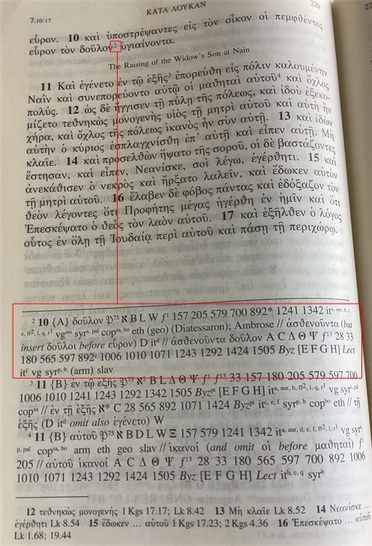 In their analysis, most biblical scholars use the The Greek New Testament published jointly by Deutsche Bibelgesellschaft, American Bible Society, United Bible Societies, edited by Kurt Aland et alii. Now, this edition presents an eclectic version of the New Testament, as the editors have already made choices between the various variants, choices to which they have attached a rating {a}, {b}, {c}, {d} according to the degree of certainty of having made the right choice, {a} designating the highest level of certainty, {d} the lowest. Note that this edition of Greek New Testament is limited to the most important variants. For a more extensive list of variants, use Nestlée-Aland's Novum Testamentum Graece. A methodical approach in textual criticism suggests four steps.
- Establishing variant readings
Variant readings are established using the critical apparatus offered by either The Greek New Testament or the Novum Testamentum Graece. For each verse, these New Testament editions point out the discrepancies between the thousands of manuscripts. It's then a matter of understanding the language of these editions to spot one or more variants, in order to analyze them later.
Let's start with an example from The Greek New Testament. Each variant place is indicated with a numbering that starts at 1 for each chapter of a document. Let's take Mt 14:24, where the number 3 appears in the middle of the verse, after ἀπεῖχεν : τὸ δὲ πλοῖον ἤδη σταδίους πολλοὺς ἀπὸ τῆς γῆς ἀπεῖχεν3 βασανιζόμενον ὑπὸ τῶν κυμάτων, ἦν γὰρ ἐναντίος ὁ ἄνεμος. This number refers to the critical apparatus at the bottom of the page, where the number 3 also appears. This critical appartus displays all the possible variants of this part of the verse, which we have bolded, as well as the manuscripts that support this variant.
Let us now turn to the Novum Testamentum Graece for this same verse, where the variant place is presented thus: τὸ δὲ πλοῖον Oἤδη
Let us give the example of the various readings or versions of the variant reading of Mt 14:24 with their very literal translation. σταδίους πολλοὺς ἀπὸ τῆς γῆς ἀπεῖχεν
 βασανιζόμενον ὑπὸ τῶν κυμάτων, ἦν γὰρ ἐναντίος ὁ ἄνεμος. Here we find three symbols: firstly, the symbol O which means that the following word (ἤδη) is omitted in some manuscripts, then the symbol that signals the beginning of a set of words that ends with the symbol to indicate that this set knows several variants. At the bottom, in the critical apparatus for v. 24, we find the same symbols and the different variants with the manuscripts that support them. Note that in v. 25 we find the symbol
  next to the word ἦλθεν to indicate that only this word knows variants.
- σταδίους πολλοὺς ἀπὸ τῆς γῆς ἀπεῖχεν (several stadia from land was far [the boat].)
- σταδίους πολλοὺς ἀπεῖχεν (several stadia was far [the boat])
- σταδίους τῆς γῆς ἀπεῖχεν ἱκανούς (stadia of the land was far enough [the boat].)
- ἀπεῖχεν ἀπὸ τῆς γῆς σταδίους ἱκανούς (was far [the boat] from the land stadia enough)
- ἀπεῖχεν ἀπὸ τῆς γῆς σταδίους ὡς εἴκοσι πέντε (was far [the boat] from the land stadia about twenty-five)
- μέσον τῆς θαλάσσης ἦν (in the middle of the sea was [the boat].)
- ἦν εἰς μέσον τῆς θαλάσσης (was [the boat] into the middle of the sea)
- ἐκινδύνευεν ἤδη μέσον τῆς θαλάσσης (was in danger [the boat] in the middle of the sea)
A preliminary observation shows that the various readings can be broadly grouped into two categories: those that speak of being several stadia away from land, and those that speak of being in the middle of the sea.
- External Evidence
External evidence search is concerned with the manuscripts that support a variant and their value. The aim is to determine whether it is possible to choose the best variant (the one that best reflects the original version) with a certain degree of probability.
What are the criteria for evaluating manuscripts that support a variant?
- The first criterion is the value of the manuscript, based on its quality. Not all manuscripts are of equal quality. Some manuscripts seem to have been copied quickly by copyists with little schooling, while others were copied with great care by copyists with a good knowledge of Greek. Some copyists thought they were doing the right thing by “improving” the text they had in front of them when a word or expression appeared obscure, while others scrupulously respected the text they were copying. Some manuscripts were revised by a proofreader. The Vaticanus and Sinaiticus codices, more complete than many others and having undergone revisions, have been given greater value by biblical scholars, as have some of the great Uncials (in capital letters) of the 5th and 6th centuries.
- The value of a text is also determined by its age: the older a text, such as that offered by the papyri, the greater its importance; for the more a manuscript is copied through the ages, the greater the likelihood that it will be distorted. This is why minuscule manuscripts are given less value than uncial ones. This is why biblical scholars value the Sinaiticus and Vaticanus codices, which date from the middle of the 4th century.
- Another criterion is the number of manuscripts supporting a particular reading or variant. For example, when a variant is supported by only one or two minuscules, it is unlikely to reflect the autograph version.
- Finally, the manuscript family must be considered in the evaluation criteria. For example, we know that manuscripts belonging to the Western text are more likely to have been altered than those belonging to the Alexandrian text. Similarly, if a variant is only found in one family, and not in the others, it may be considered as a copyist's modification replicated by the descendants of that family.
Very often, the application of all these criteria does not allow us to reach a conclusion with any degree of probability, and it is only with internal evidence that we can reach a decision. Let's take the example of Mt 14:24. Here again is the list of variant readings with the manuscripts that support each of them.
- "several stadia from land was far [the boat]." supported by the Vaticanus (4th c.), family 13 of minuscules (11th to 15th c.), Cureton's Syriac translations (3rd or 4th c.), the Peshitta (early 5th c.) and the Palestinian Syriac translation (6th c.).
- "several stadia was far [the boat]" supported by lectionary 253 (year 1020) and the Sahidic Coptic translation (late 4th c.).
- "stadia of the land was far enough [the boat]" supported by the minuscule 700 (11th c.).
- "was far [the boat] from the land stadia enough" supported by the Koridethi codex (9th c.), and Georgian (5th c.) and Armenian (5th c.) translations.
- "was far [the boat] from the land stadia about twenty-five" supported by the Coptic Bohemian translation (3rd c.) and the Ethiopian translation (6th c.).
- "in the middle of the sea was [the boat]" supported by the codexes Sinaiticus (4th c.), Ephraemi rescriptus (5th c.), Regius (8th c.), Washingtonianus (4th or 5th c.), Sangallensis (9th c.), 073 (6th c.), 0106 (7th c.), minuscules family 1 (10th to 14th c.), as well as minuscules 28 (11th c.), 33 (9th c.), 157 (year 1122), 180 (12th c.), 205 (15th c.), 565 (9th c.), 579 (13th c. ), 597 (13th c.), and many others, Byzantine uncials from the 6th to 9th centuries, most lectionaries, old Latin translations: Vercelli (4th c.), Aureus Holmiensis (7th c.), Verona (5th c.), Colbertinus (12th c. ), and several others, the Vulgate (late 4th c.), the Syriac translation Harklensis (year 616), Slavonic (9th c.), and certain Ethiopian translations (6th c.), and by Origen (185-253), John Chrysostom (347-407), Jerome (342-420) and Augustine (354-430).
- "was [the boat] into the middle of the sea" supported by the Codex Bezae (5th c.), some old Latin (5th c.), Coptic (5th c.) and Ethiopian (6th c.) translations, and by Eusebius of Caesarea (260-339).
- "was in danger [the boat] in the middle of the sea" supported by the minuscule 1546 (year 1263).
Let's try to apply our criteria.
- Consider the number of manuscripts supporting a reading. Clearly, reading vi. outclasses all the others, with over fifty manuscripts supporting it. This reading presents the idea of being in the middle of the sea. In contrast, five of the eight readings support the idea of being far from land.
- Let's now consider the age of the manuscripts. Readings i., ii., v. and vi. are supported by manuscripts from the 3rd and 4th centuries. In this case, the oldest manuscripts support both the idea of being far from land and that of being in the middle of the sea.
- Consider the value placed on the great codexes Vaticanus and Sinaiticus. The Vaticanus supports the idea of being far from land, while the Sinaiticus supports the idea of being in the middle of the sea.
- Finally, let's consider the family of manuscripts. The Alexandrian texts support both the idea of being far from the earth, through the Vaticanus and the Koridethi codex, and that of being in the middle of the sea, through the Sinaiticus and the Regius codex. The family of Western texts supports the idea of being in the middle of the sea with the codex Bezae. The family of Byzantine texts supports both the idea of being far from land, with family 13 of the minuscules, and that of being in the middle of the sea, with the codex Washingtonianus and Sangallensis. The family of Caesarean texts supports both the idea of being far from land with minuscule 700 and that of being in the middle of the sea with minuscule 1.
Using all these criteria, we can't definitively determine Matthew's original text. Of course, the weight of the number favours reading vi., but the other criteria oblige us to exercise restraint and refer us to internal evidence for the final decision.
- Internal evidence
Searching for internal evidence is an analytical process that attempts to explain, for each variant, what could have happened to make the copyist offer us this reading. The starting point is the assumption that the copyist intervened to introduce a modification to the text he was copying. The most fruitful method in this analysis is to proceed by considering different scenarios.
- A possible scenario explaining this reading is that the copyist wanted to harmonize the text of one evangelist with that of another. Probably he found hard to understand why, for a similar scene, the evangelists' expressions are not the same. Let's not forget that the copyist often imagined that an evangelist was an eyewitness to the scene, describing what he saw.
- Another possible scenario is a careless error: a copyist may skip an article or pronoun when copying a manuscript. Or he may forget a letter in the spelling of a word.
- Another possible scenario is that, faced with an unusual sentence structure, the copyist replaces it with what was customary in his day.
- Another possible scenario is that, faced with an obscure or unclear word or expression, or one that lacks precision, the copyist seeks to clarify things or give more details.
- Another possible scenario is that the text to be copied is dictated orally, in which case the words are copied according to the copyist's known spelling.
- Another possible scenario is that the copyist replaces the expression to be copied with the expression he is used to hearing during the liturgy.
- Another possible scenario is a situation called homoioteleuton, which means “similar endings”. Homoioteleuton occurs when two words/phrases/lines end with the same sequence of letters. The scribe, having finished copying the first, moves on to the second, omitting all words in between; for example, the first sentence begins with “Jesus left...”, and after copying this expression, the scribe looks back at the text to be copied, the second sentence of which, by chance, also contains “Jesus left...”; without realizing it, he continues copying with the second sentence, forgetting the first.
What criteria can be used to select the reading that is likely to be closest to the autograph copy?
- When a reading presents a clear case of harmonization, choose the one where the evangelist's version differs from its parallel.
- Copyists tend to add to the text they are copying, often to clarify or make explicit what is written. For example, a copyist will occasionally add a detail in one evangelist's account that is taken from another evangelist's account, a form of amalgam. In such cases, the principle of lectio brevior is applied: the briefest or most concise reading is chosen.
- Copyists tend to smooth out the text's difficulties and ensure that everything is coherent. With this in mind, we occasionally apply the principle of lectio difficilior probabilior: the most difficult reading is the most likely; indeed, it is more likely that the copyist has added the word we expected than the word we did not.
- Copyists sometimes replace certain Greek words or expressions with those better known in the religious world of their time. A good way to spot these modifications is to master the vocabulary and syntax of an evangelist. This allows us to conclude that it is probably impossible for the gospel to have used a particular word or expression from another literary universe.
- Finally, the copyist may have had a moment's inattention, forgetting an article, an adverb or a pronoun, or, in a case of homoioteleuton, skipping part of a sentence, leaving the text with a limp. In such a situation, we can either use other manuscripts to fill in the gaps, or have recourse to other similar passages by the evangelist to confirm his way of constructing his sentences and the vocabulary with which he is familiar.
Let's apply what we've learned to Mt 14:24.
Let's consider possible scenarios to explain the various readings.
Let's start with category 2 and reading vi. How do we explain that a copyist wrote: “in the middle of the sea was [the boat]?”
- "in the middle of the sea was [the boat]". A copyist knew the parallel passage in Mk 6:47, which begins in the same way as Mt 14:24 (then, [the late hour] having arrived) and where we read: ἦν τὸ πλοῖον ἐν μέσῳ τῆς θαλάσσης (was the boat in the middle of the sea) and therefore decided to harmonize the two passages based on Mark, and so replaced “many stadia from the land was” with “in the middle of the sea was”; this harmonization was justified, as it was the same narrative.
- "was [the boat] into the middle of the sea". For reading vii., either a scribe had reading vi. in front of him and therefore copied it, moving the verb “to be” (ἦν) so it would be at the beginning of the sentence, to imitate Marc, or, like the scribe in reading vi., he has harmonized Matthew's text with Mark's, while respecting Mark's place for the verb to be.
- "was in danger [the boat] in the middle of the sea". For reading viii, either the copyist had reading vi in front of him, or he himself took the initiative of harmonizing with Mk 6:47, and then added a detail from Lk 8:23, the story of the stilled storm, where the wind blows, the boat was submerged, and the disciples “were in danger”.
Let's continue with the first category and reading i.
- "several stadia from land was far [the boat]". If the autograph reading was that around the idea of being in the middle of the sea, a copyist might have wanted to modify this idea and come closer to the text of Jn 6:19, which describes this scene of Jesus walking on the sea, using these words: “They had rowed about 25 or 30 stadia”; he would then have borrowed the word “stadia” from John and replaced the precision of 25 or 30 stadia with “several”, and added the fact that the boat “was distant from the land”. But such a hypothesis is difficult to accept, as we have seen that the idea of being in the middle of the sea is a harmonization from Mk 6:47, and in this case the idea of being several stadia away from the land probably better reflects the autograph version. What's more, if the scribe was seeking inspiration from Jn 6:19, why would he have discarded the precision of 25 or 30 stadia for the vague expression of “several”?
- "several stadia was far [the boat]". The copyist of this reading ii. would have had reading i. in front of him, but finding the expression “from the earth” redundant and unnecessary, would have simply eliminated it.
- "stadia of the land was far enough [the boat]". The copyist of this reading iv. may have been looking at reading i. and would have considered the adjective “several” too vague, replacing it with “enough” to indicate that the boat was “sufficiently” far from the shore to be in a perilous situation, a clarification to explain the presence of wind and waves. In making this change, he also took the opportunity to move the verb to the beginning of the sentence, so as to make the adjective stick to the noun (stades) whose attribute it is.
- "was far [the boat] from the land stadia enough". The copyist of this reading iii. may have had reading i. in front of him, and would have had the same reflex as the copyist of reading iv. in adding “enough”, except that he refused to eliminate the word “several” and change the word order.
- "was far [the boat] from the land stadia about twenty-five". The copyist of this reading v. may have been looking at reading i., and would have found the adjective “several” too vague, especially as Jn 6:19 gave the precision of 25 or 30 stadia; so he borrowed the number 25 from John and, in so doing, moved the verb to the beginning of the sentence to stick the adjective 25 to the noun (stadia) of which it is the attribute.
Once we've completed this exercise, in which we've tried to put ourselves in the scribes' shoes, it remains for us to apply one or other of our four criteria of internal criticism in order to eliminate the unlikely and retain only the most probable.
- According to principle i., when a reading presents a clear case of harmonization, choose the one where the evangelist's version differs from its parallel. In this case, we must eliminate readings vi. to viii. which are cases of harmonization with Mk 6:47, and reading v. where the copyist has harmonized the text with Jn 6:19.
- According to principle ii., the lectio brevior is preferable, as the copyist tends to add details to clarify things. Thus, the briefer readings of i. and ii. are to be preferred to readings iii. and iv. which add the adjective “enough” to the word stade.
Now, how can we distinguish between readings i. and ii. and choose the reading that best reflects the autograph text? For the only difference between the two readings is the absence in reading ii. of the expression “from the land”. Was it part of the original? This brings us to the final stage, where we bring together the results of external and internal evident search.
- The final decision
The internal review left us with two candidates. Let's go back to the external evidence to decide between them. Reading i. is supported by the Vaticanus (4th c.), family 13 of the Minuscules (11th to 15th c.), Cureton's Syriac translations (3rd or 4th c.), the Peshitta (early 5th c.) and the Palestinian (6th c.) Syriac translation. Reading ii. is supported by lectionary 253 (year 1020) and the Sahidic Coptic translation (late 4th c.). This comparison of manuscripts obliges us to opt for reading i., which is supported by one of the most prestigious and oldest codexes, the Vaticanus, as well as by quality manuscripts such as Cureton's Syriac translations and the Peshitta. The criterion of age may also come into play, as the i. reading benefits from the oldest manuscripts. Finally, there's the number of manuscripts: let's remember that family 13 of minuscules comprises 13 manuscripts.
- Establishing variant readings
- Examples of textual criticism analysis
Let's apply the rules we've just enumerated
- Luke 10: 1,17
- Variant readings (v. 1 et 17)
- Μετὰ δὲ ταῦτα ἀνέδειξεν ὁ κύριος ἑτέρους ἑβδομήκοντα δύο (Then, after these things, he appointed the Lord of others, seventy-two)
- Μετὰ δὲ ταῦτα ἀνέδειξεν ὁ κύριος ἑτέρους ἑβδομήκοντα (Then, after these things, he appointed the Lord of others, seventy)
This is a scene from Luke where, in addition to the Twelve, Jesus appoints and sends out other disciples on mission. How many disciples? Some manuscripts refer to 72 other disciples, while others speak of 70. Let's concentrate on Lk 10:1, since v. 17 is an echo of v. 1.
- External evidence
- The reading “Then, after these things, he appointed the Lord of others, seventy-two” is supported by papyrus P75 (3rd c.), codex Vaticanus (4th c.), codex Bezae (5th c.), codex 0181 (4th/5th c.), as well as by several old Latin translations (4th-6th c. ), the Vulgate (4th/5th c.), Coptic (3rd c.), Armenian (5th c.) and Georgian (5th c.) translations, the Diatessaron (2nd c.), Adamantius (4th c.), the Apostolic Constitution (380 c.), Pseudo-Ambrose (4th c.) and Augustine (5th c.).
- The reading “Then, after these things, he appointed the Lord of others, seventy” is supported by the codexes Sinaiticus (4th c.), Alexandrinus (5th c.), Ephraemi Rescriptus (5th c.), Washingtonianus (4th/5th c.), Zacynthius (6th c.), Regius (8th c.), Sangallensis (9th c.) and Augustine (5th c.), Sangallensis (9th c.), Athous Lavrensis (9th/10th c.), families 1 and 13, as well as a considerable number of manuscripts in minuscule (11th to 15th c.), manuscripts from the Byzantine tradition such as uncials 07 (8th c.), 011 (9th c. ), 013 (9th c.) and 022 (6th c.), some Latin translations (5th-7th c.), Syriac (5th-7th c.) and Coptic (3rd c.), Ethiopian (6th c.), Slavonic (9th c.), as well as the testimony of a number of Church Fathers such as Irenaeus of Lyon (2nd c. ), Clement of Alexandria (2nd/3rd c.), Origen (3rd c.), Eusebius of Caesarea (4th c.), Basil the Great (4th c.), Cyril of Alexandria (5th c.), Theodoret (5th c.), Tertullian (3rd c.), Ambrose (4th c.) and Jerome (4th-5th c.).
Let's apply our criteria.
- Let's consider the quality of the manuscripts, bearing in mind that biblical scholars give priority first to the two prestigious manuscripts, Vaticanus and Sinaiticus, and then to the other major codices. Reading i. is supported by codex Vaticanus, codex Bezae and codex 0181, while reading ii. is supported by codex Sinaiticus, codex Alexandrinus, codex Ephraemi Rescriptus, codex Washingtonianus, codex Zacynthius, codex Regius, codex Sangallensis and codex Athous Lavrensis. Both readings are therefore supported by quality codexes, even if they are slightly more numerous in reading ii.
- In terms of age, reading i. is supported by manuscripts from the 2nd, 3rd and 4th centuries, while reading ii. is supported by manuscripts from the 4th and 5th centuries, as well as by the testimony of the Church Fathers, some of which date back to the 2nd century. The support of papyrus P75 (3rd c.) may give a certain advantage to reading i., but the fact remains that both readings benefit from a certain antiquity.
- In terms of the number of testimonies, both readings are widely supported, although mathematically, reading ii. seems to predominate.
- Both readings are supported by the various manuscript families. The family of Alexandrian texts is present in reading i. through papyrus P75, codex Vaticanus and codex 081, and in reading ii. through codex Sinaiticus and codex Regius. The family of Western texts is represented in reading i. by the codex Bezae, and in reading ii. by Irenaeus of Lyons and Tertullian. The family of Caesarean texts does not seem to be present in reading i., but it is present in reading ii. through the family of minuscule f1 and f13, as well as 28, 565 and 700. Finally, the Byzantine text family does not appear to be present in reading i., but is present in reading ii. through the Alexandrinus, Ephraemi rescriptus, and Washingtonianus codexes.
With these criteria, the readings are almost of equal value. Some might acknowledge a slight prevalence to reading ii. due to the number of manuscripts and its presence in all text type families. But on the other hand, the great value of the testimony of papyrus P75, Tatian's Diatessaron and the Apostolic Constitution would point others in the direction of a preference for reading i. Nevertheless, all this is insufficient to make a final decision.
- Internal evidence
Before considering the various possible scenarios to explain either the number 72 or the number 70, we need to try and understand where these two numbers come from.
According to the Hebrew version of Gn 10, only Noah and his sons survived the flood that wiped out the entire earth. Yet all the nations of the world were born from Noah's three sons. Now, if we count the nations begotten by Noah's first son, Shem, and his descendants, we get the figure 27; and if we do the same with Noah's second son, Ham, we get the figure 11, and finally, if we do the same with the third son, Japheth, we get the figure 32. And so, if we add up the nations from which Noah's three sons originated, we get 70 nations. On the other hand, when we read Gen 10 according to the Greek translation of the Septuagint, Shem would be the origin of 27 nations, Ham would be the origin of 30 nations, Japheth would be the origin of 15 nations. And if we add up the Septuagint version, we get a total of 72 nations.
How do you choose between 70 and 72? It's clear that, for Luke, this second sending, after that of the Twelve, is no longer addressed to the Jews, but to all the nations of the world. Now, how many nations does the Bible say there are in the world? According to the Hebrew Bible, the number is 70; according to the Septuagint version, the number is 72. The following scenarios are therefore conceivable.
- One possible scenario is that Luke, rooted in his Greek culture and a regular visitor to the Septuagint, recorded the number 72 as the total of the nations according to the Septuagint. A copyist with a Jewish culture and knowing that in this milieu the total of nations is 70, would then have replaced the number 72 with 70.
- Conversely, it's possible that Luke, through Paul or other Jews, knew that in Judaism the total number of nations was 70, and so for him this is the number of the other disciples who were sent out. However, a copyist familiar with the Septuagint and unaware of Jewish tradition would have replaced the number 70 with 72.
- A final possible scenario is that of an oversight. In fact, Luke would have written: ἑβδομήκοντα δύο (seventy-two), but the copyist would have forgotten to copy the final δύο.
The first three criteria for internal criticism that we established earlier are difficult to apply in this situation. Firstly, as there is no parallel text, this cannot be a case of harmonization. Secondly, this is not a case of clarification where the principle of lectio brevior must be applied. Finally, this is not a case of difficult text, where the principle of lectio difficilior probabilior must be applied. We could apply our fifth criterion by assuming that we are faced with a case where a scribe forgot to copy δύο; however, given that the number 70 is justified as the number of nations, it seems unlikely to us that this is a case of forgetfulness. This leaves us with the fourth case, where a copyist makes a change because of his religious or cultural background. Using this criterion, it seems more likely to me that Luke the Greek, familiar with the Septuagint, inscribed the number 72 as the number of disciples sent to all nations, and that it was a scribe who, as early as the 2nd century (as Irenaeus of Lyons seems to have known this reading), when the Jewish world was exerting influence, replaced it with the number 70.
- The final decision
Considering the great value of the testimony of papyrus P75, the Vaticanus, Tatian's Diatessaron and the Apostolic Constitution, and considering that it is more likely that Luke the Greek used the Septuagint total of the number of nations, we opt for reading i., i.e. the number 72.
It should be noted that the Greek New Testament has opted for the number 72, but with the degree of certainty rating {C} (i.e. the editors had difficulty reaching a decision). The vast majority of French Bibles have opted for the number 72, with the exception of the 1910 Louis Second translation, while English Bibles have mostly opted for the number 70, with the exception of the New International version with 72, and the New American Bible, which has bracketed the number “two” after the number 70.
- Variant readings (v. 1 et 17)
- Mark 10: 7
- The variant readings
There are three readings for this variant.
- ἕνεκεν τούτου καταλείψει ἄνθρωπος τὸν πατέρα αὐτοῦ καὶ τὴν μητέρα (For this reason a man will leave his father and the mother)
- ἕνεκεν τούτου καταλείψει ἄνθρωπος τὸν πατέρα αὐτοῦ καὶ τὴν μητέρα καὶ προσκολληθήσεται πρὸς τὴν γυναῖκα αὐτοῦ (For this reason a man will leave his father and the mother and will stick towards his wife)
- ἕνεκεν τούτου καταλείψει ἄνθρωπος τὸν πατέρα αὐτοῦ καὶ τὴν μητέρα καὶ προσκολληθήσεται τῇ γυναικὶ αὐτοῦ (For this reason a man will leave his father and the mother and will stick to his wife)
- External evidence
- The reading “For this reason a man will leave his father and the mother” is supported by the codex Sinaiticus (4th c.), the Vaticanus (4th c.), and Athous Lavrensis (9th c.) as well as the Syriac version of the Sinaiticus (3rd/4th c.).
- The reading “For this reason a man will leave his father and the mother and will stick towards his wife” is supported by the codexes Bezae (5th c.), Washingtonianus (3rd/4th c.), and Koridethi (9th c.), and family 13 of minuscule manuscripts, Byzantine texts, lectionaries of old Latin translations, the Vulgate and old Syriac, Coptic and Armenian translations.
- The reading “For this reason a man will leave his father and the mother and will stick to his wife” is supported by the codexes Alexandrinus (5th c.), Ephraemi Rescriptus (5th c.), Regius (8th c.), Petropolitanus Purpureus (6th c.), Sangallensis (9th c.), family 1 of minuscule manuscripts (11th to 15th c.).
Let's apply our criteria.
- Let's consider the quality of the manuscripts, knowing that biblical scholars give priority first to the two prestigious manuscripts, the Vaticanus and Sinaiticus, and then to the other great codices. Now, all three readings are supported by good codexes, but reading i. is supported by the two best, the Vaticanus and Sinaiticus.
- Consider the age of the manuscripts. Only reading i. is supported by 4th-century manuscripts.
- In terms of the number of testimonies, readings ii. and iii. seem to benefit the most.
- Let's consider the family of manuscripts to which the witnesses belong. The family of Alexandrian text-type is present in reading i. through the codex Vaticanus, Sinaiticus and Athous Lavrensis, and in reading iii. through the codex Regius and Sangallensis, but seems absent from reading ii. The family of Western texts is only present in reading ii. through the codex Bezae. The family of Caesarean texts is absent from reading i., but present in reading ii. through the codex Washingtonianus and Koridethi, and family 13 of minuscule manuscripts, and present in reading iii. through family 13 of minuscules. Finally, the family of Byzantine texts is absent from reading i., but present in reading ii. mainly through the lectionaries, and in reading iii. through the Alexandrinus and Ephraemi Rescriptus codices.
External critics give a slight advantage to reading i. due to the quality of the Vaticanus and Sinaiticus manuscripts, and to the fact that reading ii. not only receives no support from the family of Alexandrian texts, reputed to contain few alterations, but is supported by the Western family, where modifications are regularly encountered. As for the iii. family, it appears above all as a variant of reading ii. In short, external criticism suggests that reading i. probably best reflects the autograph text. Let's turn to the internal critique for confirmation.
- Internal evidence
Before examining the various scenarios to explain the differences in the readings, let's ask the question: which OT passage is the evangelist referring to? In fact, it's Gen 2:24. Let's compare the Genesis text with our three readings and with the parallel passage in Matthew 19:5, underlining similar words present in all 5 texts, and coloring in blue the words common to reading iii. and Matthew, in green the words common to all but reading i., and in red the words common to Genesis and Matthew only.
What can we see? If we divide the text of Genesis into three parts (a, b, c), we see thatGn 2: 24 (LXX) Reading i Reading ii Reading iii Mt 19: 5 ἕνεκεν τούτου καταλείψει ἄνθρωπος τὸν πατέρα αὐτοῦ καὶ τὴν μητέρα αὐτοῦ καὶ προσκολληθήσεται πρὸς τὴν γυναῖκα αὐτοῦ, καὶ ἔσονται οἱ δύο εἰς σάρκα μίαν. ἕνεκεν τούτου καταλείψει ἄνθρωπος τὸν πατέρα αὐτοῦ καὶ τὴν μητέρα ἕνεκεν τούτου καταλείψει ἄνθρωπος τὸν πατέρα αὐτοῦ καὶ τὴν μητέρα καὶ προσκολληθήσεται πρὸς τὴν γυναῖκα αὐτοῦ ἕνεκεν τούτου καταλείψει ἄνθρωπος τὸν πατέρα αὐτοῦ καὶ τὴν μητέρα καὶ προσκολληθήσεται τῇ γυναικὶ αὐτοῦ ἕνεκα τούτου καταλείψει ἄνθρωπος τὸν πατέρα καὶ τὴν μητέρα καὶ κολληθήσεται τῇ γυναικὶ αὐτοῦ, καὶ ἔσονται οἱ δύο εἰς σάρκα μίαν. For this reason a man will leave his father and his mother and will stick towards his wife, and they will be both in one flesh.. For this reason a man will leave his father and the mother For this reason a man will leave his father and the mother and will stick towards his wife For this reason a man will leave his father and the mother and will stick to his wife For this reason a man will leave his father and the mother and will stick to his wife, and they will be both in one flesh. - reading i. copied only Gen. 2:24a, except for the personal pronoun αὐτοῦ (his) that accompanies μητέρα (mother), as if this pronoun were redundant and the personal pronoun that accompanies “father” also covered mother,
- reading ii. copied v. 24a (without the αὐτοῦ that accompanies μητέρα) and v. 24b
- Mt 19:5 copied v. 24 in full (without the αὐτοῦ that accompanies μητέρα), but eliminating the preposition πρὸς (towards, with respect to) to use instead the dative (to [his wife])
- Finally, reading iii. seems to have copied part a and b of Mt 19:5.
Let's look at possible scenarios to explain the three readings.
- For reading i., there are two possible scenarios: either this reading reflects Mark's autograph text, or a copyist had the text reflected in reading ii. before his eyes, but for some unknown reason wanted to shorten it to keep only the equivalent of Gen 2:24a.
- For reading ii. there are two possible scenarios: either this text reflects Mark's autograph copy, or the copyist had the text reflected in reading i. in front of him and, seeing a reference to Gen 2:24, decided to complete this reference, which seemed incomplete in Mark; indeed, we can't really separate “leave father and mother” and “stick to his wife”, which form a whole. On the other hand, he didn't feel the need to copy Gn 2:24c (“and they will be both in one flesh”), which is not essential to the argument.
- For reading iii. the likely scenario is a harmonization with Mt 19:5, betrayed by the use of the dative with the unique expression “to his wife”.
Let's apply our criteria for internal evidence.
- We can immediately eliminate reading iii. which is a clear case of harmonization.
- The criterion of lectio brevior leads us to eliminate reading ii. in favor of the short version of reading i., since the tendency of copyists is to add, not to subtract. And it's unlikely that the short version of reading i. is a case of omission, especially as Mark quotes a well-known passage from Genesis.
- We could add the criterion of lectio difficilior probabilior to the choice of reading i., as we would have expected Mark to quote Gn 2:24 more fully. But this is not a total surprise, as Mark has accustomed us to a sometimes rough style.
- The final decision
In the external evidence analysis we concluded that reading i. had a slight advantage due to the quality of its manuscripts. Internal evidence analysis using the criteria of lectio brevior and lectio difficilior probabilior confirms that reading i. probably reflects Mark's autograph text.
Biblical scholars are divided on the subject. The Greek New Testament opted for the western text of reading ii, but with a certainty rating of {C} (i.e. the editors had difficulty in reaching a decision). The KJV, NIV, ASB and NRSV opted for reading ii, while the NASB opted for reading i.On the French side, the Nouvelle Traduction de la Bible, TOB, Maredsous 1950 and Louis Segond 1910 have opted for version ii (Western text), while the Jerusalem Bible 1998 and André Chouraqui have opted for version i (Sinaiticus, Vaticanus).
- The variant readings
- Luke 10: 15
Here we have a passage from the Q Document. Both Matthew and Luke, this verse offers two different readings.
- The variant readings
- καὶ σύ, Καφαρναούμ, μὴ ἕως οὐρανοῦ ὑψωθήσῃ; ἕως τοῦ ᾅδου καταβήσῃ (And you, Capernaum, shall not be lifted up to heaven; you shall be descended to Hades.)
- καὶ σύ, Καφαρναούμ, μὴ ἕως οὐρανοῦ ὑψωθήσῃ; ἕως τοῦ ᾅδου καταβιβασθήσῃ (And you, Capernaum, shall not be lifted up to heaven; you shall be brought down to Hades.)
These variant readings therefore refer to two verbs: katabainō (to descend) and katabibazō (to bring down). Which one probably reflects the autograph manuscript?
- External evidence
- The verb katabainō is supported by papyrus P75 (3rd c.), codex Vaticanus (4th c.), Syriac translation 4th/5th c., codex Bezae (5th c.), Latin translation 5th c., Armenian (5th c.), Ethiopian (5th c.), Georgian (5th c.), minuscules 579 (13th c.) and 1342 (13th c.)
- The verb katabibazō is supported by papyrus P45 (3rd c.), codex Sinaiticus (4th c.), codex Alexandrinus (5th c.), codex Ephraemi Rescriptus (5th c.), codex Washingtonianus (4th/5th c.), codex Sangallensis (9th c.), Sangallensis (9th c.), Koridethi (9th c.), Zacynthius (6th c.), Athous Lavrensis (9th), 0115 (9th / 10th c.), families 1 (12th - 14th c.) and 13 (11th - 15th c. ), as well as a considerable number of minuscule manuscripts (11th-15th c.), manuscripts from the Byzantine tradition of the 2nd millennium, the lectionaries of the Greek Church, the Vulgate (4th-5th c. ), a dozen old Latin translations (4th - 7th c.), the Peshitta (5th c.) and the Syriac harklensis version (year 616), Sahidic and Bohemian Coptic translations (from the 3rd c.).
Let's apply our criteria.
- Let's consider the quality of the manuscripts. Both readings enjoy the support of the most prestigious: katabainō is backed by the Vaticanus, and katabibazō by the Sinaiticus. reading ii., on the other hand, is supported by nine codexes or uncials, while reading i. is supported by only two (Vaticanus and Bezae).
- In terms of antiquity, both readings are supported by 3rd-century papyri and 4th- and 5th-century manuscripts.
- The criterion of number of manuscripts clearly favours reading ii. which is supported by around 70 manuscripts, compared with barely ten or so for reading i.
- Finally, let's consider the family of manuscripts to which these witnesses belong. In reading i., the Alexandrian text family is present in papyrus P75, Vaticanus and minuscule 579, the Western text family is present in codex Bezae, and the Byzantine family is present in minuscule 1342. If we now consider reading ii., the Alexandrian family is present through papyrus P45, codex Sinaiticus and codex Zacynthius, the Caesarean family through minuscule 28 as well as through the f1 and f13 set of minuscules, and finally the Byzantine family through codex Alexandrinus, Ephraemi Rescriptus, Washingtonianus, Sangallensis, Koridethi, and Athous Lavrensis. Note that reading ii. is not present in the family of Western texts.
External evidence analysis gives a slight advantage to reading ii. due to the quality and number of manuscripts. Moreover, it is revealing that reading ii. is not present in the family of Western texts, a family renowned for introducing modifications to manuscripts. Let's now turn to the analysis of internal criticism.
- Internal evidence
Before examining the various scenarios for explaining the two readings, let's ask the question: might there be a reference here to a passage in the OT? When we search the Septuagint for the words katabainō (to descend) and katabibazō (to bring down), we come across two important passages: Is 14:15 for the term katabainō and Ez 31:16 for the term katabibazō. To complete our analysis, we need to include the parallel text of Mt 11:23, which also takes up the Q source, and which presents the same problem of textual criticism; so, as the decision has not yet been made, we have kept the two possibilities together: to descend / to bring down.
Isa 14: 14-15 (LXX) Ezek 31: 16b (LXX) Mt 11: 23 Lk 10: 15 Context: The king of Babylon hopes to ascend to heaven to establish his throne, but God will see to it that he descends to Sheol instead. Context: The parable of the great cedar, which is the image of the power of Egypt, whose top reached (hypsoō) to heaven, and under its branches the multitude of peoples dwell; but God will bring this power down to Sheol. Context: Jesus reproached the towns in which he had performed most of his miracles, because their inhabitants had not changed their lives. Context: Jesus declares that on the Day of Judgment the inhabitants of Sodom will be treated less severely than the inhabitants of the towns that refused to receive him. ἀναβήσομαι ἐπάνω τῶν νεφελῶν, ἔσομαι ὅμοιος τῷ ὑψίστῳ. νῦν δὲ εἰς ᾅδου καταβήσῃ καὶ εἰς τὰ θεμέλια τῆς γῆς. ἀπὸ τῆς φωνῆς τῆς πτώσεως αὐτοῦ ἐσείσθησαν τὰ ἔθνη, ὅτε κατεβίβαζον αὐτὸν εἰς ᾅδου μετὰ τῶν καταβαινόντων εἰς λάκκον καὶ σύ, Καφαρναούμ, μὴ ἕως οὐρανοῦ ὑψωθήσῃ; ἕως τοῦ ᾅδου καταβήσῃ / καταβιβασθήσῃ καὶ σύ, Καφαρναούμ, μὴ ἕως οὐρανοῦ ὑψωθήσῃ; ἕως τοῦ ᾅδου καταβήσῃ / καταβιβασθήσῃ I will ascend (anabainō) above the clouds; I will be like the Most High. And now you have descended into Hades, and into the foundations of the earth. At the sound of your fall the nations trembled, for I brought you down into Hades with those who had gone down into the abyss. And you, Capernaum, shall not be lifted up (hypsoō) to heaven; you shall be (descended / brought down) to Hades And you, Capernaum, shall not be lifted up (hypsoō) to heaven; you shall be (descended / brought down) to Hades Since in both Matthew and Luke we are dealing with a text from the Q source, the question becomes twofold: which verb was in the Q source, and which of Matthew or Luke modified the original verb? First, let's settle the question of the original verb in the Q source: katabainō or katabibazō?
If the author of the Q source had been inspired by Isa 14:15 in the Septuagint version, he would have chosen the parallel pair “ascend” (anabainō) and “descend” (katabainō) found in Isaiah's text (“I will ascend [anabainō] above the clouds; I will be like the Most High; And now you have descended [katabainō] into Hades, and into the foundations of the earth”). However, the beginning of the sentence, reproduced by both Matthew and Luke, uses the verb hypsoō (to lift up, exalt) instead: “And you Capernaum to heaven you will not be lift up (hypsoō)”. When we consider Ezek 31:14-15, we observe precisely the pairing “to be lifted up” (hypsoō) and “to bring down” (katabibazō): “so that none of the trees by the water would be lifted up (hypsoō) because of his size... At the sound of his fall, the nations trembled; for I brought him down (katabibazō) into Hades with those who had gone down into the abyss”. There is therefore a strong probability that the author of Q Document was inspired by Ezek 31:14-15 to speak of Capernaum's fate, and therefore used the pair “to lift up” (hypsoō) - “to bring down” (katabibazō).
If we accept this probability, what are the possible scenarios that explain our two readings?
- Luke, as is his wont, would have copied the Q Document with katabibazō as is, and Matthew, as he often does, modifies the Q Document. Indeed, Matthew may have judged that, to speak of movement from heaven to earth, one always uses the verb “to descend” (katabainō): (Mt 3:16) “behold, the heavens being opened: he saw the Spirit of God descending (katabainō) like a dove upon him”; (Mt 28:2) “the Angel of the Lord descended (katabainō) from heaven and came to roll away the stone”. And since Matthew certainly knew the parable of Isaiah 14:3-23 and the image of the descent into Hades, he would have felt justified in making this modification to the Q Document. But later, a scribe, aware of the parallel Mt 11:23 || Lk 10:15, would have harmonized the two versions.
- We can imagine the opposite scenario. Luke, copying the Q Document, would have replaced katabibazō by katabainō, knowing the text of Isa 14, 14-15, while Matthew would have simply copied the text of the Q Document as it stands. But later, a scribe, knowing the parallel Mt 11:23 || Lk 10:15, would have harmonized the two versions
Let's apply our criteria for internal evidence analysis.
- The only criterion we can use is harmonization. Unfortunately, it is of little use in our case, as the double reading is also found in Matthew, so the scribe may have harmonized Luke with Matthew, or vice versa, harmonized Matthew with Luke.
- So we need to step outside our usual criteria to consider Luke and Matthew as a whole, and their use of the Q Document in their respective gospels. Even if both evangelists occasionally modify what they copy from the Q Document, we note that it is Luke who tends to respect the Q Document's wording the most, and Matthew who modifies it the most often; a good example concerns the account of the Beatitudes and the Pater, where Luke seems to have respected the original wording of these Q Document texts the best. We can therefore say that it is likely that Luke respected the Q Document formulation with katabibazō, and it was Matthew, under the inspiration of Isa 14:3-23, who replaced katabibazō with katabainō. Subsequent copyists sought to harmonize the two accounts.
- The final decision
The external evidence analysis concluded that reading ii. with katabibazō probably reflected the autograph text because of the quality of the manuscripts and their number. The internal critic also concludes that reading ii. is the most likely, since it would reflect the Q source and Luke would have respected its wording.
In conclusion, let's consider the choices made by the biblical scholars. First of all, let's express our astonishment when biblical scholars opt for the term katabainō in both Luke and Matthew, a highly unlikely scenario; indeed, this scenario assumes that a copyist would have introduced the term katabibazō for either evangelist out of nowhere, a term that clarifies nothing and harmonizes nothing. Yet this was the choice made by the editorial committee of the Greek New Testament and the Novum Testamentum Graece. It seems to me that the parallel with Isa 14:14-15 had to great of an influence. The reverse scenario is also unlikely with katabibazō for both evangelists, as it would be difficult to explain the introduction of the term katabainō by a copyist. Let's turn to our various bibles.
Tranlation Matthew 11: 23 Luke 10: 15 English Standard Version katabibazō (to bring down) katabibazō (to bring down) King James Version katabibazō (to bring down) katabibazō (to thrust down) New American Standard Bible katabibazō (to bring down) katabibazō (to bring down) New International Version katabainō (to go down) katabainō (to go down) New Revised Standard Version katabibazō (to bring down) katabibazō (to bring down) Bible de Jérusalem katabainō (descendre) katabainō (descendre) Chouraqui katabibazō (précipiter) katabibazō (précipiter) Louis Second 1910 katabainō (abaisser) katabainō (abaisser) Maredsous katabainō (crouler) katabibazō (précipiter) Nouvelle Traduction de la Bible katabainō (retomber) katabainō (descendre) Traduction œcuménique de la Bible katabainō (descendre) katabainō (descendre) What do we see? Most French translations have opted for katabainō (to descend), and most English translations have opted for katabibazō (to bring down). What's most surprising is that all these translations have opted for the same verb in Luke and Matthew, with the exception of the Maredsous Bible, which has made the same choice as ours.
- The variant readings
- Acts 28: 13
- The variant readings
Let's recall the context. Paul has just stayed in Malta. He sets sail for the east coast of Sicily, for Syracuse, and then sets sail again for Rhegium, two hundred kilometers further on, on the tip of the Italian boot facing Sicily.
- ὅθεν περιελόντες κατηντήσαμεν εἰς Ῥήγιον (from where, having took off, we came to Rhegium). Note that the verb perielontes is the verb periaireō meaning: to take off or away.
- ὅθεν περιελθόντες κατηντήσαμεν εἰς Ῥήγιον (from where, having come around, we came to Rhegium). Note that the verb perielthontes is the verb perierchomai meaning: to come about or around.
- ὅθεν προελθόντες κατηντήσαμεν εἰς Ῥήγιον (from where, having come forward, we came to Rhegium). Note that the verb προελθόντες is the verb proerchomai meaning : to come forward.
- External evidence
- Reading i. is supported by the codexes Sinaiticus first hand (4th c.), Vaticanus (4th c.), and Athous Lavrensis (9th c.), lectionary 597 (10th c.) and the Coptic Bohemian translation (4th - 9th c.).
- Reading ii. is supported by papyrus P74 (7th c.), codexes Sinaiticus second correction (4th c.) and Alexandrinus (5th c.), 048 (5th c.) and 066 (6th c.), by Byzantine codexes Angelicus (9th c.) and Porphyrianus (6th), by some fifteen minuscules (9th - 15th c. ), all the Greek lectionaries, the Syriac translations of the Peshitta (early 5th c.) and Harklensis (year 616), a Slavonic translation, all the old Latin translations (4th to 12th c.), the Vulgate and John Chrysostom.
- Reading iii. is supported only by the lectionary 1441 (13th c.) and the Ethiopian translation.
Let's apply our criteria.
- Let's consider the quality of the manuscripts. For reading i. we must discard the Sinaiticus, as the corrected copy supports reading ii. All that remains is the Athous Lavrensis codex and, above all, the Vaticanus, which has some value. For reading ii, six codices support it, in particular the Sinaiticus and the Alexandrianus. The support for reading iii. is so poor that it is not worth considering.
- In terms of antiquity, both readings are supported by 4th-century manuscripts (Vaticanus and Sinaiticus).
- In terms of number, reading ii. is supported by a considerable number of manuscripts, while reading i. receives minimal support.
- Reading i. is supported by the family of Alexandrian texts in the codex Vaticanus and by the family of Byzantine texts in the codex Athous Lavrensis. As for reading ii., it is supported by the Alexandrian family of texts through papyrus P74, codexes Sinaiticus, Alexandrinus, and 048; it is supported by the Western family through codex 066 and minuscule 2818; it is supported by the Byzantine family of texts through codexes Angelicus and Porphyrianus, the Greek lectionary set and several minuscules.
External evidence analysis favors the version offered by reading ii. because of the slight advantage in manuscript quality, the large number of manuscripts supporting it and its presence in a larger number of text type families.
- Internal evidence
Let's consider possible scenarios to explain our three readings.
- Let’s assume that reading i. (perielontes) is the autograph text. A copyist has found this verb, which means: to take off or away, incomprehensible in a context where Paul is on his way to Rhegium. Moreover, he probably imagined that there had been an oversight in the Greek text where the “θ” in the verb περιελθόντες had been forgotten. So he made the appropriate correction, giving us reading ii. with perielthontes (having come around).
- Conversely, let’s assume that reading ii. (perielthontes) is the autograph reading. When copying the verb περιελθόντες, a scribe, perhaps a little sleepy, or still influenced by Ac 27:40 where he had copied shortly before the sentence: καὶ τὰς ἀγκύρας περιελόντες (and having taken off the anchors), forgot to transcribe the “θ”, and so wrote, as in Ac 27, 40: περιελόντες, which gave us reading i.
- Reading iii. is fairly self-explanatory. If the copyist had reading i. in front of him, he certainly found it incomprehensible and imagined that Luke was describing Paul moving from Syracuse to Rhegium, and so replaced the incomprehensible verb with the verb proerchomai (to come forward). If this copyist had reading ii. in front of him, but had no idea of the geography of the place, i.e. that the ship had to go around the Sicilian coast to get to Rhegium, he probably thought that the verb proerchomai (to come forward) would best explain what was happening.
Let's apply our criteria for internal evidence analysis.
- The harmonization criterion does not apply to the Acts of the Apostles, as we have no parallel text.
- We could perhaps apply the lectio difficilior probabilior criterion, which would lead us to choose reading i., which gives us an almost incomprehensible sentence. However, as the difficult word could be explained by the copyist’s carelessness in skipping a single letter, thereby introducing a new word, we need to use other criteria.
- Let’s use our crite[rion for carelessness, where we suggested using other passages reflecting the evangelist’s style. And first of all, let’s ask the question: is reading i. with perielontes (to take off or away) really possible? Biblical scholars who have opted for this reading, such as NRSV, have translated it as: “to weigh anchor”. To translate in this way, the translator have had to add the word “anchor” to the text and completely change the meaning of the verb. But in doing so, he contradicts his translation a little earlier of Acts 27:40, where we encounter the same verb: (καὶ τὰς ἀγκύρας περιελόντες) “They took off the anchors”. What do we see? On the one hand, when the action of the verb periaireō concerns the anchor, Luke makes this clear by explicitly using the word. On the other hand, in Acts 27:40 the ship is in peril and so the crew decides to get rid of the anchors, and then the word periaireō (to take off or away) is perfectly suited to the situation. How can one, on the one hand, as the NRSV does, translate periaireō as “to cast off the anchors”, and then, a few verses later, as “to weigh [anchor]”, where the anchor remains with the ship? This isolated translation cannot be accepted, especially as the word “anchor” does not appear in Acts 28:13. We must therefore conclude that Luke probably used the verb perierchomai (to come around, reading ii.) in a context where the ship is “rounding” Sicily on its way to Rhegium.
- The final decision
External evidence analysis favors the reading ii. due to the slight advantage of manuscript quality, the large number of manuscripts supporting it, and internal evidence analysis, through reference to another passage from Luke, also favors reading ii.
It should be noted that the editors of the Novum Testamentum Graece and the Greek New Testament chose reading i., but with certainty rating of {C} (i.e. the editors had difficulty in reaching a decision). This choice can probably be explained by a rather rigid application of the lectio difficilior probabilior criterion and by an overvaluation of the Vaticanus testimony.
What was the choice of translators for our Bibles? Here's the table:
Translation Acts 28: 13a English Standard Version perielthontes (we made a circuit) King James Version perielthontes (we fetched a compass) New American Standard Bible perielthontes (we sailed around) New International Version perielthontes (we set sail) New Revised Standard Version perielontes (we weighed anchor) Bible de Jérusalem perielthontes (longeant la côte) Chouraqui perielthontes (louvoyant) Louis Second 1910 perielthontes (suivant la côte) Maredsous perielthontes (en suivant la côte) Nouvelle Traduction de la Bible perielontes (levant l'ancre) Traduction œcuménique de la Bible (TOB) perielthontes (bordant la côte) As can be seen, the majority of translators have opted for reading ii, perielthontes, the only exceptions being the Nouvelle Traduction de la Bible on the French-speaking side, and the NRSV on the English-speaking side, which we have bolded.
- The variant readings
- Luke 10: 1,17
-André Gilbert, April 2025